
Alibaba's newest flagship model arrived with an unusual headline: not just how smart it is, but what it has been trained to leave out.
Qwen4-Max launched on 16 November. Alongside the usual claims about cost and coding, Alibaba described how it limits dangerous cyber-security and biological capabilities. And it isn't the first Chinese lab to do so this month. Here's what's actually been said, and why labs increasingly want to talk about it.
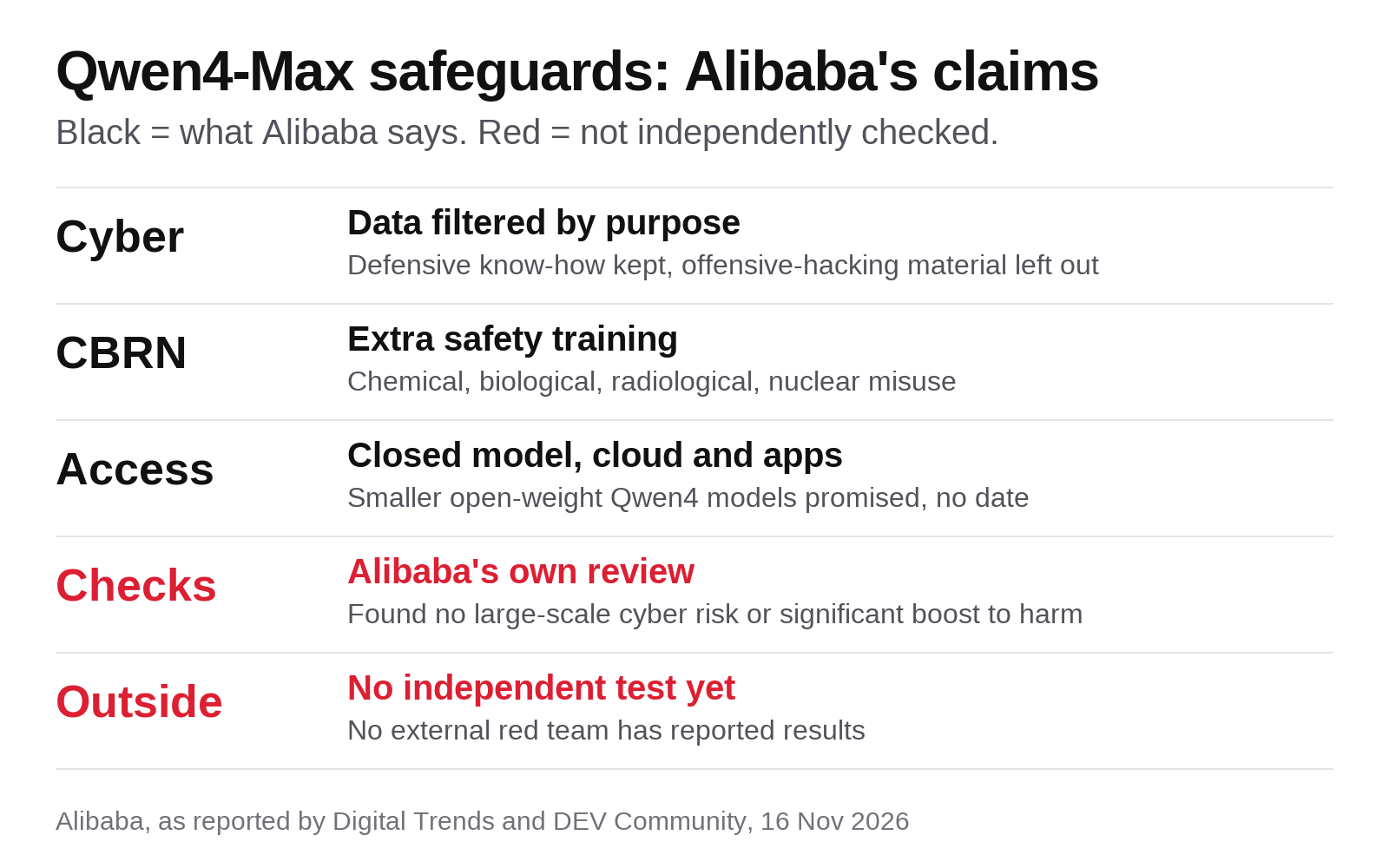
What Alibaba says it did
These details come from Alibaba's announcement as reported by Digital Trends, a DEV Community write-up and a news summary. We couldn't open Alibaba's own blog post or a model card (a model's published spec sheet), or the Reuters article itself, so everything below is second-hand.
Cyber-security. Alibaba says it filtered the training data by purpose. Material that helps with defensive work, such as finding and fixing software flaws, stayed in. Material meant to improve offensive hacking was removed. It also says its experts reviewed the model's long-running task sessions and saw no capabilities posing large-scale cyber risk. It added security checks to its coding training, aimed at problems like code injection and broken access controls.
Biological and similar risks. Alibaba says it added dedicated safety data and extra training after the main training run to guard against chemical, biological, radiological and nuclear misuse. Its internal tests, it says, found no evidence the model could significantly help someone carry out dangerous tasks.
What's missing. None of the reports we found names an outside tester. The DEV Community post called it "a claim, not an audit", and Digital Trends noted that no external red team (outsiders paid to try to break a model) has tested it yet. The reports also don't say how Alibaba measured "no significant boost" or where the passing line was.
The basics
Qwen4-Max is a closed model, which means you can use it but not download it. It's available through Alibaba's QwenCloud API and apps including Qwen Work, Qoder and Qwen Studio. Alibaba says smaller open-weight Qwen4 models are coming, with no date or licence given. Open-weight means anyone can download the model files and run them.
Reported specs are 2.4 trillion parameters in total, with about 71 billion active on any one request. Alibaba's headline claim is that average cost per task fell by around 60% against Qwen3.8-Max on its own Work360 benchmark. That compares a model with its own predecessor, on Alibaba's own test.
Some numbers don't agree across reports, so treat them with care:
- Price. Digital Trends, citing Qwen's blog, says $1.50 per million input tokens and $4.50 per million output tokens. Tokens are the chunks of text AI is billed in. The DEV post says $0.075 per million input tokens. Update, 17 November: Alibaba's pricing page confirms $1.50 and $4.50. The $0.075 figure is the price of cached input. More on cost and performance here.
- Secure-code score. One report says 31.8%, up from 22%. Another says 14.7%, up from 8%. Both describe Alibaba's own secure-code test.
For context, our benchmark data lists the earlier Qwen 3.8 Max as an API-only model, released on 2 August 2026, with no price on file. We don't yet have independent scores for Qwen4-Max.
Why safety is now a selling point
A year or two ago, labs mostly sold speed, price and intelligence. Safety was a footnote. That's shifting, for a few reasons.
Big buyers ask. Banks, hospitals and government departments need to show their own regulators that a model is safe to deploy. A vendor that arrives with documented safeguards makes that paperwork easier.
Rules are arriving, unevenly. Our explainer on mandatory AI security testing covers how patchy the rules are, and why testing is often voluntary. Our piece on reporting security incidents covers what happens when something goes wrong. And governments are looking hard at autonomous agents. We haven't found a specific Chinese rule behind these announcements.
Rivals are doing it too, including at home. On 4 November, Reuters reported that Tencent released its Hy4 model with cyber training limited to defensive uses, such as finding and fixing software flaws, and said its tests found the model couldn't meaningfully make harmful biological experiments easier. That is almost the same pitch as Alibaba's, 12 days earlier. The same report says Moonshot AI limited its newest model's cyber-offensive capabilities in October, and describes Chinese AI firms putting more into model safety despite fierce competition.
Abroad, OpenAI added a cyber-security version of GPT-6 Astra to its developer changelog on 5 November, for approved customers only, as we noted in our GPT-6.2 Astra piece. OpenAI also shelved GPT-6.1 Astra after its own safety tests. Anthropic did not give the UK's AI Security Institute a pre-release look at Claude Mythos 5.1, as we reported, which shows how much of this still rests on goodwill.
So the field splits between labs that restrict who gets powerful tools, and labs that try to build the restraint into the model. Alibaba's approach, as described, is the second kind: remove the risky material and train the model to hold back, rather than check who's asking.
Marketing or the real thing?
Both can be true. Safeguards that work are worth paying for. But a few cautions:
- Self-assessment is not verification. Until an outside group publishes results, "we tested it and it's fine" is a company statement.
- Filtering the data isn't a guarantee. A model can still work out harmful things from general knowledge, which is why labs also test what it can do.
- Open weights change the picture. Once a model's files can be downloaded, people can retrain it and strip out its refusals. If Alibaba releases smaller open Qwen4 models, their safeguards would be easier to remove than those on the closed Max model. We look at that trade-off in our companion piece on open-weight versus closed models.
- Disclosure is still progress. Publishing what you did lets others check it. That's better than saying nothing.
What this means for you
For most people, nothing changes today. Qwen4-Max is a new option, not yet independently scored.
If you're picking a model for a business, add a safety line to your checklist. Ask for the model card, how the tests were run, and whether anyone outside the company has repeated them. And if you're building with it, remember that a safer model doesn't replace your own checks on what it's allowed to do.


