When an AI company has a security problem, who finds out, and how quickly?
For years the honest answer was: when the company felt like telling you. That's changing. Several rules now set deadlines, and they differ more than you'd expect. This is the third piece in our series on AI agents and safety, after agents versus chatbots and what agents should be allowed to touch. This is an explainer, not legal advice.
What counts as an "AI incident"?
The phrase covers three quite different things.
A breach of the company. Someone steals customer data, or gets hold of a model's weights, the huge file of numbers that is the model. This is a classic security incident that happens to involve an AI firm.
A model causing harm or misbehaving. The AI does something damaging or goes against its makers' controls. As agents act on their own, this matters more. We look at who pays in who is responsible when an AI agent causes damage.
A near miss. Something went wrong but nobody was hurt, or a test caught a dangerous behaviour first. No harm has happened, yet it's often the most useful kind to learn from.
The law mostly covers the first two, and only at the serious end. A "disclosure" or "notification" is simply the formal telling of a regulator or the public.
What the rules actually require
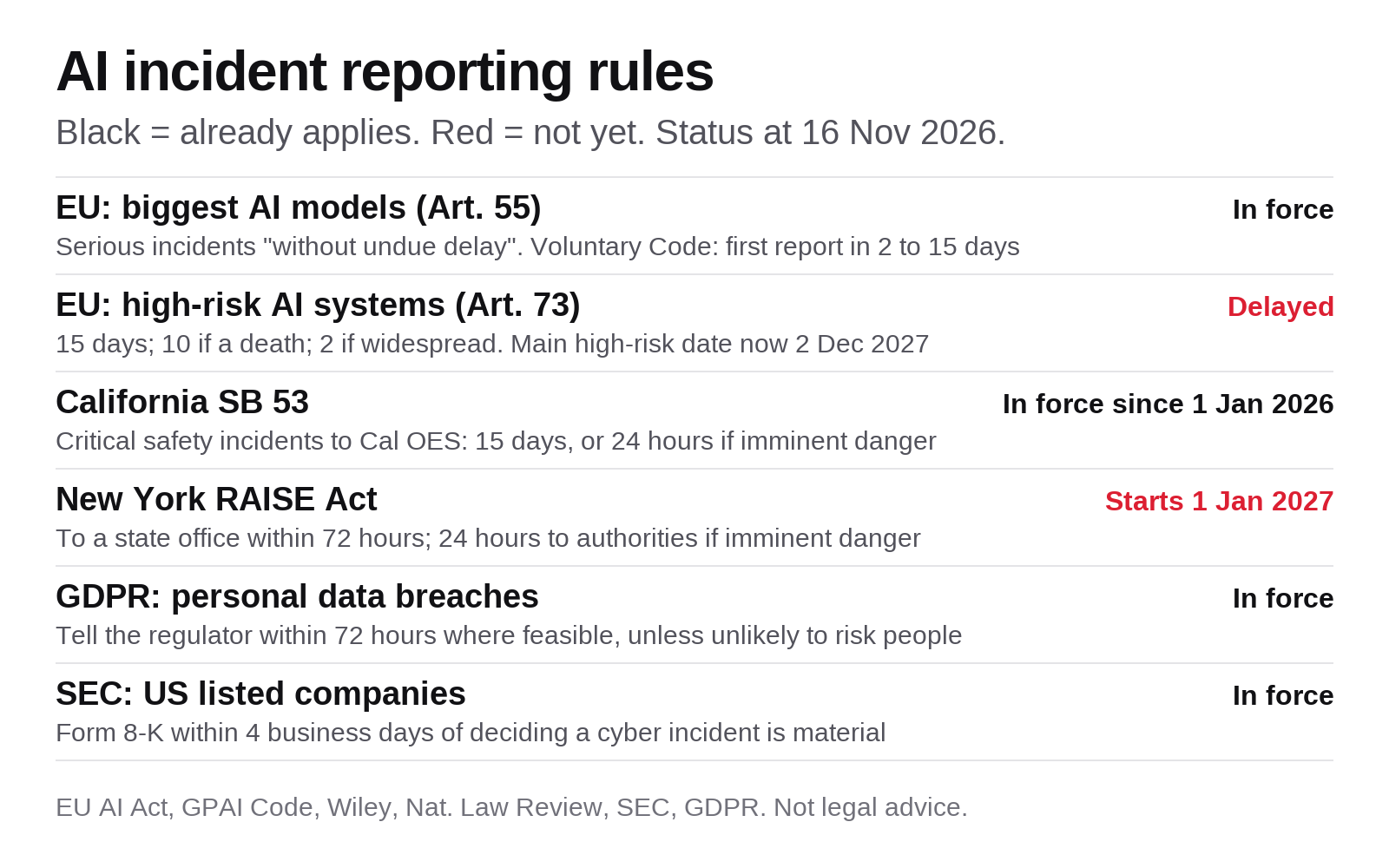
California, SB 53 (in force). Governor Newsom signed it on 29 September 2025, and it took effect on 1 January 2026. Developers of the most powerful models must tell the state's Office of Emergency Services about a "critical safety incident" within 15 days of discovering it, or 24 hours if there is an imminent risk of death or serious injury. Fines can reach $1 million per violation, and the state publishes anonymised summaries from 2027. I couldn't find public figures on how many reports have been filed.
New York, RAISE Act (passed, starts 1 January 2027). Governor Hochul signed it on 19 December 2025 and a chapter amendment, signed on 27 March 2026, finalised it. Reports go to a new office in the state financial regulator within 72 hours, with 24 hours to authorities if someone is in imminent danger. Penalties are up to $1 million for a first violation and $3 million after. Notably, stolen model weights only count if they lead to death or injury.
EU AI Act (partly in force, partly delayed). For the biggest general-purpose models, Article 55 requires providers to report serious incidents "without undue delay" to the EU's AI Office. The voluntary Code of Practice puts numbers on it for companies that sign: 2 days for critical infrastructure disruption, 5 for serious cyber breaches including stolen weights, 10 for a death, 15 for other serious harm. Anthropic, Google, Microsoft and OpenAI are among the signatories. Separately, Article 73 sets 15, 10 and 2-day deadlines for high-risk systems such as those used in hiring or medicine. An omnibus law that entered into force on 27 July 2026 pushed the main high-risk date to 2 December 2027. I couldn't confirm the exact new start for Article 73 itself, so assume it follows.
Rules that already apply to everyone. Under GDPR, a company must tell the regulator about a personal-data breach within 72 hours where feasible, unless it's unlikely to put people at risk. Every US state has its own breach-notification law too. And US listed companies must file an SEC Form 8-K within four business days of deciding a cyber incident is material. A leak of chat logs would trigger these today, whether or not an AI-specific law exists.
UK. I found no verified, mandatory AI-incident reporting law. Reports suggest ministers are considering it, but I couldn't confirm any draft. As far as we could find, the UK's AI Security Institute tests models by agreement with labs rather than under a legal duty. Whether testing should be compulsory is the subject of part five.
Voluntary pledges. In 2024, sixteen firms signed the Seoul Frontier AI Safety Commitments. They don't explicitly promise to report incidents. They commit to "work toward information sharing".
One more caveat: the US government has tried to challenge state AI laws through a Department of Justice task force. I couldn't verify that any federal action has changed SB 53 or RAISE.
The case for reporting fast
Others can patch. If one lab learns how a model was tricked, the rest can close the same hole.
Users can protect themselves. Change a password, watch for scams, stop sending sensitive files.
Regulators can spot patterns that no single company sees. One incident is an anecdote; fifty are a trend.
And trust. Companies that delay look like they're hiding things.
The case for caution
Early facts are often wrong. A report filed in 24 hours may name the wrong cause or the wrong scale, and corrections spread slower than the first claim.
Tipping off attackers. Announcing a hole before it's fixed can invite copycats. Security researchers long ago settled on a compromise: Google's Project Zero, for example, gives vendors 90 days to fix a flaw before going public, but only 7 if it is already being exploited.
Burden on small firms. Rules aimed at giants can catch start-ups with no legal team.
Defining "incident". Too narrow and nothing gets reported. Too wide and regulators drown in noise.
How other fields do it
Aviation is the usual model. A US aircraft operator must notify the National Transportation Safety Board "immediately" after an accident or a listed serious incident. Near misses go through a separate, voluntary channel: NASA's Aviation Safety Reporting System, where reporters may be protected from penalties. Fast reporting to an investigator, then slow public learning.
What good looks like
None of these systems is "report everything, publicly, now". The pattern that works looks more like this:
- Two speeds. A quick, partial report to a regulator, which the EU's Article 73 explicitly allows to be incomplete at first. Public detail comes once there's a fix.
- Clear triggers. Spell out what counts, as the EU Code does with its list, rather than leaving it to the company's judgement.
- A safe route for near misses, so people report without fear of punishment.
- Proportion. Light duties for small firms, heavier ones for the biggest models.
- Real follow-through. Reports only help if someone reads them and publishes the lessons.
What does this mean for you? Mostly, don't wait to be told. Keep your own accounts tidy, and when a company does disclose something, look at the date it knew, not just the date it spoke.