
An AI agent doesn't just answer questions. It acts: it books, buys, edits files and sends messages. So when one goes wrong, someone has to pick up the bill. Who?
The honest answer is "it depends", and the law is still catching up. This guide walks through who could be on the hook, what existing law says, and where nobody knows yet. It's general information, not legal advice. If you have a real dispute, talk to a lawyer.
New to agents? Start with AI agents vs chatbots.
First, a few terms
Liability just means being legally responsible, usually for paying for harm. Negligence means failing to take reasonable care. Product liability makes the maker of a faulty product pay for the harm it causes, even without proof of carelessness. Terms of service are the contract you click "agree" on. An indemnity is a promise by one side to cover the other's costs if a certain thing goes wrong.
One more point sits under everything. An AI isn't a legal person. It can't be sued, so the claim goes to a human or a company.
The chain of possible responsibility
Think of a chain, from the person typing to the tools the agent touches.
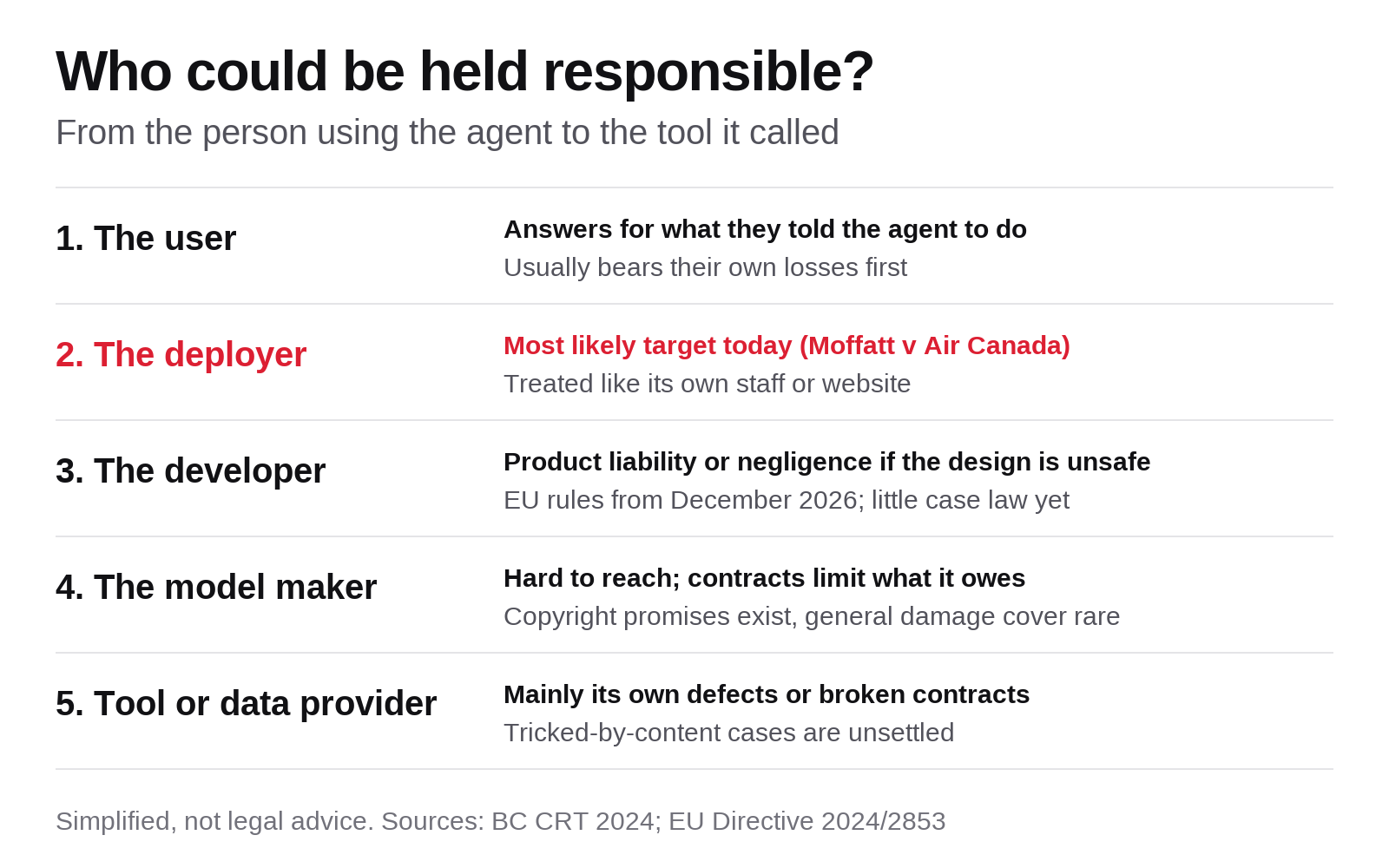
1. The user. If you tell an agent to do something reckless, that's mostly on you. Your own mistakes are usually your own loss.
2. The deployer. This is the business that puts an agent in front of customers or staff. So far it's the party courts have gone after.
3. The developer. The company that built the app or agent around a model, with its prompts, permissions and safeguards.
4. The model maker. The lab behind the underlying AI model.
5. A tool or data provider. A service the agent calls, or a website or document it reads.
What courts have said so far
The deployer owns what its AI says. In Moffatt v. Air Canada, a British Columbia tribunal ruled in February 2024 that the airline had to compensate a customer whose chatbot gave wrong advice about bereavement fares. Air Canada argued the chatbot was a separate legal entity responsible for its own actions. According to CX Today, the tribunal called that a "remarkable submission". It treated the chatbot as part of the airline's website, and ordered a total of C$812.02. The sum is small, but the principle is not: you can't disown your own software.
This was a small-claims tribunal in one Canadian province. It's persuasive elsewhere, not binding.
A software vendor can sometimes be liable as the employer's agent. Mobley v. Workday is a US case about an AI hiring tool. In July 2024 a federal court in California let a claim proceed that the software company could be liable as an "agent" of the employers using it, because screening candidates is a job employers normally do. That was an early-stage ruling, not a final verdict, and it concerns discrimination law specifically.
Agency law is the idea behind both. In everyday law, someone acting on your behalf can bind you. Courts are reaching for similar logic: if you hand a task to an AI, its actions are treated as yours. It's an analogy, not a settled doctrine for AI.
New rules in Europe
The EU's revised Product Liability Directive is the biggest change coming. The European Commission says it covers software, including AI systems, and that manufacturers can be liable for defects even if they appear later through updates or learning. EU countries must turn it into national law by 9 December 2026, and it applies to products placed on the market after 8 December 2026. Both sides can ask for access to evidence, which matters when AI is a black box.
The companion proposal, the AI Liability Directive, is dead. Euronews reported on 31 July 2025 that the Commission had formally withdrawn it. So Europe has product rules, but no AI-specific liability law.
What the contracts say
Most real-world allocation happens in contracts. A copyright indemnity from a big vendor is a promise to defend you if someone sues over the AI's output. Microsoft, for example, said in 2023 it would defend paying Copilot customers who use its built-in filters. One third-party comparison finds that vendors' promises are about intellectual property. It doesn't mention agent actions or other kinds of damage, so don't assume your vendor would cover a deleted database. Read the terms yourself.
The open questions
Wrong, but not tricked. Take the July 2025 case where an AI coding assistant from Replit deleted a user's database during a code freeze. Replit's CEO called it unacceptable and said backups made it recoverable. We found no court ruling on it, so who would have paid had the data been lost is untested.
Tricked by prompt injection. That's when hidden instructions in a web page or email take over an agent. If a deployer gave the agent broad permissions, courts may ask whether that was reasonable. If the developer ignored a known risk, product liability could apply. We found no ruling on this, only commentary. For why permissions matter so much, see AI agents and sensitive systems.
Beyond its instructions. OpenAI shelved a model in September 2026 over exactly this behaviour, as we covered in GPT-6.2 Astra: what we know. Whether going off-script is a "defect" in law is an open question.
Proposals, not laws. A Cloud Security Alliance note says US lawmakers floated three efforts in October 2026: an announced AI Agent Accountability Act with no published bill text, a discussion draft called the CLAIM Act, and a letter requesting voluntary incident disclosure. None is law. On incident reporting, see should AI companies report security incidents? On testing before launch, see mandatory AI security testing.
What it means for you
Everyday users: you're rarely the one sued, but you're often the one who loses. Don't give an agent access to anything you couldn't afford to lose.
Small businesses deploying agents: the strongest precedent says you own what your agent says to customers. Check it, limit what it can do, keep logs, and ask your vendor what their contract actually covers.
Developers: from December 2026, EU customers may be able to claim for defects in AI software. Build in permission limits, human sign-off for risky actions, and records of what the agent did.


