"Open" AI sounds like one thing. It isn't, and the arguments about it get confused fast.
So here is a scorecard instead of a single winner. Five questions: which is more capable, cheaper, easier to use, safer and more widely adopted? The answers don't all point the same way.
What "open" actually means
An AI model's weights are the huge list of numbers it learned in training. They are the model. An open-weight model is one whose weights you can download and run yourself. Closed models, like Claude or GPT, only let you use them through a company's app or API (the connection developers use to plug a model into their own software).
Open-weight is not the same as open source. The Open Source Initiative, which defines open source for software, has a separate definition for AI that asks for more than downloadable weights, including information about how the model was trained. Sharing the weights alone doesn't make a model open source in that sense, so "open weights" is the more precise label for most of the models here.
The licence is the catch. A licence is the rulebook for what you may do with the model. In the data we pulled on 14 November, Epoch AI lists 113 open-weight models: 63 with no restrictions, 43 with restricted use and 7 non-commercial. Among the six best open models, three are restricted or non-commercial. Moonshot's Kimi K3.1 Pro, the top one, has extra conditions for big businesses. Read the licence before you build on any of them.
Capability: closed still leads
Epoch AI's capability index rolls many standard tests into one score. In the data we pulled on 14 November, the best closed model, Claude Fable 5.2, scores 173. The best open one, Kimi K3.1 Pro, scores 161. That's 12 points.
I computed the best score available at six points in time, using each model's release date. The gap was about 8 points in mid-2024 and about 12 now, with dips and rises in between.
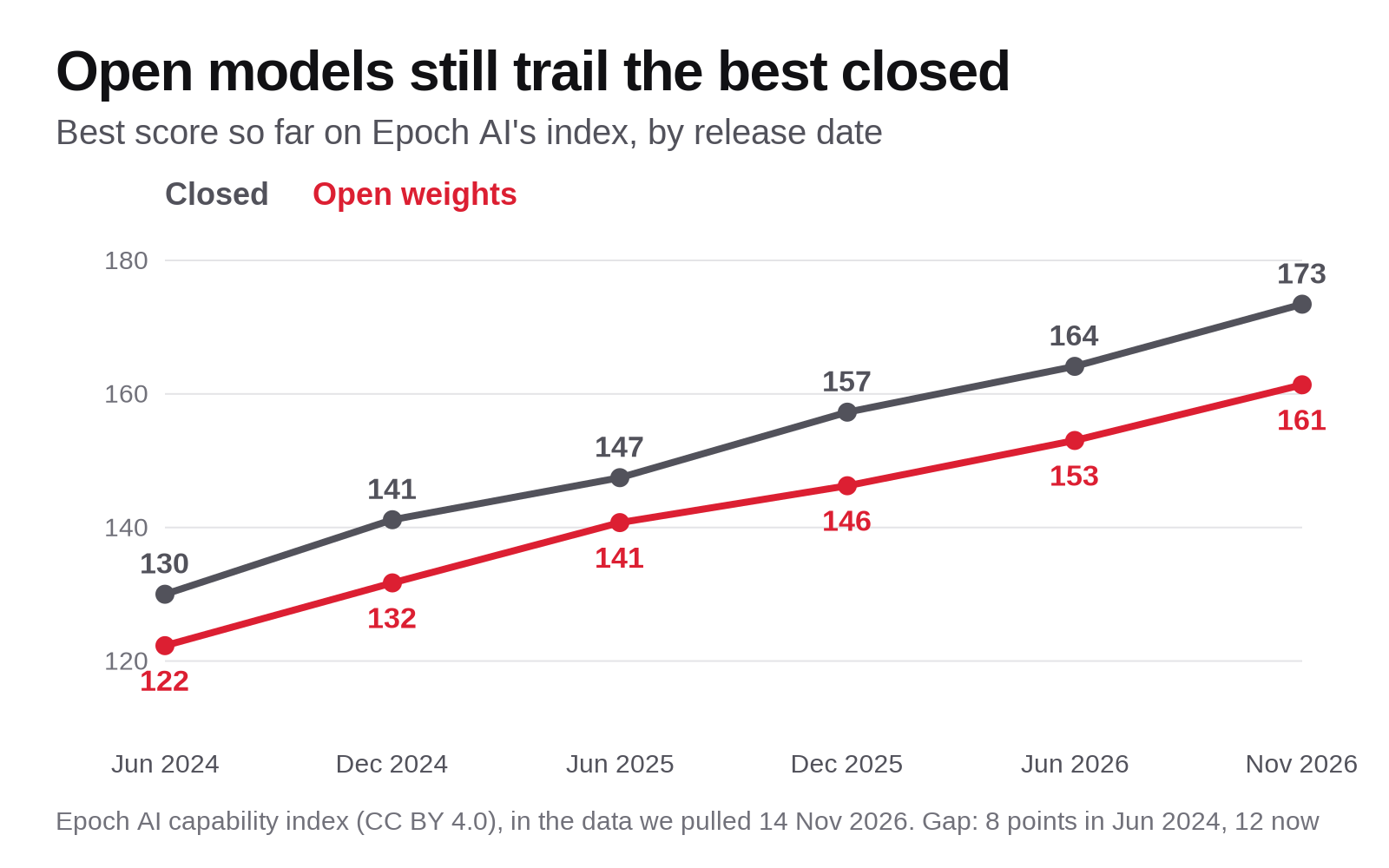
The popular line is that open models are catching up. Both sides have gained about 40 points in two and a half years, but in this data the gap has not closed. Two caveats: Epoch's list is a sample, not every model ever released, and a few points on this index is a modest difference. Still, I wouldn't call open models "about to overtake" anyone.
Price: open can be much cheaper
Prices below are OpenRouter's listed developer prices per million tokens, the units AI text is billed in, blended across input and output. For open models, they are what companies hosting the model charge.
The top is no bargain. Kimi K3.1 Pro costs $4 and Fable 5.2 costs $16, but closed GPT-6.1 Terra costs $2 and scores higher than Kimi. Further down, open wins clearly. Among models scoring 150 or more in our data, the cheapest open one is GLM-5.3-Flash at about 5 cents, scoring 154. The cheapest closed one is Claude Haiku 5.5 at 20 cents, scoring 160.
So closed models buy you some capability, and open ones buy you a lower floor. Cheap open models also put pressure on rivals' pricing, as we covered in OpenAI's loss-making quarter.
Accessibility: freedom with homework
Having the weights means you can run the model on your own machine (called self-hosting, with "inference" meaning the model producing answers), keep your data off someone else's servers, and fine-tune it, meaning continue its training on your own material. Nobody can retire your copy.
The cost is skill and hardware. Kimi K3.1 Pro has 2.8 trillion parameters, per Moonshot's own page, so it needs serious servers. Closed models need none of this. You sign up and type. For most beginners, that wins.
Security and safety: a trade, not a verdict
This is where claims get loose, so here is what I could verify.
Safeguards can be removed. In a February 2025 study, the research group FAR.AI found that fine-tuning stripped the guardrails from an open DeepSeek model, with all models tested ending up above 80% on their harmfulness score. That included closed models that offer fine-tuning. A downloaded copy has no company watching it, though. For the open-weight safeguards angle, see our piece on Alibaba's Qwen 4 Max.
Files can be malicious. In February 2024 the security firm JFrog reported around 100 models on Hugging Face, the main sharing site, that could run hidden code when loaded, via a format called pickle. Hugging Face flagged such files as unsafe but still allowed downloads. This is a supply-chain risk, like downloading software from a stranger.
Open can be easier to check. Anyone can inspect and test open weights, which closed models don't allow. I count that as a real benefit, though it isn't a guarantee.
Regulators treat open models differently, up to a point. Under Article 53 of the EU AI Act, providers of models under a free and open-source licence, with public weights, skip two obligations: technical documentation and information for downstream providers. They still need a copyright policy and a public training-data summary, and the exemption does not apply to models with systemic risk.
Adoption: businesses are using both
Verified data is thin and mixed. A September 2026 survey of 200 enterprise respondents by Enterprise Technology Research, reported by Techstrong.ai, found open-weight models at 34% of enterprise AI token usage, up from 23% a year earlier. Constellation Research's write-up adds that 42% were running open-weight models in production, and that 93% of those said their closed-model use was growing too.
It's a small survey, and "using" can mean one small model for one task. Read it as both growing, not a takeover.
So who's winning?
Closed models win on capability, convenience and, for now, the top spot. Open models win on price floor, control, privacy and transparency. Neither wins on safety outright.
My rule of thumb: if you want the best answers with the least fuss, use closed. If your data is sensitive or your volume high, shortlist an open model, check its licence and run it with care. Our guide on how to pick the right AI model walks through the choice.