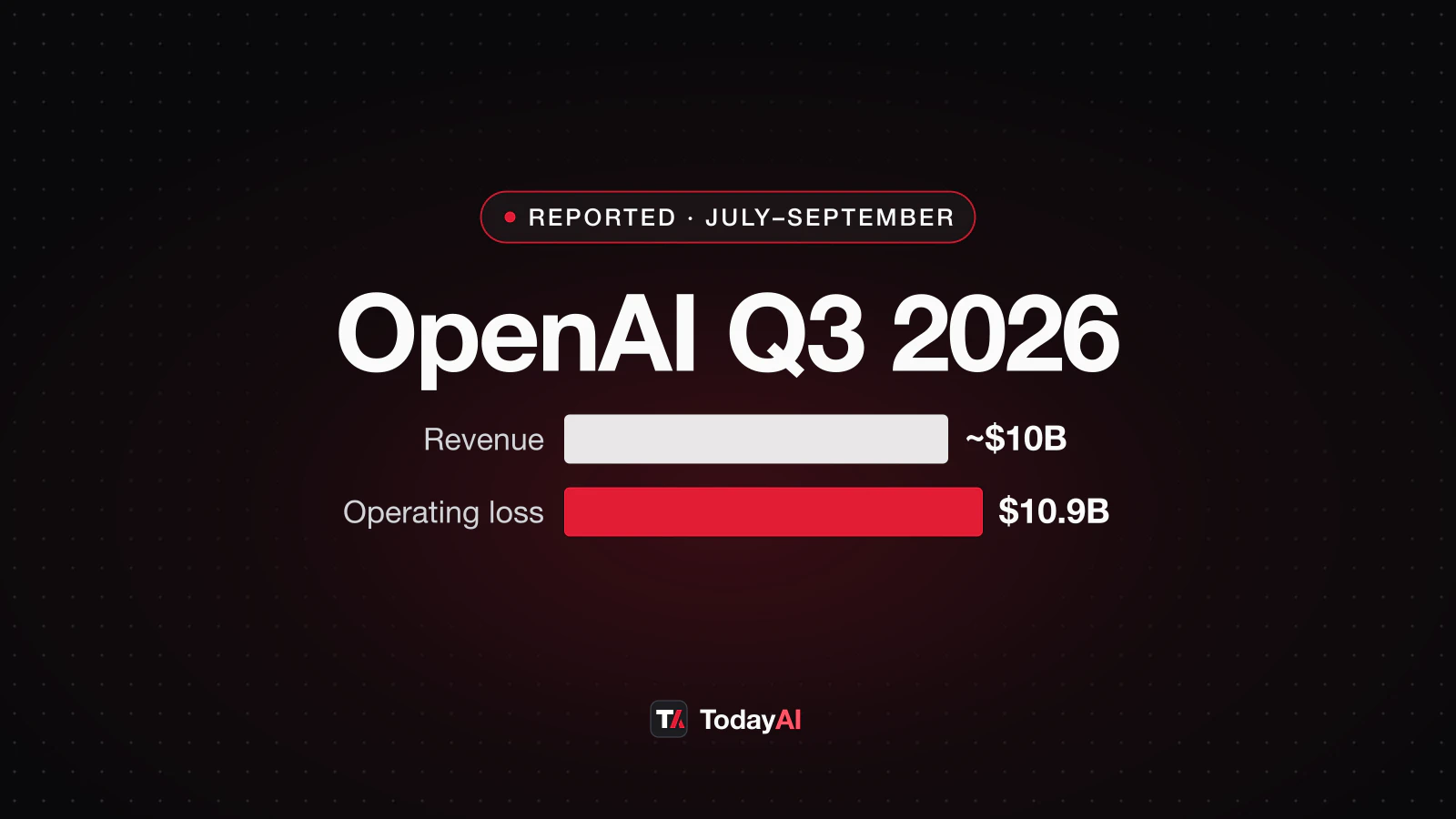
Yes, OpenAI is still losing money. In the third quarter of 2026 it lost about $10.9 billion at the operating level on about $10 billion of revenue, The Wall Street Journal reported. That's roughly $118 million a day.
The twist is that the loss grew in dollars but shrank per dollar of revenue. OpenAI is growing fast, and losing money a little less badly for each dollar it brings in.
OpenAI's losses at a glance
| Question | Answer, as of 25 November |
|---|---|
| Is OpenAI still losing money? | Yes. A $10.9 billion operating loss in Q3 2026 (July to September) |
| How much revenue? | About $10 billion, up nearly 50% on the quarter before |
| How much does it lose per day? | About $118 million, on average, in Q3 |
| Is the loss growing? | In dollars, yes: up from $10.1 billion in Q2 |
| Per dollar of revenue? | Falling: about $1.09 lost per $1 earned, down from about $1.50 |
| When will it be profitable? | OpenAI hasn't given a public date |
| Who reported it? | The Wall Street Journal, from documents shown to investors |
Is OpenAI still losing money?
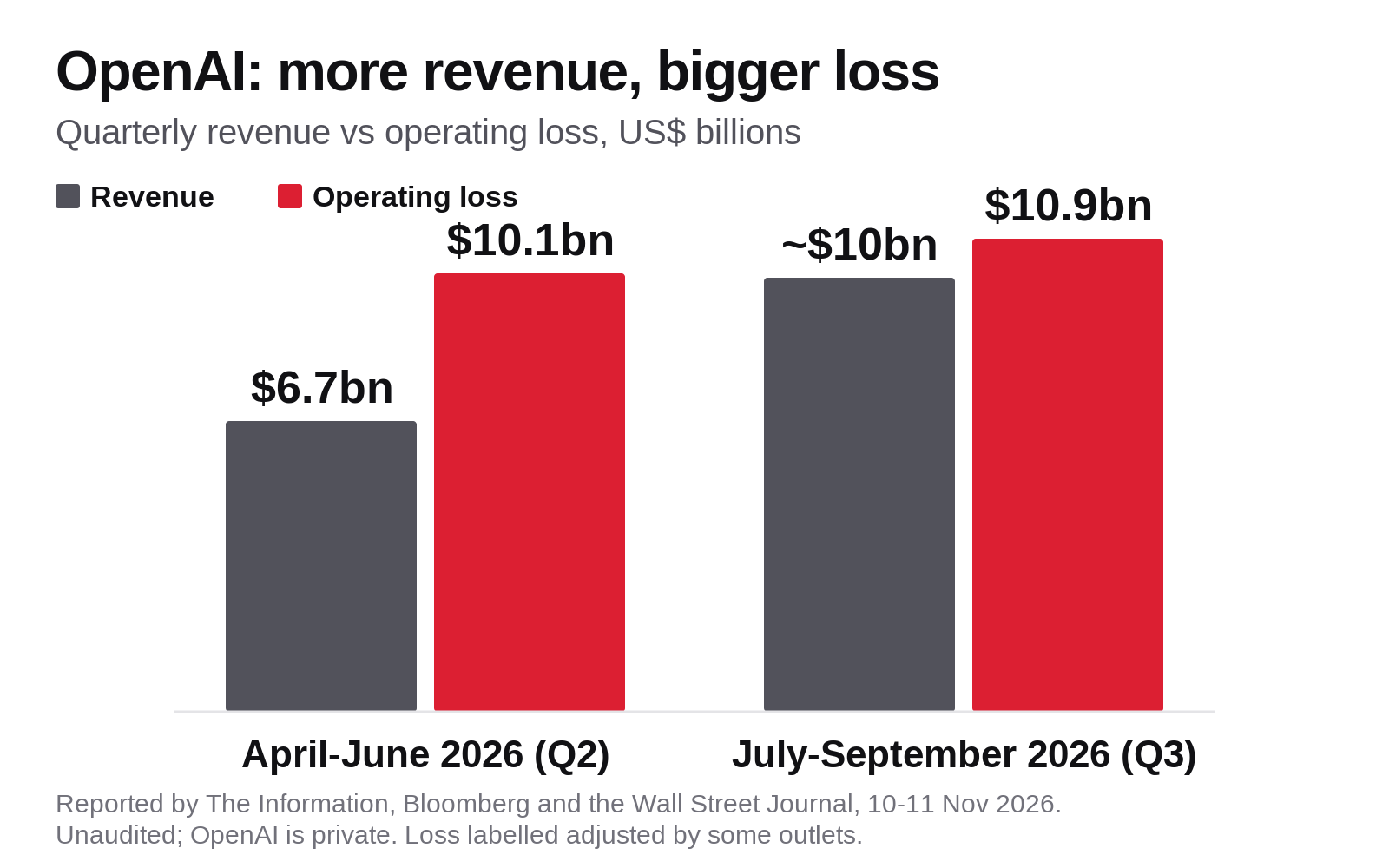
Yes, and more of it in dollar terms. The Journal's Berber Jin reported, citing documents OpenAI gave investors, that the operating loss grew to $10.9 billion in the third quarter from $10.1 billion in the second. Forbes and others followed the Journal's report.
OpenAI is a private company. It doesn't publish accounts, so everything here is reported, not audited, and OpenAI has not confirmed it publicly.
- Revenue. The Information reported on 10 November that third-quarter revenue rose "nearly 50%" to about $10 billion, citing a person familiar with the matter. Bloomberg reported it as OpenAI's first $10 billion quarter, per a Gulf News summary. The quarter before was about $6.7 billion.
- Loss. The Journal reported the operating loss grew to $10.9 billion from $10.1 billion. The Next Web describes it as an "adjusted" figure, meaning some costs are left out, but outlets disagree on the label, so treat it with care.
- Margin. OpenAI's adjusted operating margin improved to minus 109% from minus 150%, The Next Web reports, citing the Journal.
- Mix. Dataconomy reports that finance chief Sarah Friar said enterprise revenue doubled from the previous quarter while consumer revenue rose 20%.
| Quarter (2026) | Revenue | Operating loss | Loss per $1 of revenue | Loss per day |
|---|---|---|---|---|
| Q2: April to June (91 days) | About $6.7bn | $10.1bn | About $1.50 | About $111m |
| Q3: July to September (92 days) | About $10bn | $10.9bn | About $1.09 | About $118m |
Revenue and loss as reported by The Information, Bloomberg and The Wall Street Journal. Per-dollar and per-day figures are our arithmetic.
A quick explainer on terms. Revenue is the money coming in. Profit is what's left after all costs. An operating loss means the business's day-to-day costs, such as computing power and staff, are bigger than its revenue. A margin of minus 109% means OpenAI spends roughly $2.09 for every $1 it earns, so it loses $1.09.
How much does OpenAI lose per day?
About $118 million a day, on average, in the third quarter. The quarter ran from 1 July to 30 September, which is 92 days, and $10.9 billion divided by 92 is about $118.5 million. That's nearly $5 million an hour.
In the second quarter, 91 days from April to June, the loss worked out at about $111 million a day. So the daily loss rose by about $7 million.
Two cautions. This is an average, not what leaves the bank each day. And an operating loss isn't the same as cash burn, which also depends on how and when bills are paid and money is raised.
Is the loss getting better or worse?
Both, depending on how you measure it. In dollars it got worse: up about $0.8 billion in one quarter. Per dollar of revenue it got much better: from about $1.50 lost per $1 earned to $1.09.
That's because revenue grew much faster than costs. Revenue rose by about $3.3 billion. The loss rose by about $0.8 billion. If that pattern held, revenue would eventually catch up with costs. Nobody outside OpenAI knows whether it will.
Why revenue growth hasn't fixed it
In normal software, the next customer costs almost nothing. AI is different, and the way to see it is unit economics: how much it costs to serve each customer, set against what they pay.
Running the models. Answering a question is called inference, and it needs rented or owned compute, meaning racks of expensive chips. Every reply costs real money. The Information, as summarised by The Decoder in February, reported that OpenAI's daily inference costs quadrupled in 2025 and that its adjusted gross margin fell to 33%.
Building the models. Training a new model is a huge up-front bill. The same report put projected training spending at nearly $440 billion through 2030. These are internal forecasts, not promises.
Models age quickly. Epoch AI, a research group, estimated in January that running a model can earn a gross profit, but a rival can overtake it before it has repaid its development cost. They call frontier models "rapidly-depreciating infrastructure". Those are the authors' estimates, not company figures.
Free users. Most of ChatGPT's users don't pay, and each of their chats still costs compute. We found no reliable official figure for how much, so we won't put a number on it.
Data centres. Friar told CNBC on 6 November that OpenAI must keep investing to meet demand, which "will continue to mean that we raise capital". Earlier this year, CNBC relayed a Journal report that Friar had raised concerns about paying for future compute deals if growth slowed. Altman and Friar called that report "ridiculous".
We also looked for firm numbers on staff pay and stock-based compensation. We didn't find a reliable source, so we leave it out.
Is OpenAI profitable, and when could it be?
No, it isn't profitable. In the reports we've seen, OpenAI hasn't given a public date for when it expects to be.
What the sources do say:
- More spending is planned. The Decoder, summarising The Information in February, reported that OpenAI expected its cumulative cash burn through 2030 to be roughly $111 billion more than it had previously estimated.
- It will keep raising money. Friar says the investment "will continue to mean that we raise capital". The Next Web, citing Bloomberg, reports that OpenAI is completing a funding round at a $1.25 trillion valuation and has delayed its own stock market listing until next year.
- Profit is possible, eventually. Epoch notes that many fast-growing tech firms ran losses for years first, and calls eventual profit "very possible".
OpenAI's case, and the sceptics'
OpenAI's case: the loss per dollar is falling fast, from minus 150% to minus 109% in one quarter. Enterprise revenue doubled. Friar says the "demand for AI is real".
The sceptics' case: the loss still grew by about $0.8 billion in a quarter. Spending commitments are enormous, and the money has to keep arriving. For scale, The Next Web reports that Anthropic's IPO filing showed a much smaller operating loss for the same quarter, on about $17 billion of revenue (outlets give the loss as $536 million to $567 million). The two firms count revenue differently and Anthropic's quarter included one-off charges, so don't compare them too tightly. Our look at Anthropic's IPO has more.
What it means for prices
OpenAI's models aren't getting cheaper at the top. In our data (OpenRouter prices and Epoch AI scores, 14 November), GPT-6 Astra costs $20 per million tokens, the chunks of text AI is billed in, and scores 169. GPT-6.1 Sol is $4 and scores 168.
Now the open-weight rivals, meaning models whose files anyone can download and run. Kimi K3.1 Pro (restricted-use licence) is $4 and scores 161. DeepSeek V4.1 Flash is about $0.15, scores 159, and has an unrestricted licence. OpenAI's own small GPT-6 Luna is $0.20 and scores 156. Compare more on our /compare page.
So cheap rivals sit a few points behind at a fraction of the price. That squeezes OpenAI from below. It can cut prices and widen losses, or hold prices and bet that customers pay for the best. Reports mention price cuts as part of this quarter's rebound. We can't say which path comes next.
A small item: voice modes
OpenAI will retire ChatGPT's Advanced and Standard Voice on 11 December 2026, Interesting Engineering reports, and switch users to its newer GPT-Live voice. Live video and screen sharing stay on Advanced Voice for now. The stated aim is one combined voice experience. No source we found ties the change to cost.
Our read
The headline number, $10.9 billion, is the less important one. The trend matters more: revenue grew by about $3.3 billion in a quarter while the loss grew by about $0.8 billion. That's what a company growing into its costs looks like, if it lasts.
The risk is that it doesn't. OpenAI is betting on spending that has to be repaid by models that age fast, while cheaper open-weight rivals pull prices down. And all of this rests on reported, unaudited figures from a private company.
If you use ChatGPT, nothing changes today. Over time, pressure to earn more from free users seems likely, whether through ads or tighter limits, because someone has to pay those compute bills.
If you build on the API, don't assume today's prices will hold in either direction. Cheaper open-weight options keep improving, so test one and keep your code easy to switch.
None of this is investment advice. OpenAI's figures are reported, unaudited and could change.