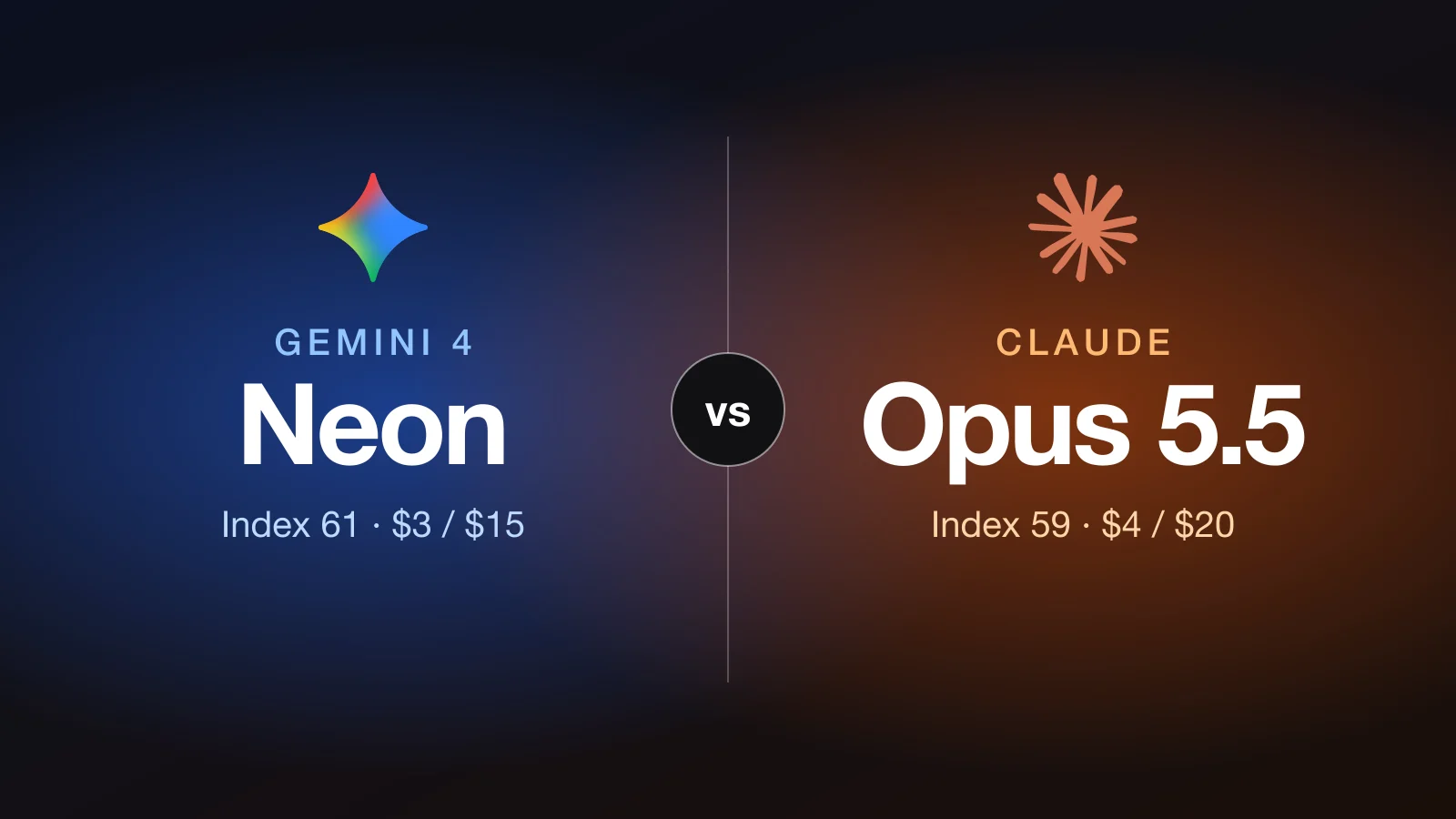
Gemini 4 Neon vs Claude Opus 5.5 is closer than the headlines say. Neon is slightly ahead on most scoreboards and about a third cheaper per finished task, but Opus 5.5 still wins some coding and science tests, so Neon isn't an Opus killer.
Since Google released Gemini 4 Neon on 18 November, headlines such as "Gemini 4 Neon beats Claude Opus 5.5" and "Google Gemini 4 Neon Beats Claude Opus 5.5 on Benchmarks" have framed it as the model that finally knocks Anthropic's workhorse off its perch. We went through Google's numbers, the independent test results and the hands-on reviews published so far.
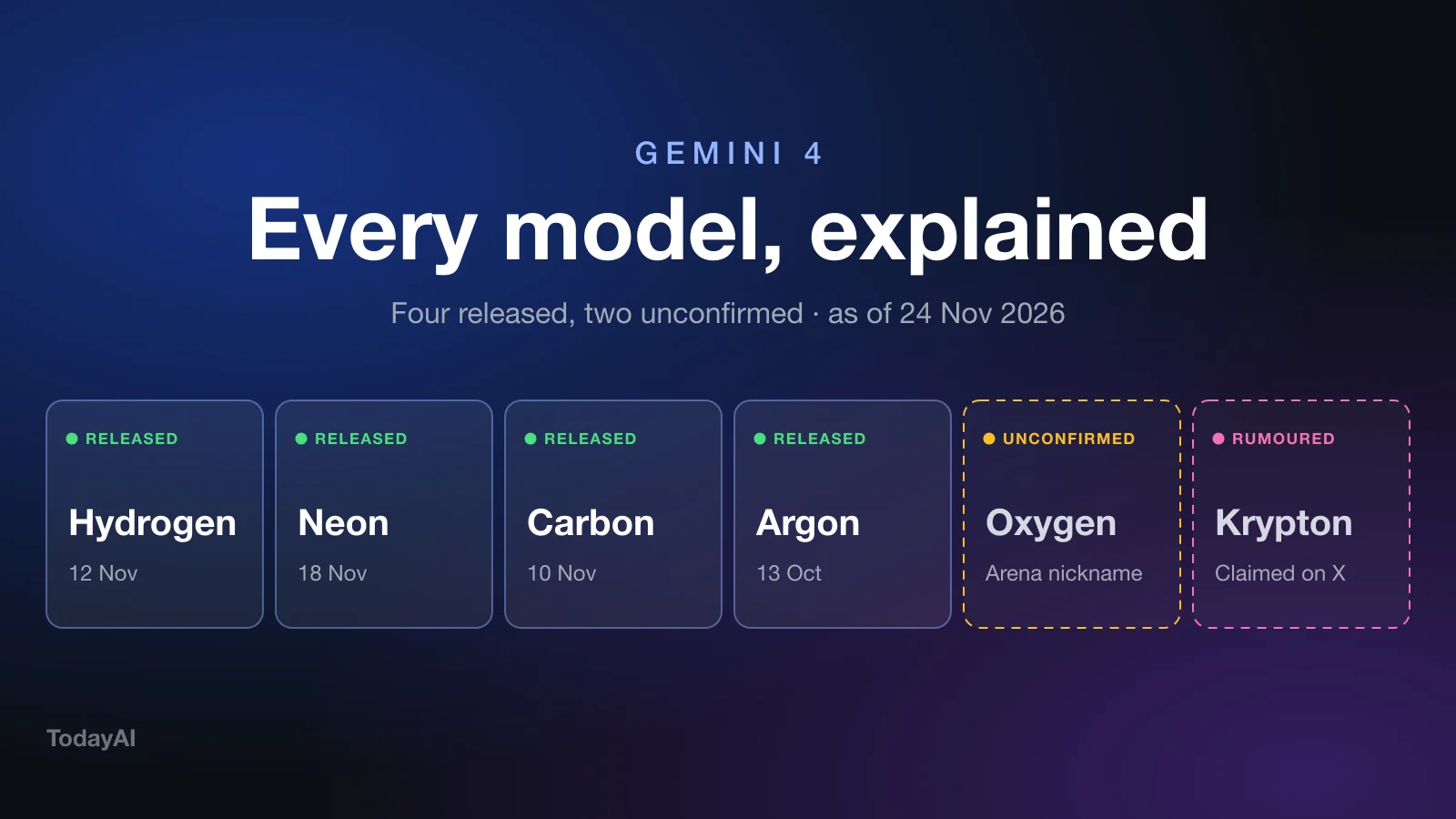
Every Gemini 4 model, released and rumoured, in one place: Gemini 4 models explained.
Is Gemini 4 Neon better than Claude Opus 5.5?
Slightly, on most measures, and it's cheaper. But the lead is small, and Opus wins in places that matter to programmers.
| Category | Winner | The numbers |
|---|---|---|
| Overall independent score | Neon, narrowly | 62 vs 59 on Artificial Analysis's index |
| Agent tasks | Tie | 1,336 vs 1,335 on Arena's Agent Index |
| Coding | Tie | Each model wins some coding tests |
| Hard science | Opus 5.5 | 68.0% vs 60.5% on CritPt |
| Cost per task | Neon | $6.44 vs $10.04 at top settings |
| Writing speed | Opus 5.5 | 117 vs 92 tokens a second |
| Images, audio and video | Neon | Opus takes only text and images |
| Hands-on tests | Split | Two favour Neon, one leans Opus, one ties |
Neither is its company's flagship. Anthropic's top model is Claude Fable 5.2, and Google's biggest is Gemini 4 Carbon. Neon and Opus 5.5 are the ones most people will actually pay for.
Gemini 4 Neon vs Claude Opus 5.5: specs
| Gemini 4 Neon | Claude Opus 5.5 | |
|---|---|---|
| Released | 18 November 2026 | 22 September 2026 |
| API model ID | gemini-4-neon | claude-opus-5-5 |
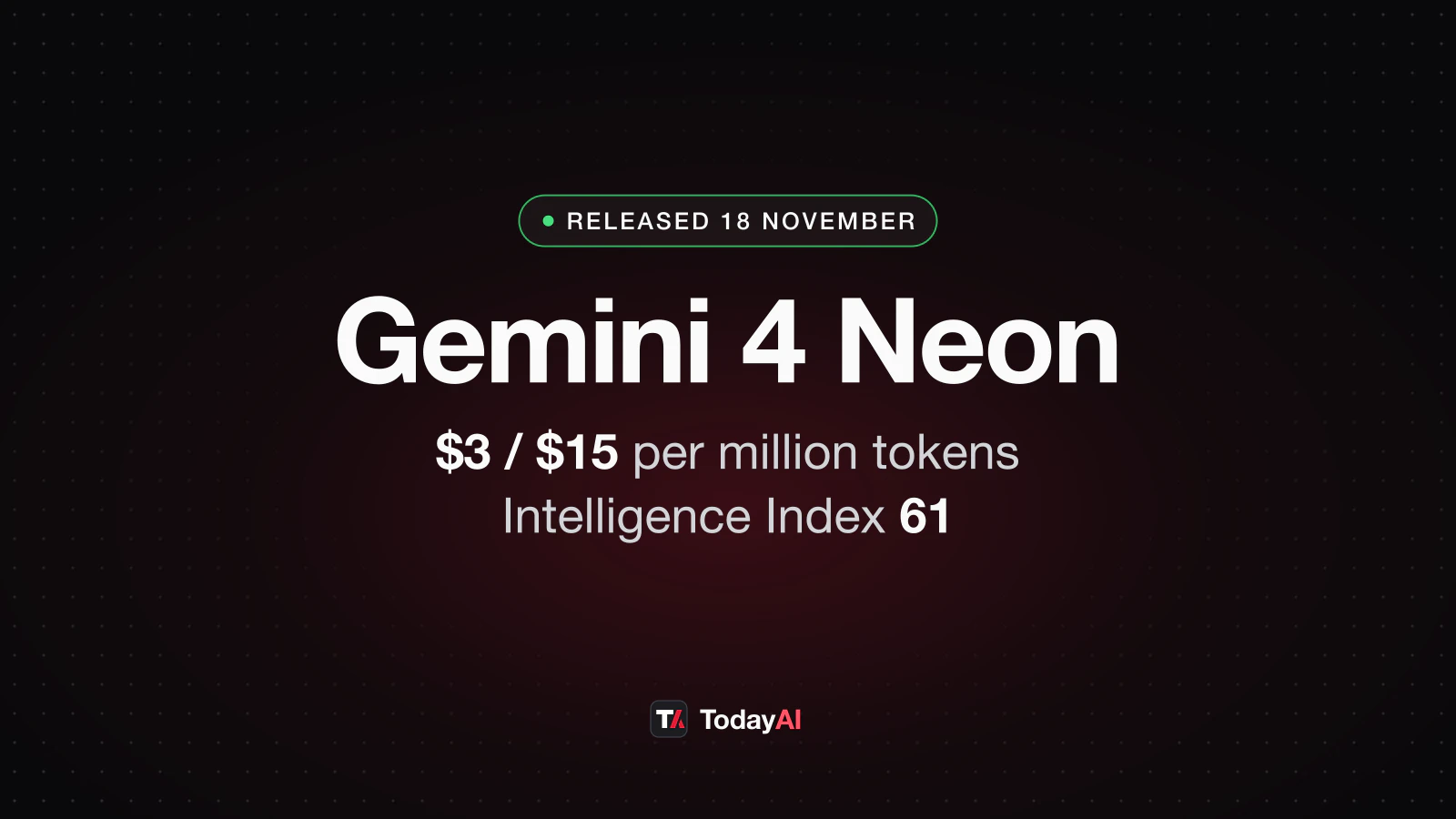
| Price per million tokens, in / out | $3 / $15 | $4 / $20 |
| Cached input, per million | $0.15 | $0.20 |
| Batch price, in / out | $1.50 / $7.50 | $2 / $10 |
| Context window | 1M tokens | 1M tokens |
| Max output per request | 64K tokens, or up to 1M with Google's long decode | 128K tokens |
| Knowledge cutoff | March 2026 | June 2026 |
| Inputs | Text, images, audio, video, PDFs | Text and images |
| Thinking settings | Low, medium, high, xhigh. Default high | Low to max. API default medium |
| Where to use it | Gemini app (AI Pro and Ultra), Gemini API, AI Studio, Antigravity | Claude apps, Claude Code, Claude API, AWS, Google Cloud, Microsoft |
Sources: Google's Neon model page and model card, and Anthropic's models overview and pricing page, all checked on 25 November.
Tokens are the chunks of text AI is billed in, roughly three-quarters of a word each. Both models let you choose how long they think before answering. Higher settings score better but cost more and take longer, so we say which setting each number comes from.
What do Google's benchmarks claim?
Google's launch table puts Neon against Opus 5.5 on 18 tests. Neon is ahead on 16. The biggest gaps, and the two Opus wins:
| Test | What it measures | Gemini 4 Neon | Claude Opus 5.5 |
|---|---|---|---|
| GraphWalks | Finding facts in very long documents | 95.2% | 66.8% |
| AutomationBench | Automating everyday office work | 56.3% | 42.5% |
| CursorBench 4.1 | Coding, from the makers of the Cursor editor | 65.4% | 58.1% |
| Terminal-Bench 4.1 | Working in a command line | 65.2% | 65.8% |
| FrontierCode 2.0 | Hard coding problems | 46.2% | 47.3% |
Treat this table as Google's pitch. Google chose the tests and ran Neon itself. Some Opus numbers don't match Anthropic's: Google lists Opus at 42.5% on AutomationBench, while Anthropic's own page says 40.0%, from runs Zapier did during early access. Several tests also ran each model in its own company's coding tool, so the setup isn't identical.
What do independent benchmarks say?
Independent testers run every model the same way. Their results are closer than Google's, and more mixed. Figures are each model's top setting, as of 25 November unless dated.
| Test | Gemini 4 Neon | Claude Opus 5.5 | Source |
|---|---|---|---|
| Intelligence Index | 62 | 59 | Artificial Analysis |
| Vals Index | 70.9% | 70.1% | Google, citing Vals |
| Arena Agent Index | 1,336 | 1,335 | OfficeChai, 19 November |
| Coding Agent Index | 59 (in Antigravity) | 58 (in Claude Code) | Artificial Analysis, via OfficeChai, 19 November |
| Terminal-Bench 4.1 | 65.2% | 59.1% | Artificial Analysis |
| FrontierCode 2.0 | 44.4% | 46.9% | Artificial Analysis |
| AutomationBench | 79.3% | 69.5% | Artificial Analysis |
| HLE-Diamond | 71.3% | 67.9% | Artificial Analysis |
| CritPt, hard subset | 60.5% | 68.0% | Artificial Analysis |
| AA-Briefcase (Elo) | 1,699 | 1,797 | Artificial Analysis |
| Vision Evals | 91.0% | 82.0% | Roboflow, 19 November |
Three results stand out:
- Terminal-Bench flips. In Artificial Analysis's run, Neon leads 65.2% to 59.1%. Google's table has Opus ahead on the same version, at 65.8%. The two agree on Neon's score but not on Opus's. That's another reason to treat vendor tables with care.
- Opus keeps the hard thinking. It holds clear leads on CritPt, research-level physics problems, and on AA-Briefcase, which ranks models with chess-style Elo ratings.
- Neon is far ahead on images. Roboflow's Vision Evals rank Neon first of 73 models and Opus 5.5 tenth, across counting, object detection, reading text, identification and reasoning. Both were tested on their low setting. Neon took 20.7 seconds per image to Opus's 7.6.
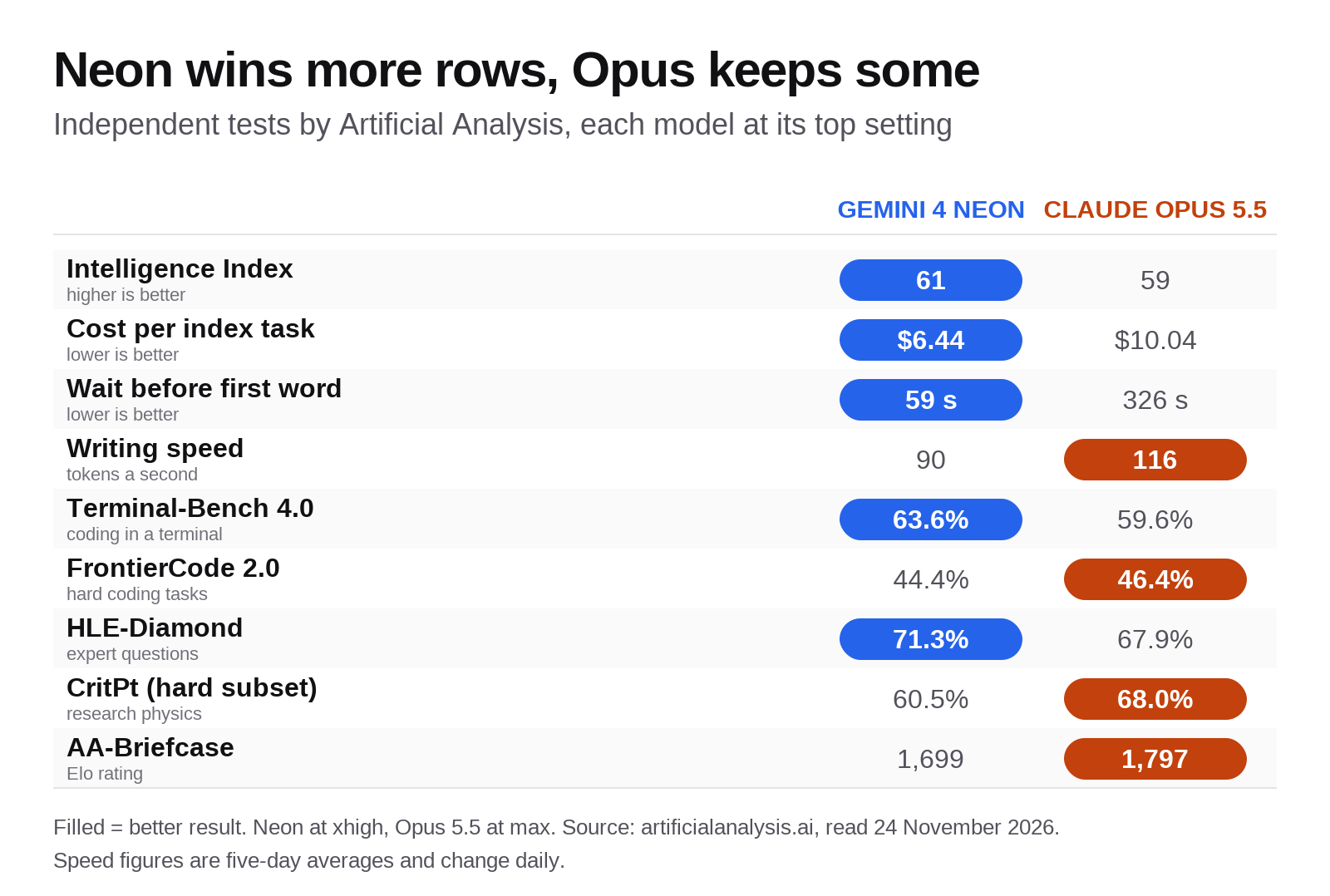
Two of the closest results, Vals and Arena's Agent Index, are within the normal wobble between test runs. Call them ties. These scores also move. Our scorecard from 24 November, below, shows how they looked a day earlier, when Artificial Analysis had Neon at 61 and was still using Terminal-Bench 4.0.
Which is better for coding?
Neither, clearly. Each model wins some coding tests:
- Neon wins CursorBench in Google's table, Terminal-Bench in Artificial Analysis's run, and Artificial Analysis's Coding Agent Index by a point, 59 to 58.
- Opus wins Terminal-Bench and FrontierCode in Google's table, and FrontierCode in Artificial Analysis's run.
The hands-on results below split the same way. Neon looks stronger on long, open-ended jobs, going by the developers who have used it most. On small, well-defined tasks, Opus 5.5 is usually quicker and cheaper, because Neon thinks a lot before answering. If Opus already works for you in Claude Code, Neon isn't a clear upgrade.
How much does each cost? Price and cost per task
Per token, Neon is 25% cheaper on everything: input, output and cached text. Neither has an announced price change. Google's bigger Carbon model doubles in price on 1 December, which makes Neon Google's cheaper option from then, as we covered at launch.
The price per token isn't the whole bill, because Neon writes more. When we first checked on 24 November, Artificial Analysis said Neon produced 283 million output tokens getting through its tests, to Opus's 218 million. But Opus read almost twice as much input, and Neon still comes out cheaper for each finished task.
Here is each model's score and cost per task by thinking setting, from Artificial Analysis on 25 November:
| Setting | Gemini 4 Neon score | Neon cost per task | Claude Opus 5.5 score | Opus cost per task |
|---|---|---|---|---|
| Max (Opus only) | 59 | $10.04 | ||
| Xhigh | 62 | $6.44 | 58 | $6.05 |
| High | 60 | $3.74 | 52 | $3.46 |
| Medium | 55 | $1.90 | 48 | $2.45 |
| Low | 44 | $0.75 | 35 | $0.98 |
So Neon's everyday high setting scores a point higher than Opus at full effort, for just over a third of the cost. At roughly the same cost per task, around $3.50, Neon on high scores 60 and Opus on high scores 52. If you're paying the bill for an agent that runs all day, that matters more than any single test score.
Which is faster?
Speed claims cut both ways. At each model's top setting, from Artificial Analysis on 25 November:
| Measure | Gemini 4 Neon (xhigh) | Claude Opus 5.5 (max) |
|---|---|---|
| Wait for the first word | About 60 seconds | About 338 seconds |
| Writing speed once it starts | 92 tokens a second | 117 tokens a second |
| Average time per index task | 25.6 minutes | 24.7 minutes |
On lower settings Opus starts much sooner: about 21 seconds on high, against Neon's 36. In a small test by developer Flavio Copes, Opus 5.5 finished short coding tasks two to four times faster than Neon. These figures move from day to day.
What do hands-on tests say?
Scoreboards don't capture whether you like the result. Four hands-on comparisons have been published so far, each by a single tester, so none is conclusive.
| Tester | Task | Winner | Caveat |
|---|---|---|---|
| Chase AI | Five builds, judged blind | Opus 5.5, slightly | Each model ran in its own company's coding tool |
| DataCamp | A playable chess variant | Neon | One build |
| MindStudio (KingBench 4) | Six one-shot coding projects | Neon, 37.9 to 34.7 | Unclear who ran it. Opus had a 60-minute cutoff |
| Flavio Copes | Small coding tasks and a 100,000-token search | Tie on quality. Opus faster and cheaper on small tasks | Short tasks only, through OpenRouter |
A blind test favoured Opus, slightly. Chase Hannegan of Chase AI ran five builds, including a 3D jet-engine explainer, a website homepage and an animated watch, picking a winner before learning which model made which. Neon won two narrowly, one was a tie, Opus clearly won the homepage, and the write-up doesn't say which model took the fifth by a slight edge. His verdict: "by the raw numbers they're on par", but "I slightly prefer Opus 5.5's outputs." Neon finished four of the five jobs sooner, mostly at lower cost.
A chess build favoured Neon. DataCamp's Josef Waples had each model build a playable chess variant. Neon's version finished all 12 test games with checkmate; Opus's version ended five of 12 in draws. Neon's run cost $0.90 to Opus's $1.70.
A coding test favoured Neon, with an asterisk. On KingBench 4, six one-shot coding projects reported by MindStudio, Neon scored 37.9 out of 60 and Opus 34.7. The page doesn't say who ran it, and Opus had a 60-minute cutoff that the other models apparently didn't.
Small tasks favoured Opus on speed and cost. Flavio Copes gave both models two parsing functions to write, a commit message to rewrite and a search through about 100,000 tokens of blog posts, all on the high setting. Both got every check right. On the CSV parser, Opus took 12.4 seconds and cost $0.029; Neon took 49.3 seconds and cost $0.091. On the long search, Neon was cheaper, $0.33 to $0.57, but slower. He calls Neon "a good model" but says it "thinks a lot" on short tasks, and suggests its low setting for small coding jobs.
What do YouTube reviewers say?
Much of the buzz comes from developers on YouTube. We watched two of the most detailed reviews in full.
Theo Browne: "the first real Opus 5.5 competitor". Browne, who runs the t3.gg YouTube channel and has been one of the harshest critics of Google's recent models, titled his review "Where was Google hiding this?" He calls Neon "a very, very real competitor" to Opus 5.5 and "neck and neck with Opus" for coding, and says "this might be my favorite model right now". Later he goes further, saying that for his own code work he finds it more capable than any Anthropic model.
His strongest example is a long coding job. He set Neon loose on his own Rust rewrite of the TypeScript type checker, with the goal of making it smaller and faster. He says Neon, working in Google's Antigravity tool, took about 10 hours to make the program 5.95 times smaller (47.44 MB down to 7.97 MB) and cut the time to run his full test suite by 48.6%. By his account, GPT-6.2 Astra spent more than a week on the same goal and made it slower, and Opus 5.5 and Fable 5.2 got it about 20% faster over several days. These are his own measurements on his own project. We haven't checked them.
What he likes most is what he calls coherence: Neon stays on task over long jobs, explains clearly what it's doing, and writes plainly. He isn't uncritical:
- It still makes things up. In one test, 10 of the 72 claims it made about his codebase were wrong. He puts that slightly behind Fable 5.2.
- It's weak at 3D. "It's not a good 3D model," he says of a 3D game test.
- It once ignored an instruction to use one of his saved workflows.
Two things to weigh. He says Google pays him through YouTube ad revenue, and the video has a paid sponsor, WorkOS. He also says friends at DeepMind told him Google's engineers pushed to release Neon early because they liked it so much. We can't confirm that.
Bijan Bowen: strong builds, especially from images. Bowen runs the same set of app- and game-building tests on every new model. In "Gemini 4 Neon Is INSANE", with Neon on its highest thinking setting and Antigravity's swarm mode, which splits a job between several AI helpers working in parallel:
- He called its browser-based desktop "probably the best browser OS we've seen".
- Asked to turn a photo of his room into a fighting-game arena, it produced what he called "by far" the best recreation he's seen. He judged it "an excellent vision model", which Roboflow's scores back up.
- It designed a 3D-printable car roof that printed without supports and fit the car.
- Not everything impressed him. On a GTA-style city game, he said some Claude results, which he recalled as Opus 5.5 or Sonnet, had looked better. Several of its games had simple graphics, though he rated them fun to play.
He didn't run Opus 5.5 side by side in this video. His full set of tests used 10% of the weekly allowance on his $200-a-month Google plan.
The pattern. Browne went in expecting to be disappointed, and Bowen had already seen the hype. Neither tested in a way that can settle "better than Opus". But the reports line up with the scores: very good, slightly better in some places, behind in others, and pleasant to work with.
Where does Opus 5.5 still win?
- Some hard coding, on Google's own table, and FrontierCode on Artificial Analysis's.
- Research-level science problems, going by CritPt.
- Head-to-head ratings. Opus leads on AA-Briefcase, and the Chase AI reviewer slightly preferred its output.
- Speed on short jobs. It writes faster and, below its top setting, starts answering sooner.
- 3D work. Both YouTube reviewers found Neon weaker here than recent Claude models.
- Fresher knowledge. Its knowledge runs to June 2026, against March 2026 for Neon.
- Where you can use it. Opus 5.5 runs on Amazon Web Services, Google Cloud and Microsoft Azure, and in Claude Code, Anthropic's coding tool. Switching tools has its own cost.
Where does Neon win?
- Price, per token and per finished task.
- Very long documents. The GraphWalks gap is the largest in Google's table, though it's Google's number.
- Images, audio and video. It tops Roboflow's vision tests, and Opus 5.5 takes only text and images.
- The Gemini app. Neon is the strongest model on the Google AI Pro plan. Carbon still needs Ultra.
- Automating office tasks. It leads AutomationBench in both Google's run and Artificial Analysis's.
- Long jobs and clear explanations, according to the developers who have used it most. That's opinion, but it's a consistent one.
Is Gemini 4 Neon an Opus killer?
Not by the evidence available today, though the early reviews make it the strongest challenger yet. A killer would win clearly on quality. Neon wins narrowly on most scoreboards, loses a few that matter to programmers, and splits the controlled hands-on tests. The developers who have used it most heavily are its biggest fans, and that's worth taking seriously, but it's still a handful of people on their own projects.
What Neon does is match Opus 5.5 for noticeably less money. That's a big deal. It puts Opus-level work at a mid-tier price, and it puts pressure on Anthropic's pricing. It's also worth remembering that Opus 5.5 came out two months earlier.
Which should you use?
- Pick Neon if cost matters, if you work with long documents, images, audio or video, or if you're on Google AI Pro. Start on the default high setting. It is the best value in this comparison.
- Stay on Opus 5.5 if it already does your coding well in Claude Code, if you need quick answers on small tasks, or if your work leans on hard maths and science. Neon isn't clearly better at those, and switching has a cost.
- For a team decision, run both on one real task from your own work and compare the cost per finished job, not the price per token.
What about Claude Opus 5.6?
It isn't out. As of 25 November, Anthropic hasn't announced a successor to Opus 5.5. Since 24 November, several posts on X have said Anthropic is quietly testing an "Opus 5.6" in Claude Code, and one leaker expects it by the end of November or in the first week of December. One account even pitched it as "an answer to Neon", with an unverified leaked price of $2 in and $10 out.
None of that is confirmed. If a new Opus does arrive with better scores or a lower price, this comparison changes, and we'll update it. For the screenshots, the dates and what's confirmed, read Claude Opus 5.6: what the leak shows.
You can line both models up against others on our compare page, or read our guide to picking the right AI model.