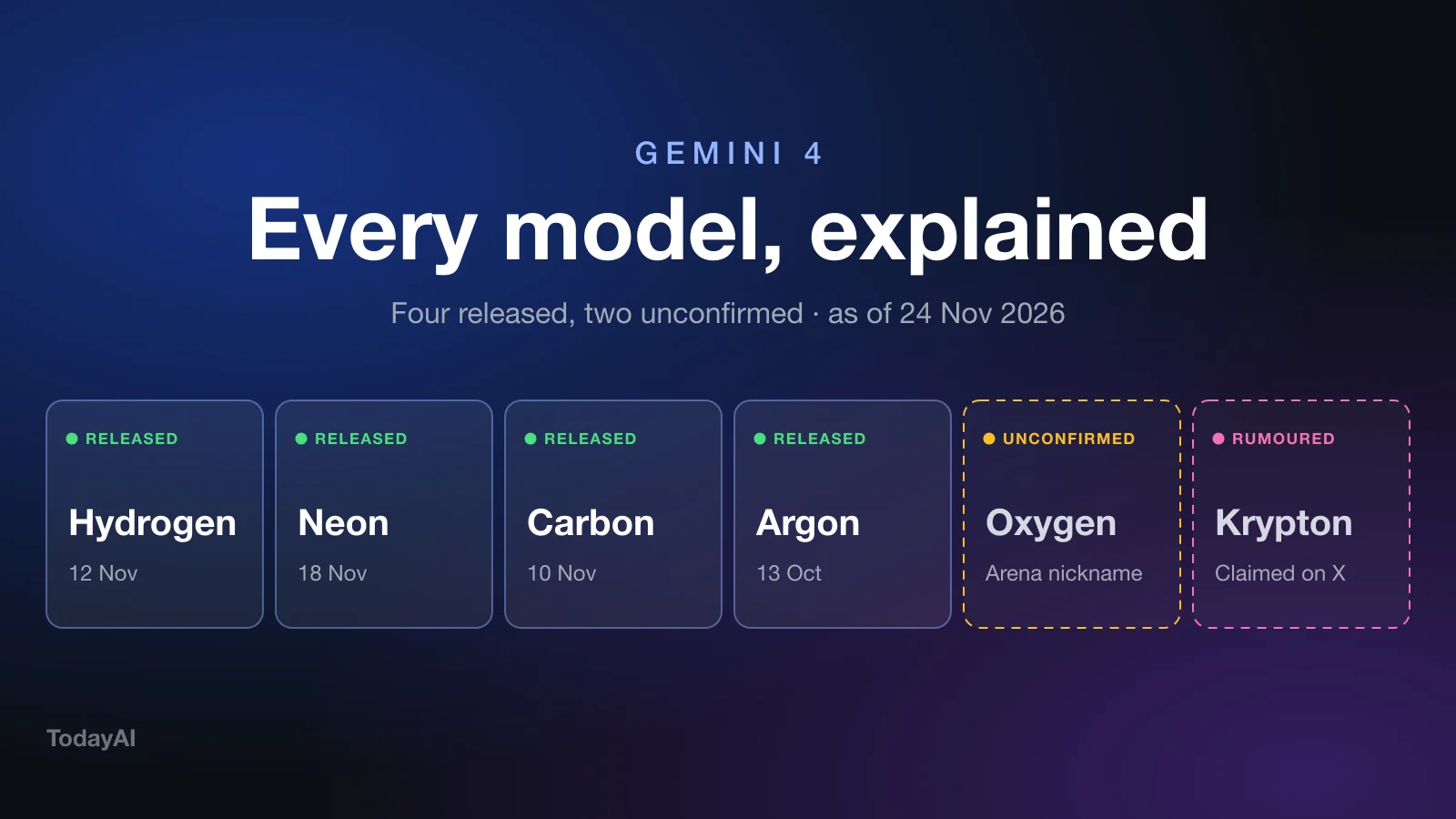
Gemini 4 Hydrogen vs Neon vs Carbon vs Argon, in short: Hydrogen is the fast, cheap one, Neon is the middle model most people should use, Carbon is for the hardest jobs, and Argon, the first of the family, has been overtaken. From 1 December, Carbon and Argon double in price, so Neon becomes cheaper per token than both.
Two other names, Krypton and Oxygen, are going around online. As of 25 November, Google hasn't confirmed either of them.
All four released models are named after chemical elements, and Google hasn't explained the scheme. Don't read the names as a ranking. Hydrogen, the lightest element, is the fast, cheap model, but Argon is a heavier element than Carbon and isn't the stronger model.
Prices are per million tokens. Tokens are the chunks of text AI is billed in, roughly three-quarters of a word each.
Gemini 4 models at a glance (as of 25 November)
| Model | Status | What it's for | API price, in / out | In the Gemini app |
|---|---|---|---|---|
| Hydrogen | Released, 12 Nov | Fast, cheap everyday tasks | $1.50 / $7.50 | Everyone; free users via Auto |
| Neon | Released, 18 Nov | Most serious work: coding, long documents, research | $3 / $15 | Google AI Pro and Ultra |
| Carbon | Released, 10 Nov | The hardest, longest jobs | $2 / $10 until 30 Nov, then $4 / $20 | Google AI Ultra |
| Argon | Released, 13 Oct | Google's first Gemini 4 frontier model, now overtaken | $2 / $10 until 30 Nov, then $4 / $20 | Reportedly replaced by Neon in the menu |
| Oxygen | Unconfirmed: testers' nickname | Looks like a fast model in Arena testing | None | No |
| Krypton | Rumoured | Claimed on X to beat Carbon | None | No |
The four released models all read up to a million tokens at once, about 750,000 words, and take text, images, audio, video and PDFs, according to Google's model list. Their API names are gemini-4-hydrogen, gemini-4-neon, gemini-4-carbon and gemini-4-argon.
Gemini 4 API prices, and what changes on 1 December
Carbon and Argon launched at an introductory price that ends on 30 November. Google's pricing page lists their new rates "starting December 1, 2026". The cached-input price doubles too, which Google's launch posts didn't mention. Cached input is text the model has already seen, like a long document you ask several questions about.
| Model | Price until 30 November (in / out) | Price from 1 December (in / out) | Cached input, until 30 Nov / from 1 Dec |
|---|---|---|---|
| Hydrogen | $1.50 / $7.50 | No change | $0.075 / no change |
| Neon | $3 / $15 | No change | $0.15 / no change |
| Carbon | $2 / $10 | $4 / $20 | $0.10 / $0.20 |
| Argon | $2 / $10 | $4 / $20 | $0.10 / $0.20 |
Source: Google's Gemini API pricing page, checked 25 November. Standard tier, per million tokens.
So until 30 November, Carbon is cheaper per token than Neon. From 1 December, Neon costs 25% less than Carbon or Argon, and exactly twice as much as Hydrogen. Batch jobs, which run within a day rather than straight away, cost half: Carbon and Argon go from $1 in and $5 out to $2 and $10.
What it means for a real bill. Say your app sends 20 million tokens in and gets 4 million out each month:
| Model | Monthly bill until 30 November | Monthly bill from 1 December |
|---|---|---|
| Hydrogen | $60 | $60 |
| Neon | $120 | $120 |
| Carbon or Argon | $80 | $160 |
That's the same job at list prices. In practice, models use different numbers of tokens for the same task. Google says Carbon spends more tokens than Argon, and Neon writes a lot, so test the cost of a finished job, not just the price per token.
Free API tier. Only Hydrogen is free to try on the Gemini API's free tier. Neon, Carbon and Argon need the paid tier, according to the pricing page.
Which Gemini 4 model do I get on Free, Pro or Ultra?
| Plan | Hydrogen | Neon | Carbon | Argon |
|---|---|---|---|---|
| Free Gemini app | Yes, through Auto | No | No | No |
| Google AI Pro | Yes | Yes | No | Was included at launch, now reportedly replaced by Neon |
| Google AI Ultra | Yes | Yes | Yes | Was included at launch, now reportedly replaced by Neon |
| Gemini API, free tier | Yes | No | No | No |
| Gemini API, paid tier | Yes | Yes | Yes | Yes |
Sources: Google's launch posts for Hydrogen, Neon, Carbon and Argon, plus 9to5Google on the app menu. Google's posts don't mention the cheaper Google AI Plus plan.
9to5Google reports that the app's menu now reads Auto, "Everyday help" (Hydrogen), "Deeper analysis" (Neon) and "Code & complex work" (Carbon). Your menu may differ while the update rolls out.
What are the Gemini 4 thinking levels?
You can set how long some Gemini 4 models think before they answer. More thinking usually means better answers, a longer wait and a bigger bill.
- Hydrogen: low, medium, high (the default) and xhigh, according to Google. Google called xhigh a new tier.
- Neon: four levels, with high as the default and xhigh as the highest. 9to5Google lists them as Low, Medium, High and Extra High.
- Carbon and Argon: Google's launch posts don't list thinking levels.
At xhigh, Neon took about 57 seconds on average before writing its first word. For chat, a lower setting is usually fine.
What is Gemini 4 Hydrogen?
Status: released on 12 November. Hydrogen is Google's quick everyday model. Google's launch post pitches it at "rapid execution" in coding and agent work, either on its own or alongside a bigger model.
- Price: $1.50 in and $7.50 out, the same across its full million-token window. It's the cheapest Gemini 4 model.
- Who can use it: the widest reach of the family. It's in the Gemini app's model menu, and free users can get it when the app's Auto setting picks it. It's also in Google Search for all users, and it's the only Gemini 4 model on the API's free tier.
- Scores: 54 on Artificial Analysis's Intelligence Index at its highest thinking setting. Google says it scores 51 on the default setting. In mid-November it was 13th in LMArena's public vote, where people pick the answer they prefer.
- Google's claims: 57% on Terminal-Bench 4.1, a test of working in a command line, against 18.2% for the older Gemini 3.8 Flash, and tasks finished 2.5 times faster than 3.8 Flash.
In Google's Antigravity coding tool, Hydrogen does the hands-on work while a bigger model plans. Its Orchestrator mode has Carbon plan and review while Hydrogen writes the code.
What is Gemini 4 Neon?
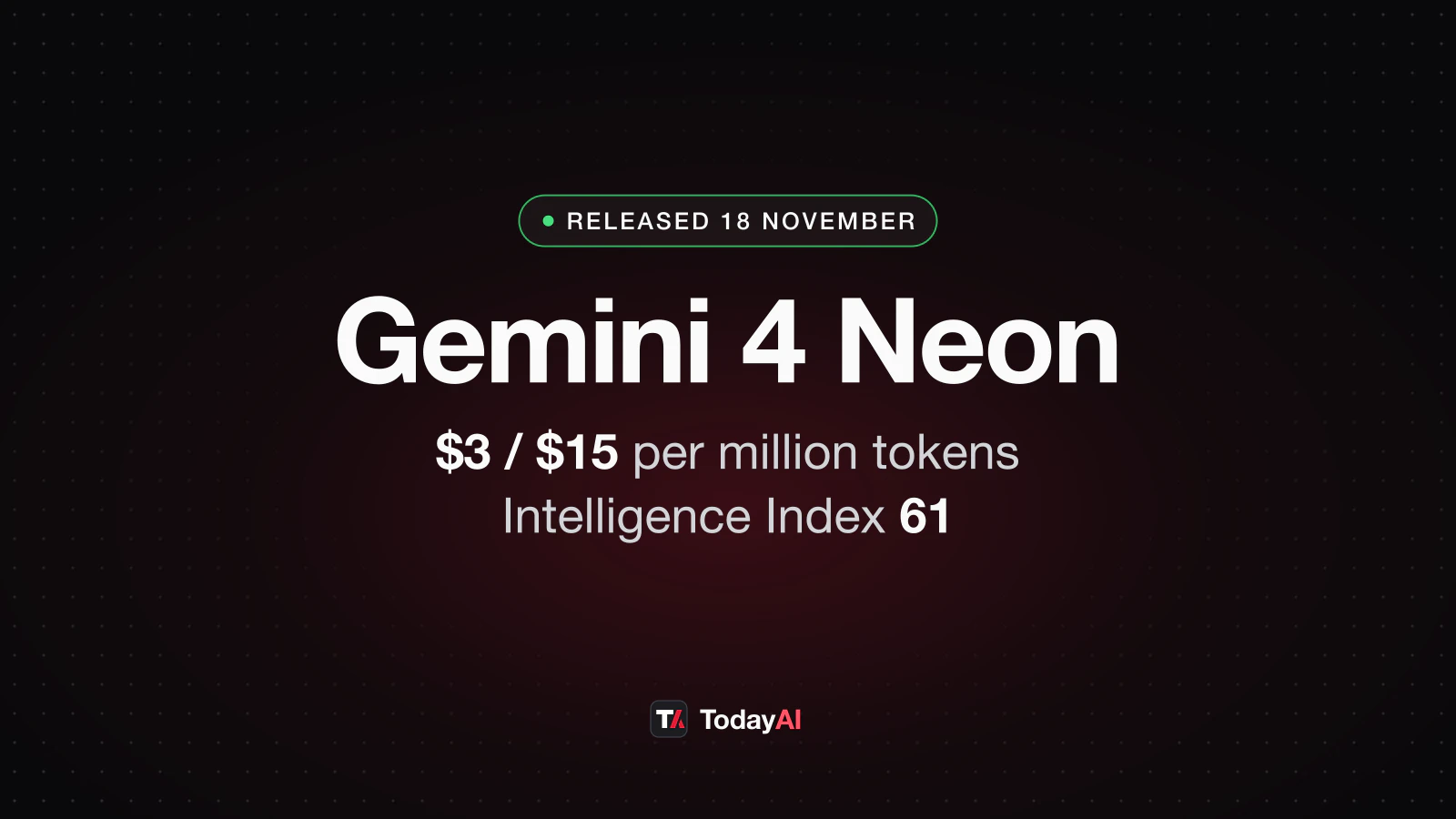
Status: released on 18 November. Neon sits in the middle of the family. Google says it "balances depth and efficiency", aimed at complex coding, analysis and business workflows.
- Price: $3 in and $15 out, with cached input at $0.15.
- Who can use it: Google AI Pro and Ultra subscribers in the Gemini app, the paid tier of the Gemini API, and Antigravity. Free app users don't get it.
- Scores: 61 on Artificial Analysis's Intelligence Index, third behind Claude Fable 5.2 (65) and GPT-6.2 Astra (62), and just ahead of Carbon (60). It scores 70.9% on the Vals Index.
- The catch: it can think for about a minute before writing at its highest setting, and it uses a lot of tokens. Cheap per token isn't the same as cheap per job.
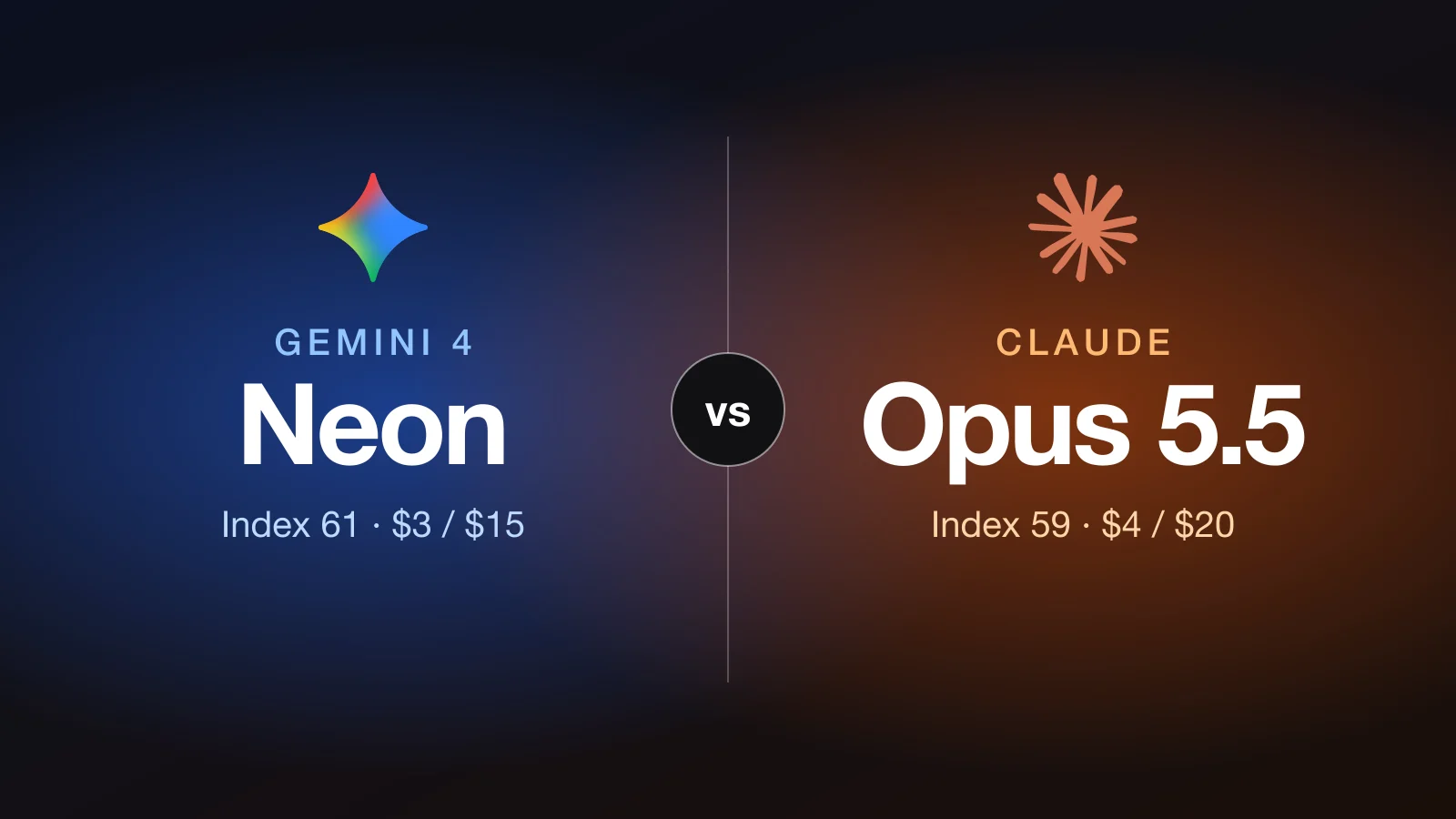
For the full launch details, read Gemini 4 Neon is out. For how it stacks up against Anthropic's model, see Gemini 4 Neon vs Claude Opus 5.5.
What is Gemini 4 Carbon?
Status: released on 10 November, after going to vetted cyber defenders first on 28 October. Google calls Carbon its strongest reasoning model, for hard engineering, science and security work. Its launch post says it spends more tokens than Argon, exploring and checking its work.
- Price: $2 in and $10 out until 30 November, then $4 in and $20 out.
- Who can use it: Google AI Ultra subscribers in the Gemini app, plus the paid tier of the Gemini API, Gemini for business and Antigravity.
- Scores: 60 on Artificial Analysis's index. In the data we pulled on 14 November, it was second on Epoch AI's capability index with 170, behind Claude Fable 5.2's 173, and first in LMArena's vote with 1526.
- The fine print: both of those leads are a photo finish, with margins of error that overlap its nearest rivals. We explain the split between votes and tests here.
Is Gemini 4 Argon being retired?
Not from the API, as far as Google has said. Its deprecations page lists "No shutdown date announced" for gemini-4-argon, and the same for the other three Gemini 4 models (checked 25 November). In the Gemini app, though, 9to5Google reports that "Neon also replaces Argon" in the model menu.
Status: released. Google announced Argon on 30 September for a small group of cyber defenders, then launched it publicly on 13 October as its "latest frontier model". Google's model list now describes it as faster than Carbon, using fewer tokens per turn.
- Price: $2 in and $10 out until 30 November, then $4 in and $20 out, the same as Carbon.
- Scores: in the data we pulled on 14 November, it scored 166 on Epoch AI's index, ninth of 256 models. It was second in LMArena's vote with 1522, from nearly 21,000 votes, about five times as many as Carbon had.
When Carbon launched, Google said Argon was still the better choice for most software and knowledge work. That was before Neon arrived. If you built on Argon, Neon is the obvious model to test next: from 1 December it's cheaper per token and scores higher on Artificial Analysis's index.
Gemini 4 Neon vs Carbon: which is better?
For most people, Neon. It scores about as well, runs faster and, from 1 December, costs less per token.
| Gemini 4 Neon | Gemini 4 Carbon | |
|---|---|---|
| Artificial Analysis Intelligence Index | 61 | 60 |
| Writing speed (early measurements) | About 110 tokens a second | About 59 tokens a second |
| Price until 30 November (in / out) | $3 / $15 | $2 / $10 |
| Price from 1 December (in / out) | $3 / $15 | $4 / $20 |
| Gemini app plan needed | Google AI Pro or Ultra | Google AI Ultra |
Speeds as reported by VentureBeat; scores from our Neon launch coverage. Carbon's one clear win is the public vote: it was first in LMArena's ranking in mid-November.
Google says a task at the default high setting costs 32% less on Neon than on Carbon. Choose Carbon when the job is long and hard enough that a small gain in quality matters more than time or money, and test it on your own tasks first. Google itself pitches Carbon at "your hardest, long-horizon projects".
Gemini 4 Hydrogen vs Neon
Hydrogen is half the price of Neon per token, and it's the only Gemini 4 model free users get. Neon is the clear step up for anything that needs careful thinking.
| Gemini 4 Hydrogen | Gemini 4 Neon | |
|---|---|---|
| Artificial Analysis Intelligence Index | 54 | 61 |
| Terminal-Bench 4.1 (Google's figures) | 57% | 65.2% |
| Price (in / out) | $1.50 / $7.50 | $3 / $15 |
| Free Gemini app | Yes, through Auto | No |
| Free API tier | Yes | No |
Use Hydrogen for quick questions, drafts, summaries and high-volume, simple jobs. Use Neon for coding, long documents and research. In Antigravity, Neon can direct a team of Hydrogen helpers working in parallel, so for coding agents the answer can be both.
Gemini 4 release dates
| Date | What happened |
|---|---|
| 30 September | Google announces Argon for vetted cyber defenders |
| 13 October | Argon launches publicly in the API and, for Pro and Ultra, the Gemini app |
| 28 October | Carbon goes to vetted cyber defenders |
| 8 November | First X post claiming Google is testing "Krypton" (rumour) |
| 10 November | Carbon becomes generally available; Ultra gets it in the app |
| 12 November | Hydrogen launches; free users get it through Auto |
| 14 November | Arena testers start talking about "Oxygen" (unconfirmed) |
| 16 November | gemini-4-neon spotted in the Gemini website's code |
| 18 November | Neon launches for Pro and Ultra, reportedly taking Argon's place in the app menu |
| 30 November | Carbon and Argon's introductory prices end |
| 1 December | Carbon and Argon rise to $4 in and $20 out, with cached input at $0.20 |
Which Gemini 4 model should I use?
- On the free Gemini app: Hydrogen is what you get, through Auto. It's fine for quick questions, drafts and simple tasks.
- On Google AI Pro: pick Neon for anything that needs careful thinking. It's the strongest model on that plan.
- On Google AI Ultra: Neon for most work, and Carbon for the hardest, longest jobs.
- Building with the API: Hydrogen for high-volume, simple jobs, and Neon for most serious work. Use Carbon only where tests on your own tasks show it's worth the extra.
- Already paying for Carbon or Argon: test Neon before 1 December. From then, Carbon and Argon cost $4 in and $20 out, and Neon stays at $3 and $15.
Whatever you pick, compare the cost of a finished job, not the price per token. Wordy models can cost more than their price suggests. You can line the Gemini models up against other companies' on our compare page, or read our guide to picking the right AI model.
Is Gemini 4 Krypton real? What we know
Status: rumoured. Google has not confirmed it. Since 8 November, posts on X have claimed Google is testing an internal checkpoint, a saved snapshot of a model in development, called Krypton, and that it beats Carbon. As of 25 November, it isn't in Google's model list.
Here's what we know:
- The evidence is a handful of X posts and demo clips, including side-by-side clips of a "krypton-a" against Carbon and Argon. The posters didn't say how they got access.
- There's no model card, no test results, no price and no release date. We can't even say whether Krypton is a product name or a testing nickname.
- The early reports are mixed. One tester says it ran about twice as slowly as Carbon and wrote about twice as much code.
- It isn't Neon, as far as anyone can show. Some videos said Krypton was renamed Neon. Google's Neon launch doesn't mention Krypton, and nothing links the two.
- Websites selling "Gemini 4 Krypton" API access are marketplace listings, not Google products. Don't pay for one.
Our full write-up, including the release dates going round, is Gemini 4 Krypton: release date, leaks and what's confirmed.
Oxygen is a separate puzzle. Since 14 November, testers on Arena, the site where people vote between anonymous AI answers, say that picking Hydrogen sometimes returns a different, better-looking model. They nicknamed it Oxygen. The name came from testers, not Google, and there's no evidence it's a cut-down Krypton. Here's what's known about Oxygen.
Two more names, "helix" and "radium", turned up alongside Neon in the Gemini website's code in mid-November, found by a user on a developer forum, as we reported in our Neon leak story. We haven't seen them mentioned anywhere else.
Until Google publishes a model card and a price, none of these is a model you can choose. We'll update this guide when one becomes real, and when the new prices take effect on 1 December.