Alibaba launched Qwen4-Max on 16 November. We've already looked at the safety claims it launched with. This piece asks the practical questions: how good is it, what does it really cost, and should you use it?
The short answer: it's a good, cheap model that isn't quite in the top tier, with one habit that matters for your bill.
What it is
Qwen4-Max is a closed model. You can use it through Alibaba's apps and API, but you can't download it. Here are the basics from Alibaba Cloud's documentation and launch coverage from Digital Trends and DataCamp:
- Memory. It can take in about a million tokens at once, roughly 750,000 words, and write up to 131,000 tokens back, or about 262,000 with thinking on. Tokens are the chunks of text AI is billed in.
- Inputs. Text, images and video in. Text out.
- Thinking. It reasons before answering by default, with low, high and extra-high effort settings.
- Size. Reported at 2.4 trillion parameters in total, with about 71 billion used for any given word. Parameters are the internal settings a model learns. This design, called mixture-of-experts, keeps it cheaper to run than its size suggests.
Alibaba says smaller open-weight Qwen4 models, which anyone could download, are on the way. There's no date. As of 17 November, the Qwen page on Hugging Face still lists Qwen3.8 as the newest.
How good is it?
Two kinds of numbers are circulating, and they tell different stories.
Alibaba's own chart, as reported by DataCamp, picks tests where it does well. It narrowly beats Claude Opus 5.5 and GPT-6 Astra on DeepSWE, a coding test, scoring 75.7 against 74.2 and 74.1. It wins clearly on a legal test and on Agents' Last Exam, which checks multi-step tasks. But it trails badly on Terminal-Bench, which tests working in a command line (48.5 against 59.6 for Opus), and on ProgramBench (31.5 against 65.0). The chart leaves out Claude Fable 5.2 and Gemini 4 Carbon, the two models at the top of most rankings.
Independent testers are less generous:
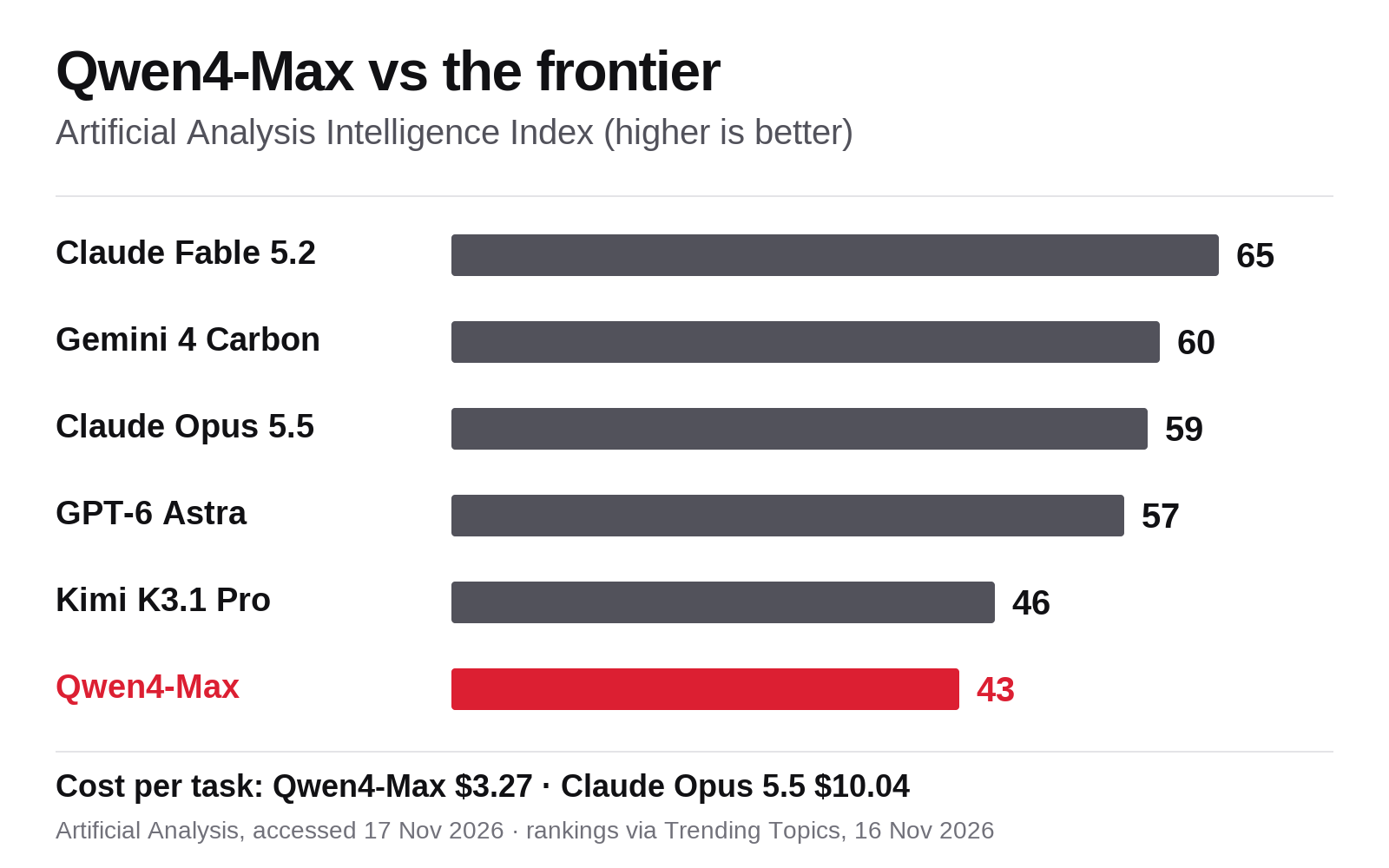
- Artificial Analysis gives it 43 on its Intelligence Index. That's behind Claude Fable 5.2 (65), Gemini 4 Carbon (60), Claude Opus 5.5 (59), GPT-6 Astra (57) and Moonshot's open Kimi K3.1 Pro (46).
- Vals puts it 11th of 38 models, and first among Chinese models. It ranks 8th on finance tasks but 15th of 65 on Terminal-Bench.
- On Arena, where people vote between answers, early results put it 6th for building web pages. There's no overall ranking yet.
So Qwen4-Max is a clear step up for Alibaba, but it isn't challenging the leaders. Its sweet spot, according to DataCamp's testing, is agent work that involves reading and pulling together lots of documents. Its weakest areas were coding in a terminal, reading charts and understanding video.
What it costs
There's been confusion here, so let's settle it. Alibaba's official pricing page, updated on 17 November, lists:
- $1.50 per million input tokens and $4.50 per million output tokens in the Singapore ("International") region.
- About $1.41 and $4.24 in Beijing, Hong Kong, Frankfurt, Virginia and Tokyo.
- $0.075 per million tokens for cached input. Caching means the model reuses text you've already sent, like a long document you ask several questions about.
That $0.075 figure is where reports of a rock-bottom price came from. It only applies to repeated input. There's no extra charge for long prompts: the same price covers everything up to a million tokens. The previous Qwen3.8-Max cost $2 in and $6 out.
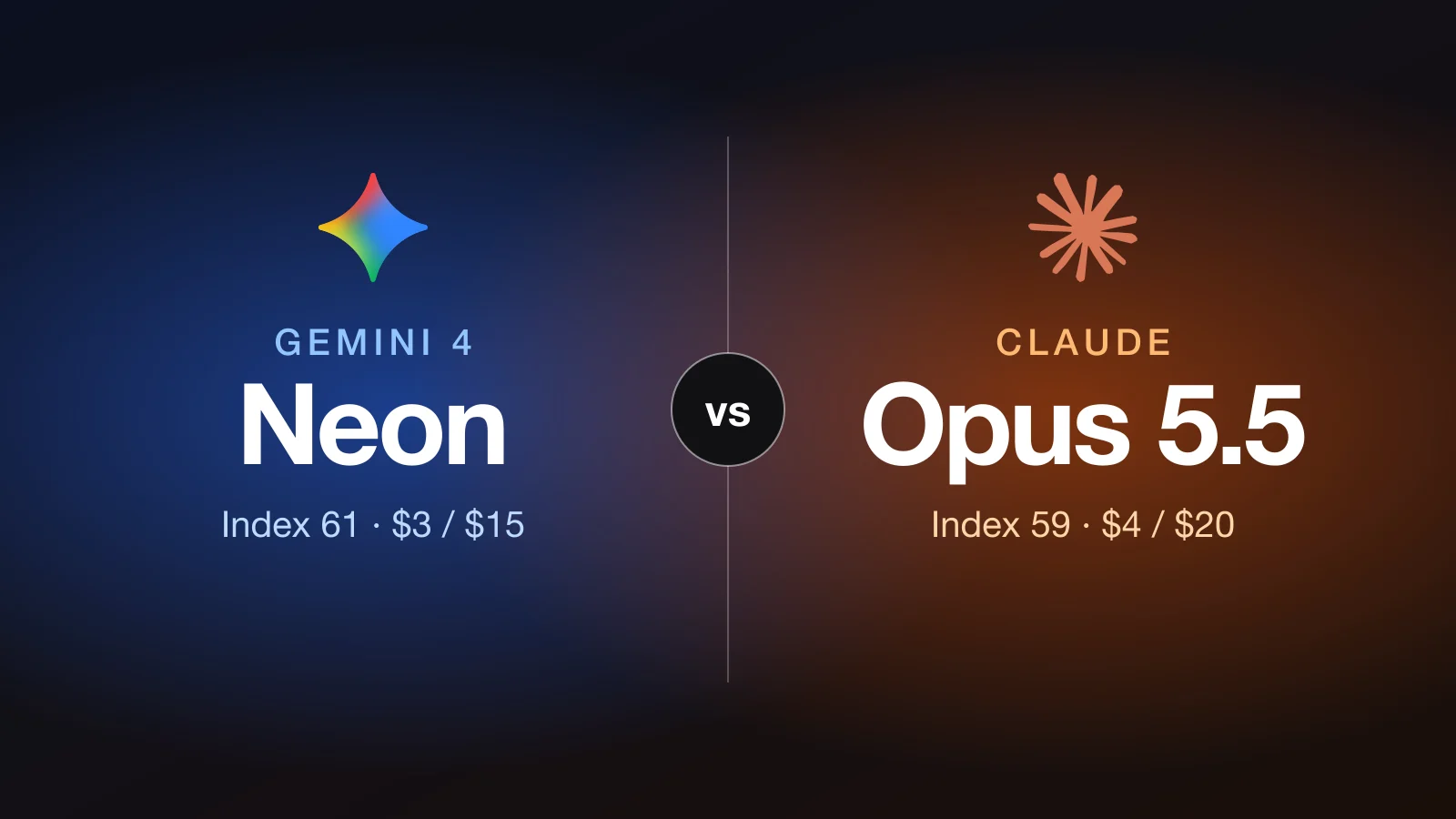
For comparison, from the data on our compare page: Gemini 4 Carbon is $2 and $10 (rising after 30 November), Claude Opus 5.5 is $4 and $20, Claude Fable 5.2 is $8 and $40, and GPT-6 Astra is $10 and $50.
The catch: it talks a lot
Price per token is only half the bill. The other half is how many tokens a model uses to finish a job.
Artificial Analysis found Qwen4-Max produced about 127 million output tokens across its tests, against a typical 79 million. It was also slow, at around 54 tokens a second. Testers at DataCamp and MindStudio noticed the same thing: it overthinks simple tasks and adds explanations nobody asked for.
Even so, it works out cheaper than the big Western models on a finished job. Artificial Analysis puts its cost per task at $3.27, against $10.04 for Claude Opus 5.5. But OpenAI's smaller GPT-6.1 Sol did it for $1.27. Cheap per token doesn't automatically mean cheapest.
Alibaba's own headline is a 60% cut in cost per task compared with Qwen3.8-Max, from $4.43 to $1.67 on its in-house Work360 test of 721 job types. That compares the model with its own predecessor, on a test Alibaba designed. DataCamp points out that the saving is bigger than the lower prices and shorter answers would explain, and Alibaba hasn't said why.
How to try it
- Free API tokens. New Alibaba Cloud Model Studio accounts get 1 million free tokens in the Singapore region, valid for 90 days. The model ID is
qwen4-max, and it accepts the same request formats as OpenAI's and Anthropic's APIs, so many existing tools work with a one-line change. - OpenRouter. The model is listed on OpenRouter, a service that lets you reach many AI models through one account, at about $1.43 in and $4.28 out.
- Apps. Alibaba's Qwen Chat, Qwen Work, Qwen Studio and its Qoder coding tool all offer it. We couldn't confirm whether free chat access continues now that the preview has ended.
If you're new to building with APIs, our guide to building your first AI agent walks through the basic loop, and the same ideas apply here.
Should you use it?
It depends on the job:
- Long documents on a budget. Worth a serious test. The million-token window, flat pricing and cheap caching are a strong combination.
- Hard coding and reasoning. The independent scores say Claude Fable 5.2, Gemini 4 Carbon or Claude Opus 5.5 will do better. Our guide to picking the right model can help you choose.
- Sensitive data. It's a hosted service run by Alibaba Cloud. Check which region your data is processed in and whether that meets your rules.
Whatever you pick, test it on your own tasks and measure cost per finished job. A model that's cheap per word but uses twice the words isn't the bargain it looks.