GTA VI came out on Thursday. By Friday, someone had played it without touching a controller.
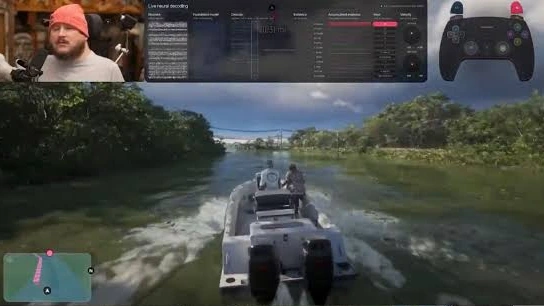
On 20 November, Neuralink posted a roughly two-minute clip on X with a simple caption: "Playing GTA VI with a Neuralink." It shows a participant in the company's clinical trials steering a speedboat under a bridge and into a narrow, tree-lined channel to pick up a package, using only the brain implant.
What the video shows
The main shot is the game. A small window in the corner shows the player, a live dashboard of their decoded brain signals, and a picture of a game controller whose buttons and sticks light up as each command comes through.
Neuralink didn't say who the player is or which console they used. GTA VI is out on PlayStation 5 and Xbox Series X|S.
How you play a game with your brain
Neuralink's implant, which the company calls Telepathy, is a small device placed in the skull, with ultra-thin threads that reach into the part of the brain that controls hand movement.
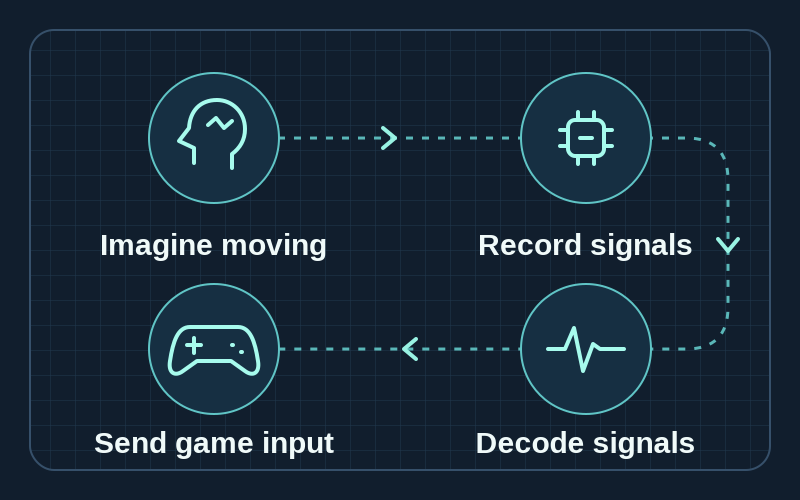
Here's the basic idea:
- You imagine moving. The participant pictures moving their hand or fingers, even though they can't physically do it.
- The implant listens. Neurons in that movement area still fire when you imagine the movement, and the threads pick up those signals.
- Software decodes it. AI models, trained on that one person's brain activity, learn which pattern means "push the stick left" and which means "press this button."
- The game gets normal inputs. To the console, it just looks like a controller being used.
Participants usually start by learning to move a cursor this way, with imagined movements becoming clicks and scrolls. Some are now testing experimental controls for game consoles, keyboards, wheelchairs and robotic arms. Neuralink says not everyone in its trials has access to these yet.
Why GTA is a harder test than it looks
This isn't the first game played with a Neuralink. In 2024, the company's first participant, Noland Arbaugh, who has quadriplegia, played Civilization VI and Mario Kart.
But a speedboat in GTA is a step up. Civilization is turn-based, so you can take your time with each click. Driving in a fast 3D world needs continuous, smooth control: steering a little left, then a little more, then easing off, all while moving through tight spaces. Doing that by thought alone, without overshooting, means the decoder has to read fine changes in intention in real time.
One two-minute clip, chosen by the company, doesn't tell us how often it works this well. It does show the control is now good enough for at least some participants to handle a brand-new, demanding game.
Who it's really for
The people in Neuralink's trials have serious paralysis, from spinal cord injuries, ALS or brainstem strokes. The company's stated goal is to give them back what it calls digital independence: using a computer, messaging, browsing and, yes, gaming, without help from anyone else.
Gaming makes a great demo because everyone gets it immediately. The bigger point is that if someone can steer a boat through a channel, the same control could drive a wheelchair or move a robotic arm.
The caveats
- It's experimental. Neuralink's implants are investigational devices and are not approved by the US Food and Drug Administration or any other regulator.
- It's brain surgery. The implant has to be placed surgically, which carries real risks. This is for people with severe disabilities, not for gamers.
- It's a company video. We don't know how many attempts it took, or how this participant compares to others in the trials.
What's next
Neuralink is also working on Blindsight, an implant meant to restore some vision by stimulating the brain's visual area directly, bypassing damaged eyes or optic nerves. Elon Musk said on 30 October that it was ready from an engineering standpoint and waiting on regulators. It received the FDA's Breakthrough Device Designation in 2024, which speeds up review but is not an approval, and it has not yet shown it can restore useful vision in people.
For now, the GTA clip is the clearest public demo yet of how far brain-controlled computing has come in two years: from cursor clicks to driving through one of the most detailed game worlds ever made.
For more on AI in the physical world, see our robotics coverage.


