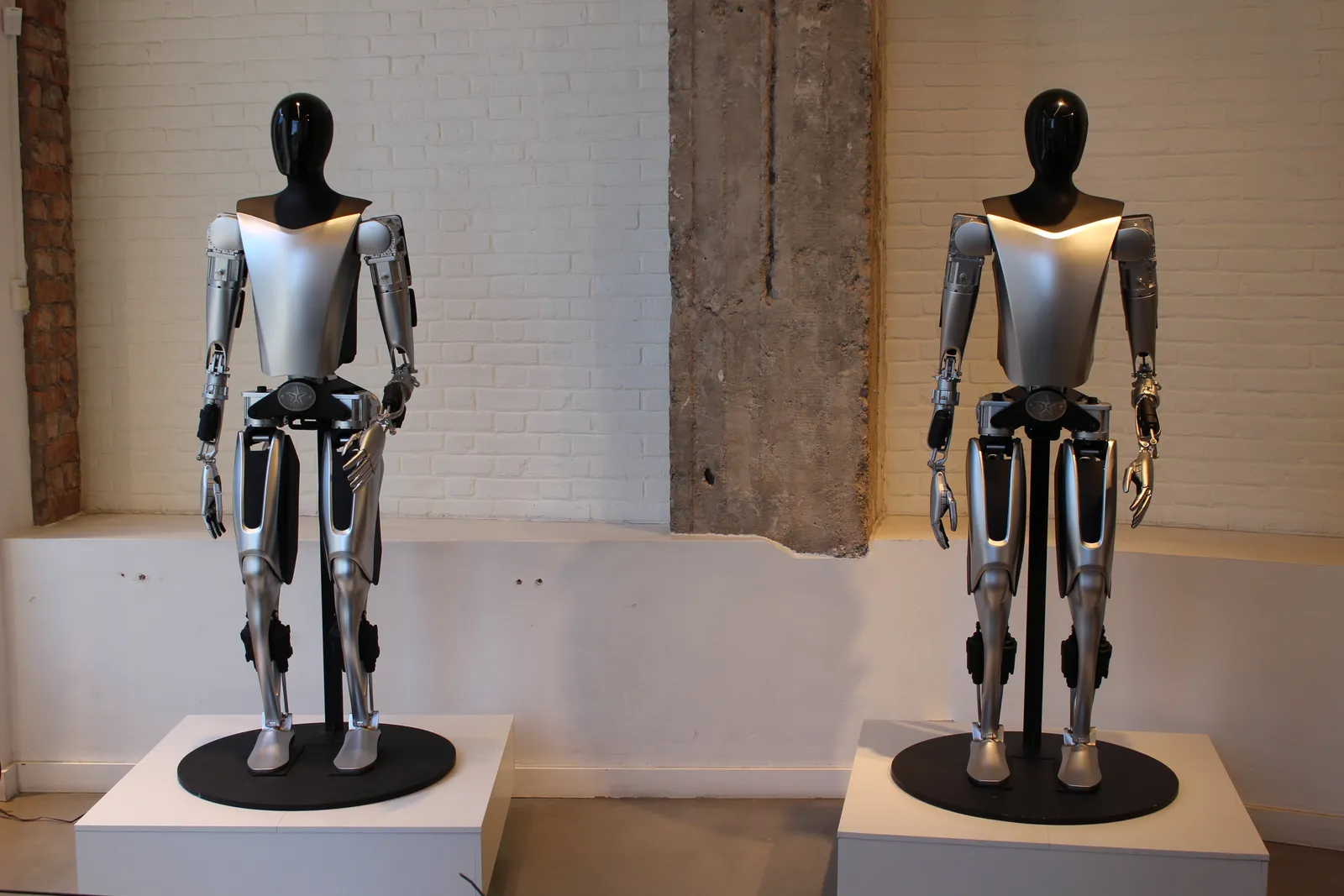
Chatbots got good partly because the internet was full of text to read. Robots have had no such library. Nobody has a vast archive of "how to fold a towel" written in robot motor commands.
NVIDIA thinks it has found a substitute: us. On 9 November, at the Conference on Robot Learning in Austin, it introduced GR00T 2, a robot model that learns mostly from watching humans do things.
What GR00T 2 is
A "foundation model" is a large AI trained on a huge, general pile of data, then adapted to specific jobs. The models behind chatbots are one kind. GR00T 2 is NVIDIA's version for robots. It predicts what a scene will look like next and what the robot should do about it.
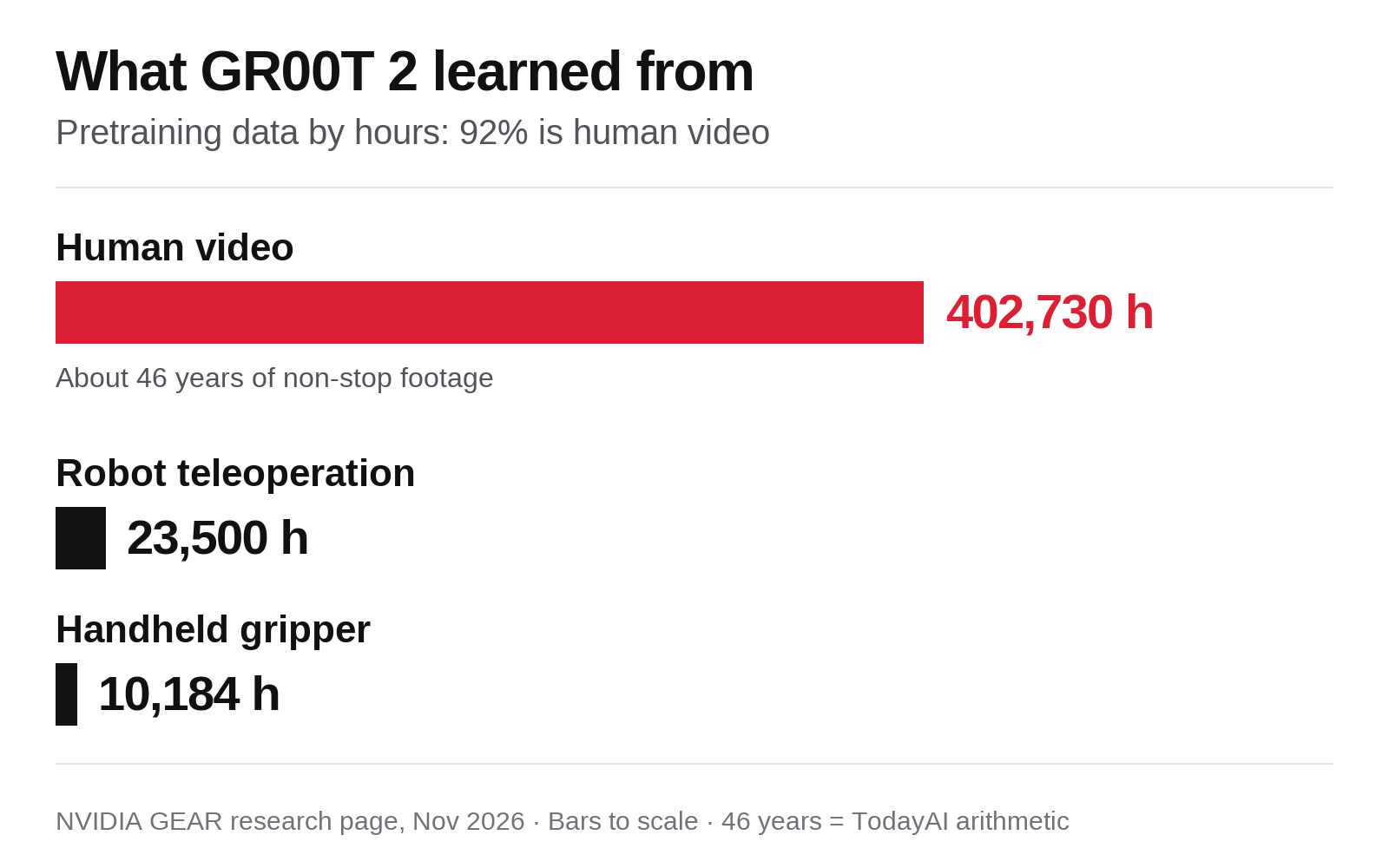
Its pretraining mix, per NVIDIA's research page, has three parts:
- 402,730 hours of first-person video of humans doing tasks.
- 23,500 hours of robot teleoperation, meaning a person remotely steering a real robot while it records.
- 10,184 hours of handheld-gripper demonstrations, where a person uses a hand-held tool that mimics a robot gripper.
That's 436,414 hours in total, and human video is 92% of it. To make 402,730 hours tangible: played back to back, non-stop, it would run for about 46 years.
The 95% claim
Here is where NVIDIA's headline comes from. The test robot is a two-armed machine with two multi-fingered hands. NVIDIA picked 50 tasks that appear in other robots' data or in human video, but never in this robot's own data.
With no extra training, GR00T 2 averaged 40% success. Then NVIDIA gave it five demonstrations per task, under three minutes of robot data each, and ran a 30-minute fine-tune on a single RTX 5090 graphics card. A "demonstration" is just a person showing the robot the task. A "fine-tune" is a short extra round of training on those examples. Average success rose to 95%, according to NVIDIA's page.
One demonstration gave 71%. With five, 37 of the 50 tasks succeeded in every trial.
That is striking: a few minutes of showing, half an hour of training, and a new skill. If it holds up, the economics matter. Robots that need weeks of engineering per task don't spread. Ones that need an afternoon might.
Why you should be careful with it
Every number here is NVIDIA's. The research page reports only NVIDIA's own evaluations, and none of the coverage I found cites an independent test. Some specifics matter.
The 50 tasks were NVIDIA's pick. The page's only stated criterion is that the tasks show up in other robots' data or in human video. Two secondary write-ups, Unite.AI and Pebblous, say NVIDIA's whitepaper limited them to tasks learnable from five episodes at 80% or better. I couldn't confirm that on NVIDIA's page, so treat it as a reported detail. If true, a high average is partly built in.
The page doesn't give the number of trials behind the 50-task average.
Corrective data and recovery agents belong to a different result. The 95% is described as fine-tuning on five demonstrations. NVIDIA's toy-assembly results, at 98, 97 and 97 successes out of 100, use a separate setup. There, a reasoning "agent" plans the steps and triggers recovery routines when something drops. Without that agent, NVIDIA reports 71% to 84%, and 23% to 69% with fine-tuning alone. Don't mix the two sets of numbers up.
It's one robot. The headline figure comes from one two-handed machine. NVIDIA says the model also runs on other robots, but the 95% is not a promise for all of them.
NVIDIA lists its own limits. Most misses, it says, "come from execution, not intent": the robot knows what to do but fumbles. On some visual-steering tasks it "rarely complete[s] the full task."
The open data
The part anyone can check is the dataset. NVIDIA has released 100,000 hours of its human video as Human-1M-100K. The Hugging Face dataset page says it carries the CC BY 4.0 licence and is "ready for commercial and non-commercial use."
"Open dataset" and "licence" sound dry, but they are the point. CC BY 4.0 means you can use the data, even commercially, as long as you credit NVIDIA. At 100,000 hours, that's about 11 years of footage, with language descriptions and head and hand tracking. It's roughly a quarter of the human video GR00T 2 itself used.
The model is a different story. Interesting Engineering covered the launch, and NVIDIA's page says "Code Available in December." A Humanoids Daily report says NVIDIA hasn't yet published licence terms for the model weights (the learned settings that make the model work). Until then, nobody outside NVIDIA can try it.
One more point from Pebblous: the footage came from outside vendors, and it says the public data card doesn't explain who the 41,288 collectors were or on what terms they filmed. That's that site's reading, not something I could confirm independently.
Could video become robots' internet text?
NVIDIA's own test supports the idea, within limits. In its experiment, adding all the human video lifted real-robot progress from 50% to 70% across 72 tasks. That's a real gain, and the pattern echoes what text did for chatbots: more data, better skills.
But a chatbot's output is words, and words are forgiving. A robot's output is a hand closing on a real object. The gap between "understands the task" and "does it every time" is exactly where NVIDIA's own caveats sit.
What it means for you
If you only follow the news, here's the takeaway. The race in robotics is shifting from building clever hardware to collecting the right data, and a lot of it is simply people being filmed doing ordinary things. That raises good questions about consent, as with any big training dataset.
If you build or tinker, the 100,000 hours are available now and the licence is permissive. That's real.
For everyone else, wait. The honest status is a strong claim from the company that made it, with the model not yet in anyone else's hands. For what robots are actually doing in jobs today, see our look at humanoid robots at work.