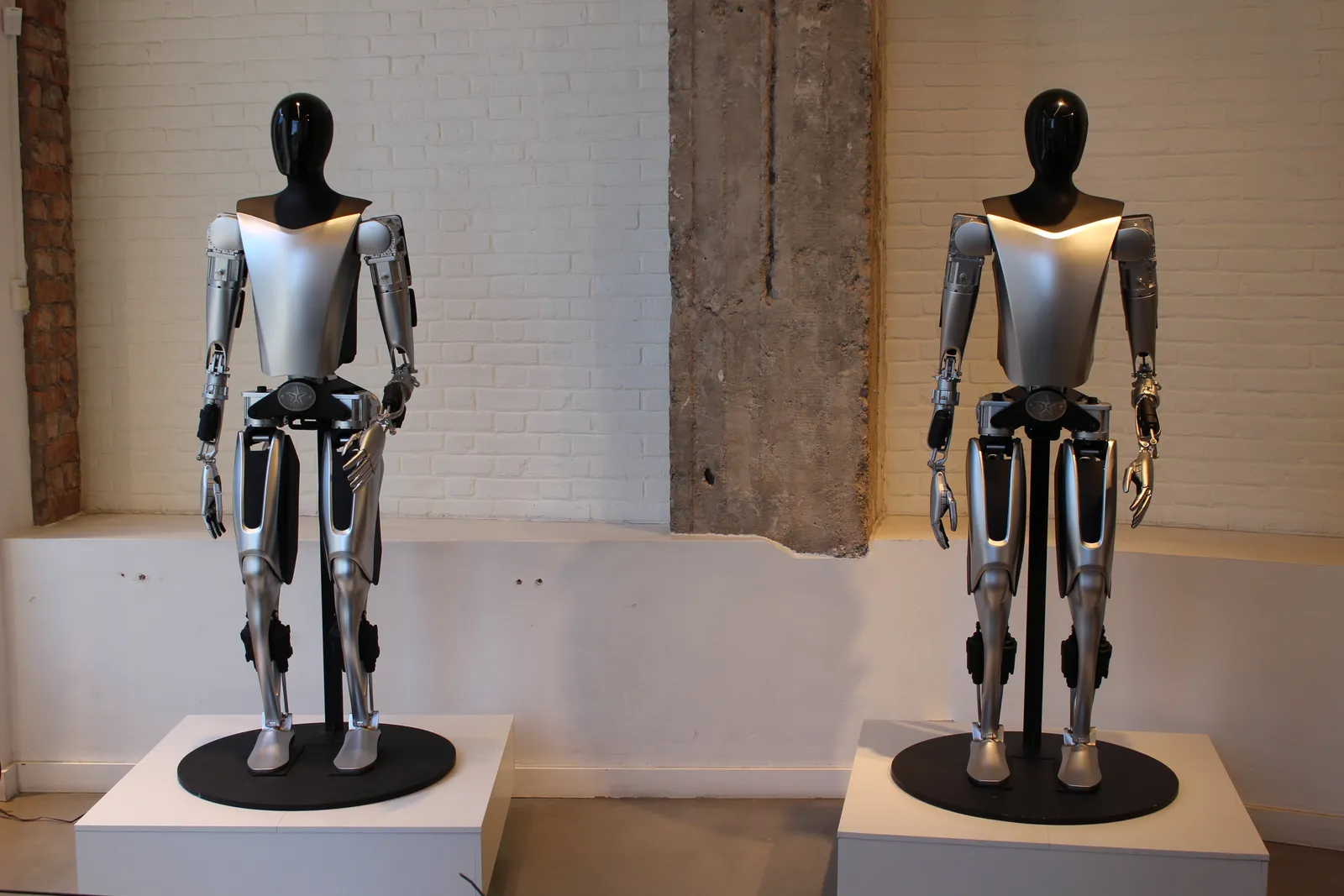
Every few weeks a humanoid robot walks onto a stage and does something impressive. Much less often, one turns up for a shift.
October gave us a few headlines that blur the line. So here is what is paid work, what is a trial, and what is still a promise.
A quick definition first. A humanoid is a robot built roughly like a person, with legs, arms and hands, so it can work in spaces designed for people. A pilot is a limited trial, before a company commits to buying at scale.
The AGCO deal: commercial, but still a pilot
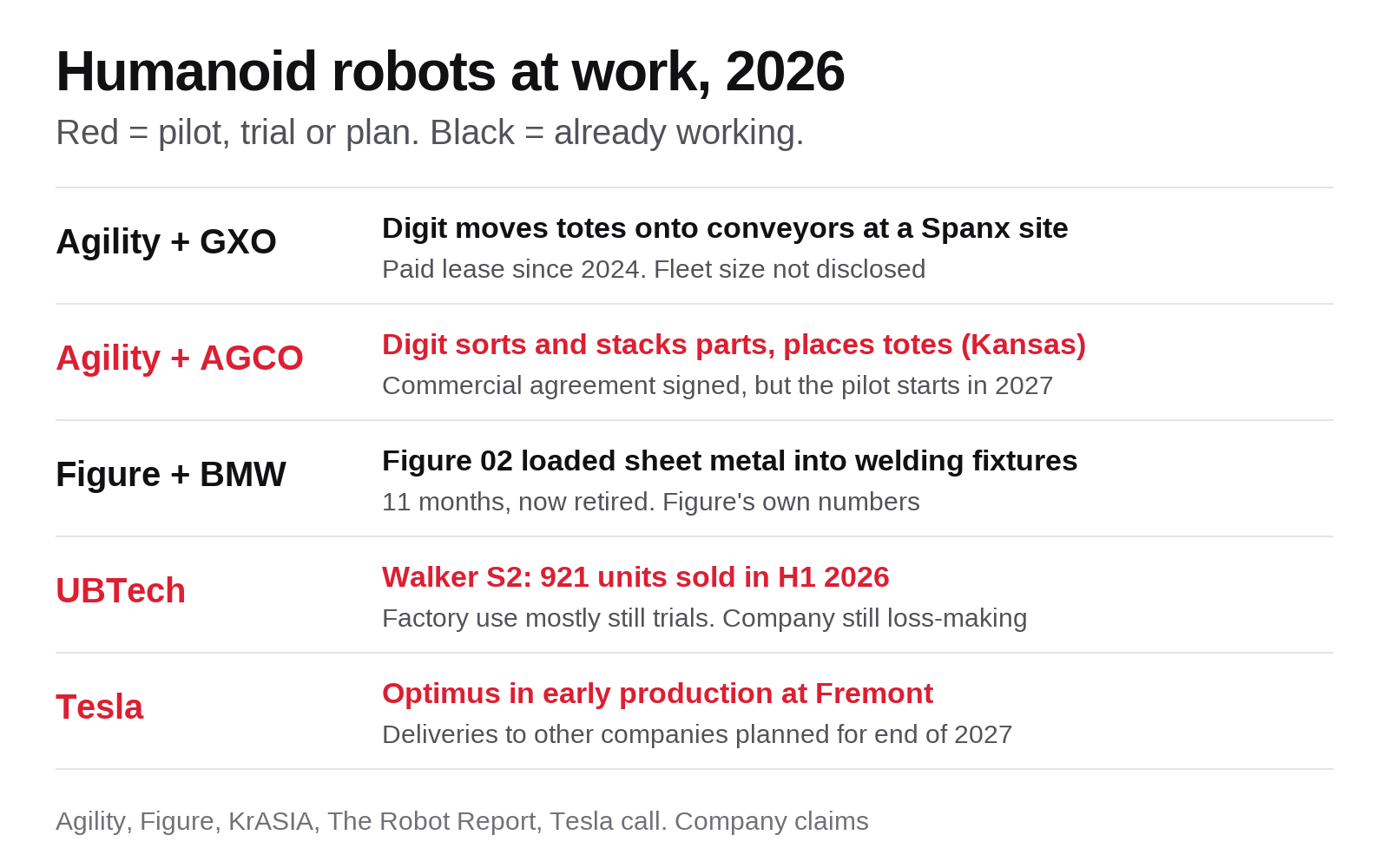
AGCO, the farm machinery maker, and Agility Robotics signed a commercial agreement in October to bring Agility's Digit robot into AGCO's plant in Hesston, Kansas. The pilot is expected to begin in 2027.
Digit will start with sorting and stacking parts and placing storage totes (plastic crates). That is useful, but it is not assembling a combine harvester. The Robot Report's round-up includes the deal.
The coverage I read did not give the number of robots, the price or the length of the pilot. So "commercial agreement" tells you money is involved. It does not tell you a fleet is working.
Where robots are really working
The best-documented paid case is older. In 2024, Agility and logistics firm GXO announced a multi-year deal in which Digit moves totes at a site handling products for Spanx. Agility describes it as the first formal commercial humanoid deployment, on a robots-as-a-service basis, meaning GXO leases the robots rather than buying them. The release does not say how many robots.
Another is BMW. Figure AI says its Figure 02 robot spent 11 months at BMW's Spartanburg plant loading sheet-metal parts into welding fixtures. Figure reports more than 1,250 hours of running time and more than 90,000 parts loaded, with "minimal hardware failures". Those are the company's own numbers, and Figure has since retired that model for its successor.
In China, UBTech reported 921 full-size humanoids sold in the first half of 2026, with humanoid revenue up 1,445% from a small base. KrASIA's reading of the results is that industrial use is still mostly task validation, and the company is still losing money.
Putting 19,100 in context
Smart Analytics Global estimates (as reported by Humanoid.guide, citing the South China Morning Post) that about 19,100 humanoids shipped worldwide in the first half of 2026, up 272%. Chinese makers supplied more than 97%. I could not open the firm's own release, so treat this as a reported estimate. Another report presented in August reportedly put China's figure alone above 40,000, so counts differ.
For scale, the International Federation of Robotics says factories installed more than 600,000 industrial robots in 2025. Those are mostly fixed arms. The periods differ (half a year against a full year), but humanoids are a small fraction of what factories already buy.
Shipped is also not the same as working. Humanoid.guide notes that unit counts do not show sustained industrial work, and that Unitree's volume leans on a small model sold partly for education, research and performances.
Tesla: production, not yet sales
On its third-quarter earnings call, Elon Musk said Tesla had started "early production" of Optimus on a Fremont line, and expected at least a year to reach 20,000 a week. Tesla plans to start delivering to other companies around the end of 2027, after remaining reliability and durability problems are solved, he said.
That is a plan, reported by a Tesla-focused site rather than a Tesla filing I could read. The same caution applies to every number in this piece that comes from the makers.
What is holding them back
Safety rules. A two-legged robot can fall over, and older factory-robot standards were not written for that. One explainer says the main standard for these machines, ISO 25785-1, was still a draft, and that experts did not expect volume deployment alongside people before 2027. Agility says its new Digit 5 can work near people without barriers, but that is its claim, and its certifications are still expected, not granted.
Battery and uptime. Uptime is the share of time a machine is actually working. Agility says Digit 5 runs for 90 minutes and recharges in nine, which is far better than before, but still frequent breaks. Digit 5 is due for early access in the first half of 2027.
Reliability, speed and cost. I found no independent test comparing a humanoid's speed with a person's, and none of these companies publishes a price I could find. Those are the questions buyers will ask.
Learning new jobs. Many robots are still taught tasks by teleoperation, where a human remotely drives the robot to show it what to do. Newer models try to learn from video instead, as we cover in NVIDIA's GR00T 2 robot model.
What it means for you
If you work in a warehouse or factory, the near-term change is small: a few robots doing the dullest carrying, mostly in trials. Nothing here shows people being swapped out at scale.
For students, the opportunity is in the unglamorous parts: safety engineering, maintenance, and integrating robots into real workplaces. The demo is the easy part. The shift is the hard part.