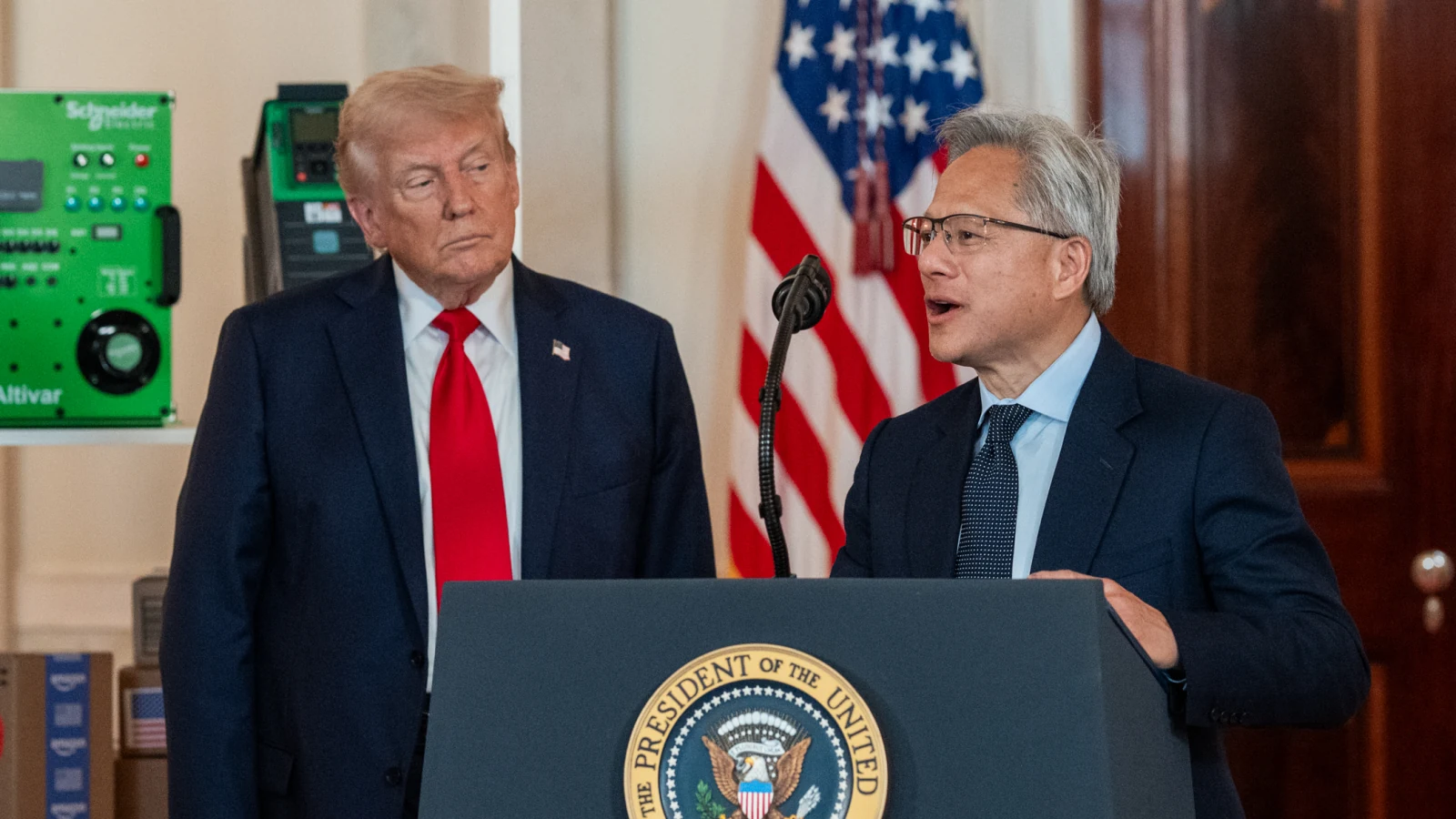
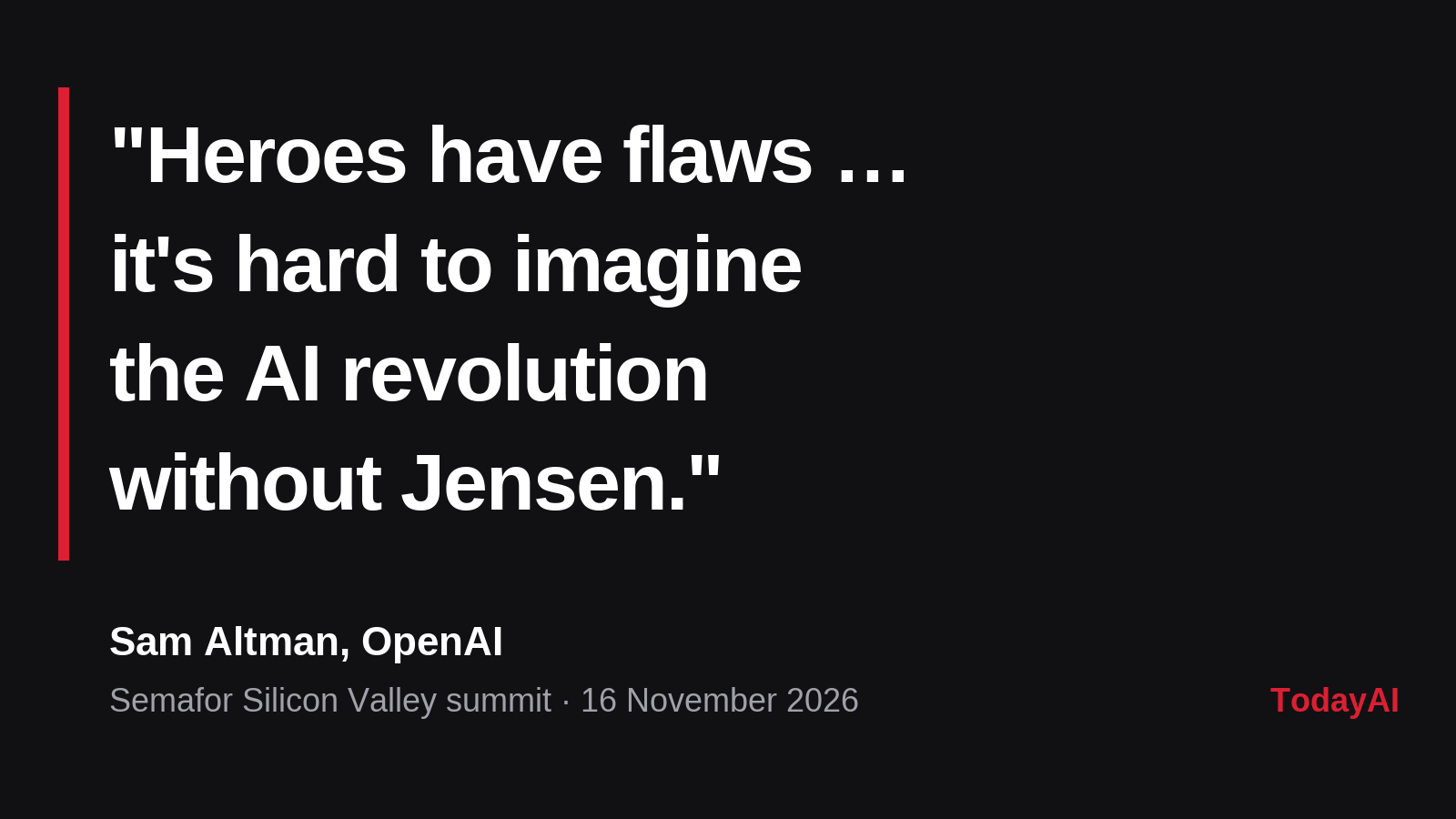
Update, 24 November: Jensen Huang is back. On 22 November Nvidia's board voted unanimously to reinstate him as president, CEO and director, and Nvidia announced it on 23 November. Harvey Jones stays chair, Colette Kress remains CFO, and the board says its investigation will continue. The reversal came five days after Jones told analysts on the 17 November earnings call that the board did not intend to reinstate Huang. Read how the comeback happened and what Nvidia reported in its earnings. The original article, as published on 17 November, follows.
Jensen Huang resigned as Nvidia's CEO on 11 November, and an online campaign wants him reinstated. As of 17 November, sources say the board won't do it, and Nvidia hasn't announced a decision.
A week ago, Huang was the most recognisable person in AI hardware. He had run Nvidia since founding it in 1993. Now he's out, and a loud campaign wants him back.
If you've seen "Jensen is back" posts, they're wrong as of today. Here's what is actually confirmed, what is only reported, and what happens next.
What Nvidia has confirmed
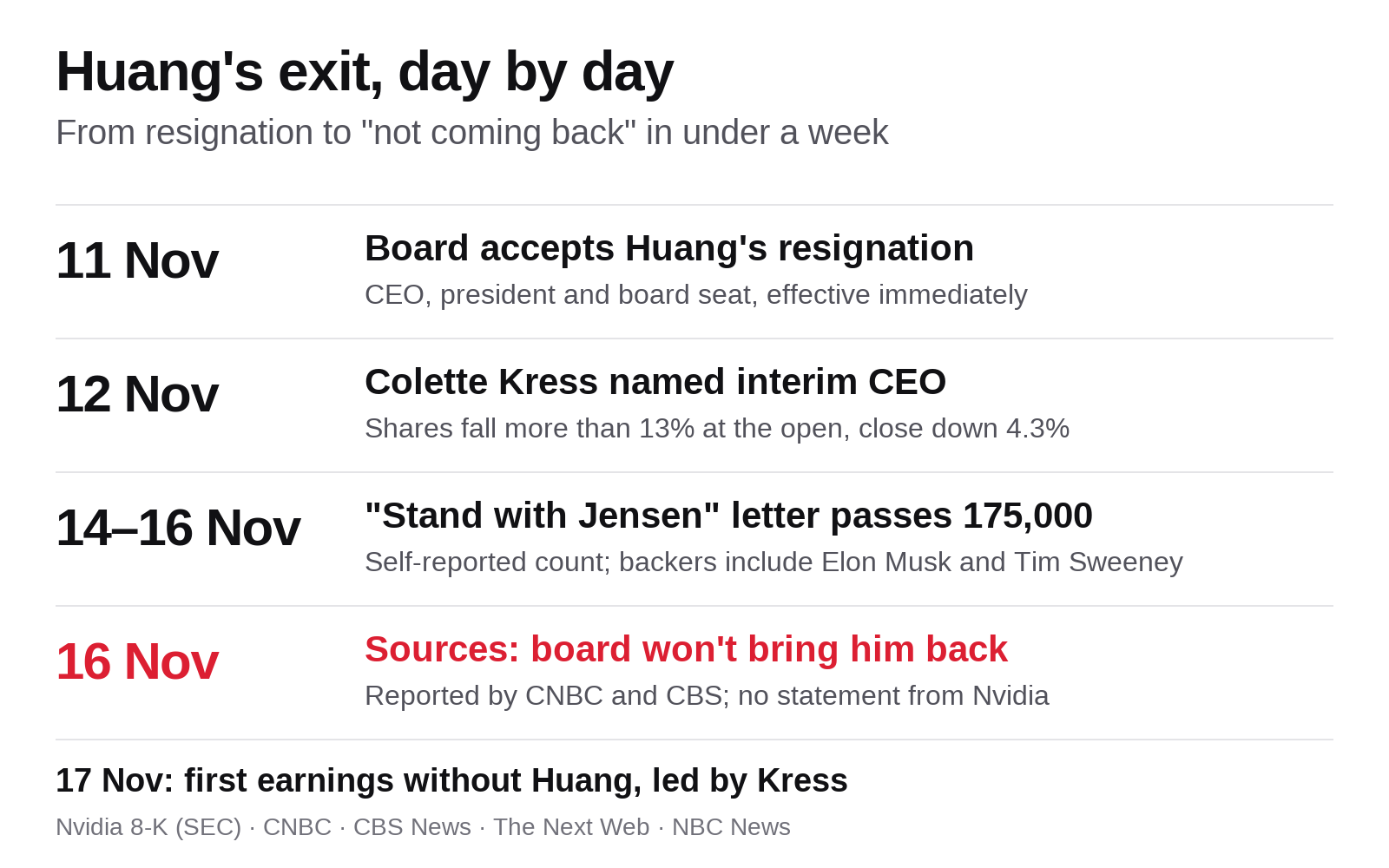
Nvidia's official filing with US regulators, known as an 8-K, says that on 11 November the board "accepted the resignation of Jen-Hsun Huang, as NVIDIA's President, Chief Executive Officer and member of the Board", effective immediately. Jen-Hsun is Huang's given name. The filing gives no reason.
The press release that followed on 12 November thanks him for his "immeasurable contributions". It doesn't offer him an adviser's role or anything similar. An Nvidia spokesperson went further, telling NBC News that Huang "will not be working with Nvidia in any capacity going forward".
The same filing names the new leadership:
- Colette Kress, Nvidia's chief financial officer, is interim CEO and keeps her CFO job.
- Harvey C. Jones, a long-serving director, becomes the company's first-ever board chair.
- The board is searching inside and outside the company for a permanent CEO.
Why he left
Nvidia hasn't said why. News coverage links the exit to reports of extramarital relationships, which the board had hired the law firm Wachtell Lipton to investigate. NBC and CNBC report that the board met on the night of 11 November, after The New York Times published a story about one of those relationships. A source told CNBC the board decided to push him out, even though the company calls it a resignation.
Before he left, Huang sent staff a memo apologising. "I was unfaithful to my wife," he wrote, according to NBC. "There is no excuse for what I did. I am deeply sorry." He hasn't said anything in public since, and his spokesperson declined to comment to the Financial Times.
We're not repeating the details of the reported relationships here. They involve other people, the investigation isn't finished, and none of it has been confirmed by Nvidia.
The campaign to bring him back
Within days, an open letter called "Stand with Jensen" appeared online. It asks the board to reinstate Huang while the investigation runs, explain what the inquiry covers, and give him a hearing. The volunteers behind it don't name themselves and say they have no backing from Nvidia or Huang.
The count has climbed quickly, but the numbers come from the organisers:
- About 108,000 signatures on 14 November, while fake signatures were being removed.
- More than 175,000 by 16 November, including 8,766 people who say they work at Nvidia. Those job claims haven't been checked.
- More than 187,000 by 17 November, by the organisers' own count.
Some big names have signed or spoken up. CBS News and CNBC list Elon Musk, Epic Games boss Tim Sweeney, Y Combinator's Garry Tan and Shopify's Tobias Lütke among them. Investors Brad Gerstner and Gavin Baker wrote separately to urge the board to keep "all options" open. President Trump said on 16 November, "I would not mind seeing that."
The video and social posts we checked also mention protests. We found no reports of physical protests. As far as we can tell, the campaign is online.
The board's answer, so far
On 16 November, CNBC reported, citing people familiar with the matter, that the board "is not considering bringing Jensen Huang back" and remains focused on investigating his conduct. A source told CBS the board isn't interested in reinstating him as CEO or in any other role.
That's the strongest signal yet, but it's still anonymous sourcing. Nvidia hasn't published a statement or filing saying so. Pulling the other way, the Financial Times reported on 15 November that Huang had discussed a comeback with allies. So the honest summary is: he's out, the board reportedly wants to keep it that way, and nothing is formally closed.
On a permanent replacement, the FT says the board approached Arm's chief executive, Rene Haas. Nvidia told CNBC it is still choosing a search firm and hasn't formally approached any candidates.
What it's done to the share price
Investors didn't like it. Nvidia shares closed at $173.73 on 11 November. The next day they fell more than 13% at the open before recovering to close down 4.3%, according to CNBC's live coverage. By 13 November they were at their lowest since July 2025, about a third below October's record high. They fell another 4% or so on 16 November, Yahoo Finance reports, with at least 10 analysts cutting their rating to Hold.
Analysts disagree on how much it matters. Cantor's CJ Muse called it "a major loss for Nvidia and also a major loss for the United States". KeyBanc's John Vinh pointed to a "material increase in strategic, organizational, and execution risk". Wedbush's Dan Ives argued Kress can "steady the ship".
That last point is worth taking seriously. Nvidia's lead comes from its chips and its CUDA software, which developers have built on for nearly two decades, and from orders that are already booked. One person leaving doesn't change that overnight. What it does change is who makes the big bets on the next few chip generations, at a time when AI companies are spending record sums on data centres.
What to watch today
Nvidia reports its third-quarter results on 17 November, with a call for analysts at 2pm Pacific time. It's Kress's first as interim CEO. CNBC says analysts expect revenue of about $109 billion, against Nvidia's own forecast of around $108 billion.
Three things will tell you the most:
- Demand. Do the numbers and the forecast for next quarter hold up? That's about customers, not the CEO.
- Leadership. Does Kress give a timeline for the CEO search, or say anything about Huang?
- Reassurance on plans. Do the roadmaps for upcoming chips and its robotics work, like the GR00T 2 models, stay on schedule?
Since published: Nvidia reported $115.8 billion in revenue, above expectations, and Jones said the board did not intend to reinstate Huang. Our earnings coverage has the details.
Huang still reportedly owns around 812 million shares, which keeps him one of the company's largest individual shareholders. He has also been called to testify before Congress, CNN reported. So this story isn't over. But on 17 November, the answer to "is Jensen back?" was no. Six days later it was yes: the board reinstated him.