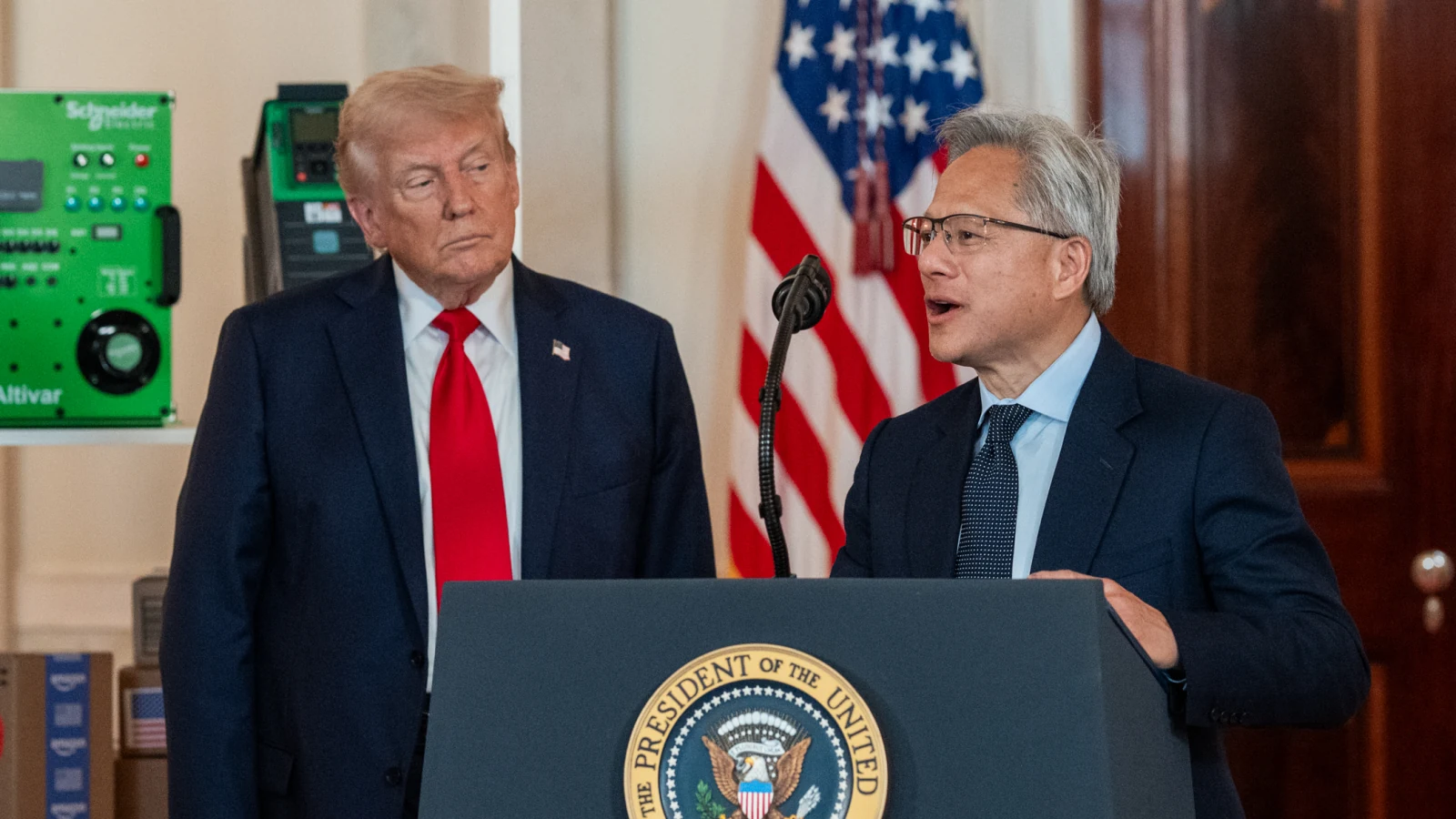
Sam Altman picked an awkward week to sit on a stage. Jensen Huang, Nvidia's co-founder and the man whose chips power almost every big AI model, resigned as chief executive on 11 November after reports about his personal conduct. (We cover whether he could come back separately.) Anthropic, OpenAI's closest rival, is due to price its IPO on 18 November.
So when OpenAI's chief executive spoke at Semafor's Silicon Valley summit on 16 November, hosted by Reed Albergotti, the questions were never going to be easy. Here's what he said, and what it tells us. The quotes below come from the session recording.
On Jensen Huang: "Heroes have flaws"
Altman's first answer was a refusal to judge. Asked about Huang's situation, he said: "I don't think I know enough to answer that question."
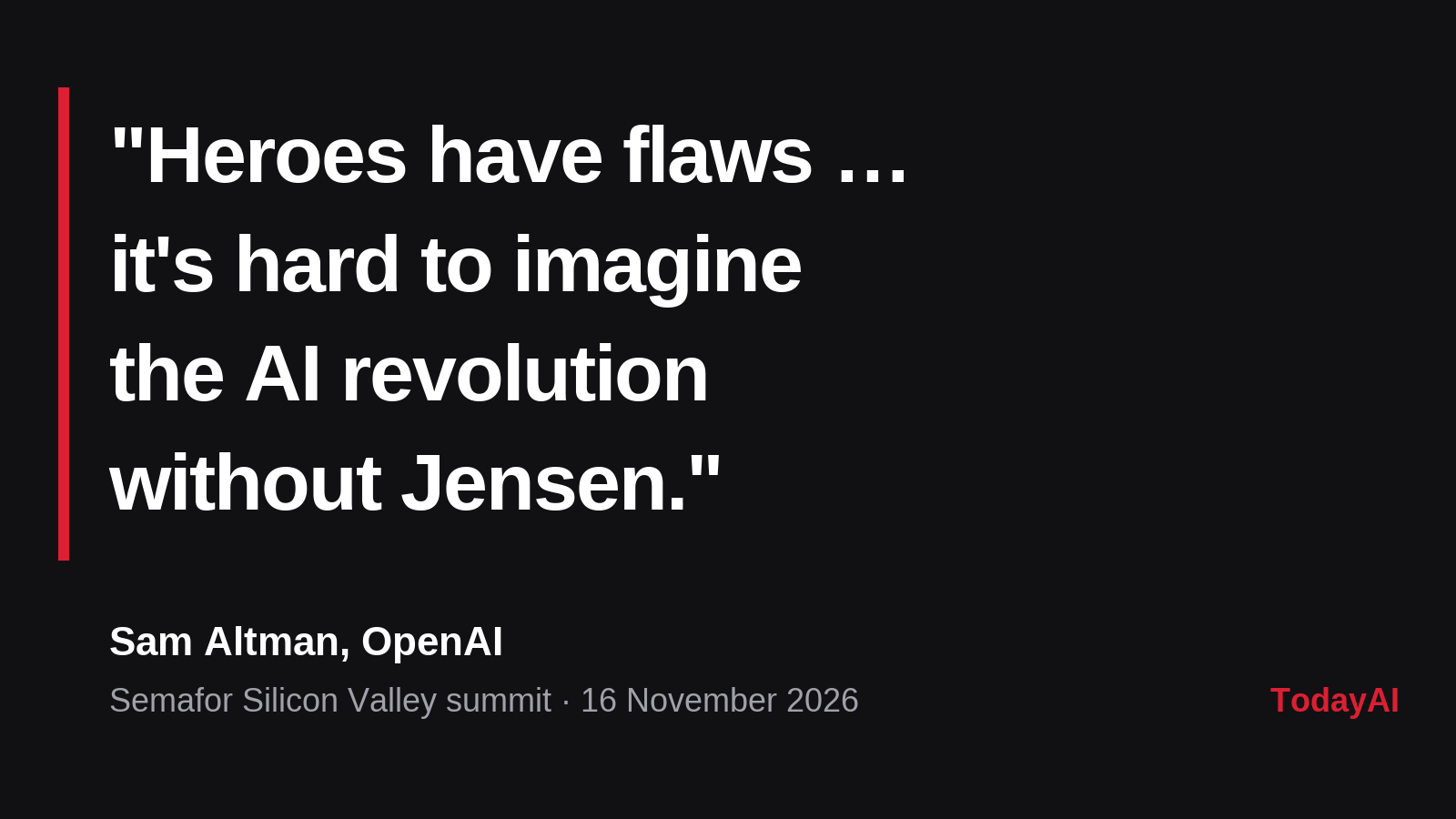
Then he went further than most executives would. "Jensen has long been a hero of mine. Heroes have flaws," he said. He added that he has "personal strong empathy" for a situation like this. Altman was himself briefly pushed out of OpenAI by its board in 2023, and said he remembers what it was like, "although it feels like forever ago".
Mostly, though, he talked about gratitude. Nvidia "took an early bet on us", he said, and OpenAI took one on Nvidia. "It's hard to imagine the AI revolution without Jensen."
Albergotti pressed on money. He said Nvidia had guaranteed around $105 billion for OpenAI's data centre in Ohio, and asked whether that guarantee is worth as much now as it was a couple of weeks ago. Altman said Nvidia is "a behemoth" and that people "still trust their guarantees very much". But he admitted that Nvidia and Huang are "very deeply associated", and that Huang's ambition has been "quite important to the industry".
Would there be a ripple effect? Altman's view was that demand for AI is now strong enough that "the industry will be fine", even if Huang played a special role in pushing it forward.
On going public: "There are real downsides"
Anthropic will become the first of the big AI labs to list. (Our explainer on the ANT ticker covers what its filing shows.) Asked whether he'd avoid an IPO if he could, Altman was candid.
"We will go public at some point," he said. "I think there are real downsides to being public." He pointed to how volatile the industry is, and to the "very high stakes consequential decisions" around safety and how society interacts with AI. Some of those decisions are easier to make as a private company.
The argument for listing, in his view, is fairness. It's not only investors with access to private deals who want a piece of AI. "The world as a whole would like exposure to this," he said, and that's "directionally a good thing".
Would Anthropic soak up the investor demand and leave OpenAI as the Lyft to its Uber? "That is not a worry," Altman said, to laughter. He said the past year has had "way too much investor demand and not enough supply". He also pushed back on the framing: journalists are sceptical, he said, but investors "seem to be pretty bullish".
On chips: the "double counting" problem
The most useful part of the interview was Altman explaining a comment he'd reportedly made privately to Samsung executives: that there has been "double counting" in the chip industry.
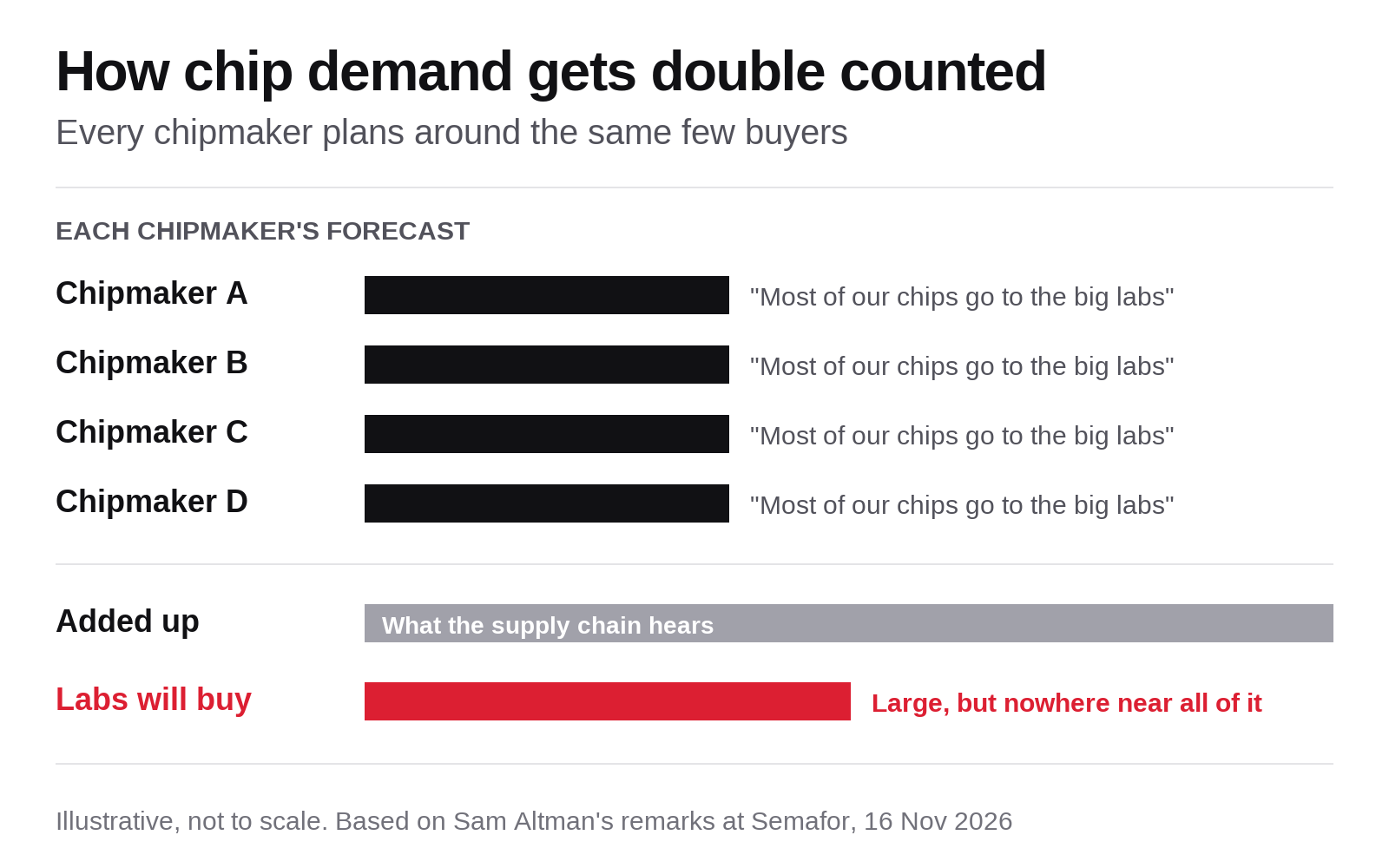
His explanation goes like this. For a long time there was basically one big supplier of AI chips. When the factories that make silicon wafers wanted to plan, they could ask labs like OpenAI how much they'd need, and get a fair sense of real demand.
Now many companies make AI chips. And, Altman said, many of them assume they'll sell most of their volume to OpenAI, Anthropic and a few others. Each of those chipmakers goes to the shared supply chain with its own optimistic forecast. Add them up and you get far more "demand" than the labs could ever buy.
"We're not all going to be able to or need to buy … all of our supply from every chip vendor," he said.
Albergotti asked the obvious follow-up: does that mean things are overpriced? Altman didn't say yes. He said there will be "ups and downs", periods of overbuilding and underbuilding, but the long-term demand for computing is clear. What's hard is matching supply and demand "quarter to quarter and year to year".
He also described how messy the supply chain is. At different times OpenAI has been held back by memory, by rack assembly, by data centre space, and sometimes by "some random component". His example: being unable to sell more services because the world has run out of "PCB laminate", a material used in circuit boards.
Why it matters: If one buyer's demand is being counted several times over, some chipmakers may build capacity nobody uses. That's the kind of thing that turns into write-downs later. It's also a notable thing for one of the biggest buyers to say out loud.
On the backlash: "a terrible sales pitch"
The last section of the interview turned to politics. Albergotti said nearly all of the local referendums on data centres in the latest US elections had gone against them, and that voters on both sides are increasingly hostile to AI. How did the industry tell its story so badly?
Altman's answer was the most striking of the session. If the pitch is a cure for cancer and cheap goods, and the price is that "you are going to lose all agency and control and voice in the future", then people will reject it.
"You are going to live like a Labrador," he said, describing that vision. "Maybe the machines will try to make you happy." He called it "a terrible sales pitch" and said: "I don't want that world. And I don't think most people want that world."
He also offered a theory of why data centres in particular get the anger. They are "a big physical instantiation" of a much broader worry. Underneath, he said, there's an immediate fear about jobs, which people "feel very deeply", and a longer-term question about what people's role in society will be and how power gets balanced. (In separate reporting on the event, he's also quoted as accepting that building data centres close to where people live no longer works.)
The recording we have cuts off as he gets into that balance of power, so we don't know how he answers it.
What to take from it
Three things stand out.
- Nvidia's grip is a person, not just a product. Altman, a major customer, said plainly that Huang and Nvidia are hard to separate. Whoever runs Nvidia next inherits that.
- The chip boom may be less solid than it looks from the factory floor. Demand from the labs is real, Altman insists, but forecasts built on the same few buyers can overlap.
- AI leaders are starting to admit the story went wrong. Agreeing that "live like a Labrador" is a bad offer is a start. Whether companies change what they build, not just how they talk about it, is the real test.
Keep in mind who's talking. Altman runs a company that needs a steady flow of chips, money and public trust, so his reassurances are also part of his job. For the money side of OpenAI, see our look at its quarterly losses. This isn't investment advice.