Every chatbot reply runs on a building full of chips, and someone has to pay for the building. This is the zoomed-out version of our "AI money" pair, OpenAI's reported losses and Anthropic's IPO filing. It asks whether the whole industry can afford its own buildout.
The spending, company by company
Capex (capital expenditure) means money spent on long-lasting things, like data centres and chips, instead of day-to-day running costs. A hyperscaler is a giant cloud company that rents out computing, such as Amazon, Microsoft and Google. Their latest plans, from October results:
- Amazon: "approximately $220 billion" of cash capex in 2026, per its 29 October release. Its trailing-12-month free cash flow, the cash left after spending, fell to an outflow of $42.4 billion.
- Alphabet (Google): $195 billion to $205 billion for 2026, and it signalled 2027 will top $300 billion, per coverage of its 28 October results. We couldn't open Alphabet's own filing, so treat this as secondhand.
- Microsoft: CFO Amy Hood said spend for calendar 2026 should be "approximately $170 billion", including finance leases, after delays to third-party capacity. The quarter to September was $45.2 billion.
- Meta: $135 billion to $145 billion for 2026, narrowed on 21 October. Its Q3 spend was $34.91 billion.
- Oracle: $90 billion to $95 billion for its fiscal year to May 2027, with remaining performance obligations (signed but not yet delivered contracts) of $664 billion, reported by a MarketBeat call summary.
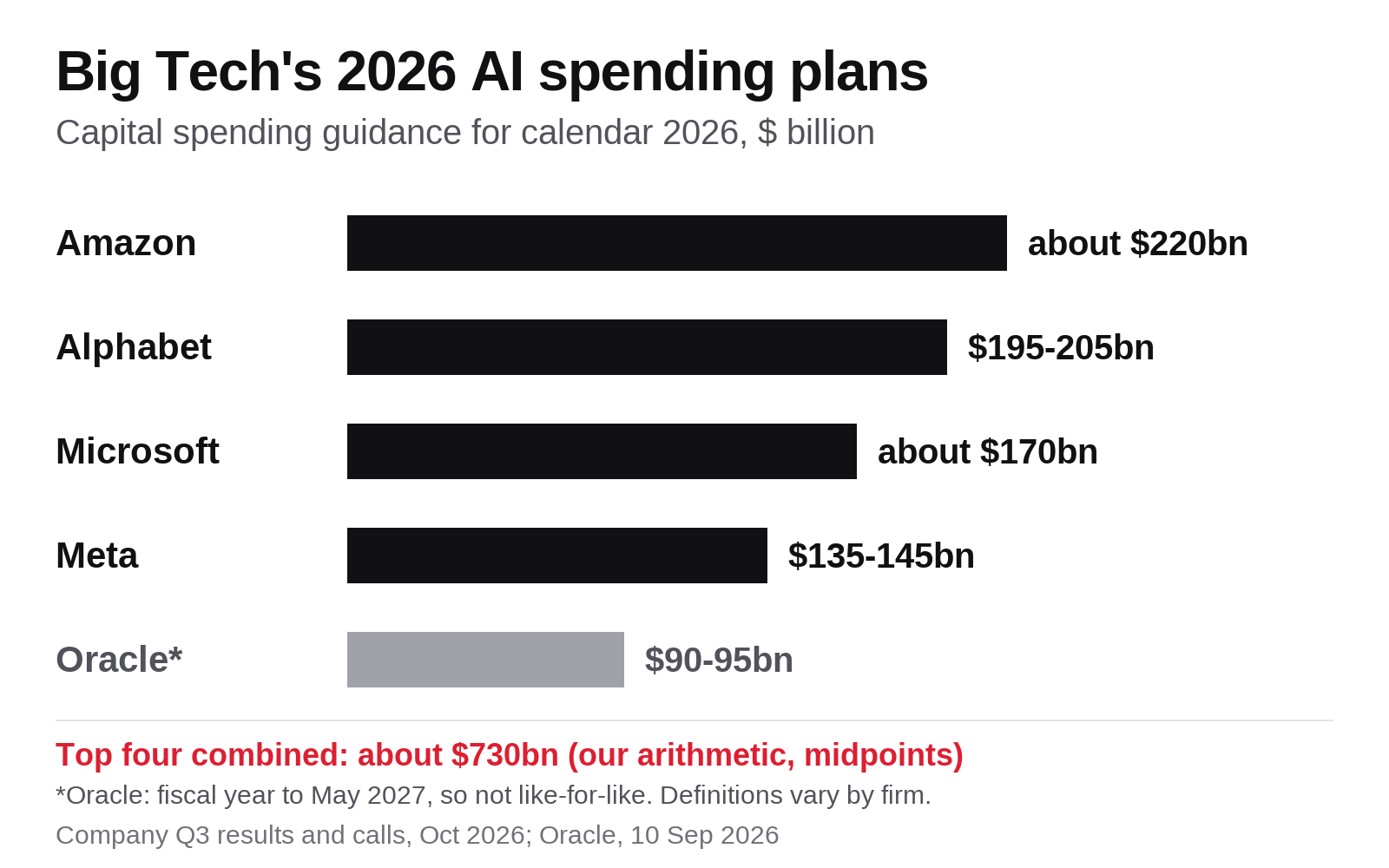
Definitions differ a little, for example Meta and Microsoft count finance leases. Our arithmetic: the midpoints of the first four add up to about $730 billion. FactSet analysts expect the four to reach about $1 trillion in 2027, per CNBC.
Then there are mega-projects. Epoch AI's April review found only one of seven US Stargate sites, the OpenAI-backed project, operating, with the group projected to exceed 9 gigawatts by 2029. A gigawatt is a billion watts, about the output of one large power station.
Why chips are the biggest line
NVIDIA, the dominant AI chip maker, reported data-centre revenue of $89.0 billion for the quarter to 26 July 2026, up 117% on a year earlier. That is about 92% of its $96.2 billion total (our arithmetic). Its next results are still to come.
Chips also wear out in a business sense. Hood said roughly three quarters of Microsoft's latest capex was for "short lived assets, primarily CPUs and GPUs".
Depreciation is spreading an asset's cost over its useful life. The fight is over how long AI chips really last. Investor Michael Burry argued in 2025 that firms overstate it, and put the understatement at about $176 billion from 2026 to 2028, as Yahoo Finance reported. Defenders cite old A100 chips still being rented and CoreWeave renewing a three-year-old H100 contract within 5% of the earlier price. The Yahoo author thinks five to six years is reasonable and discloses holding NVIDIA stock. Neither camp has settled it.
The electricity bill
The IEA says data centres used about 415 terawatt-hours in 2024, 1.5% of world electricity, and are set to reach around 945 by 2030. A terawatt-hour is a billion kilowatt-hours. In the US they account for nearly half of demand growth to 2030.
The US Department of Energy, drawing on Berkeley Lab, put the US share at 4.4% in 2023, rising to 6.7% to 12% by 2028. That range is wide because the future is uncertain.
You can already see it on bills. In July, PJM, a major US grid operator, held its capacity auction for 2028-29. It cleared at the cap of $325 per megawatt-day, about 6.8 gigawatts short of reliability needs. Its market monitor attributes about $6.3 billion of $16.4 billion in charges to data-centre demand, per Fortune.
On supply, Meta signed nuclear deals worth up to 6.6 gigawatts by 2035, per AP. Some of that is existing plants. Other reactors aren't built yet. We didn't verify specific gas-plant deals, so we leave them out.
Cheaper tokens, more tokens
Inference is running a trained model to answer a request, billed in tokens, small chunks of text. Per-token prices are falling fast. Epoch AI found that reaching a fixed performance level fell in price by 9 to 900 times a year, depending on the test (March 2025, and it warned the pace might not last).
Our own data (OpenRouter prices, 14 November) shows the spread: GPT-6 Astra is $20 per million tokens, GPT-6.1 Terra $2, and open-weight DeepSeek V4.1 Flash under $0.10.
But usage is rising faster. Google says it processed over 3.2 quadrillion tokens a month in May 2026, 7x on a year earlier. That is self-reported. Critics note reasoning models and agents use far more tokens per task, so token counts overstate real growth.
Who pays, and is it circular?
Not all of this comes from cash. Moody's, reported by Fortune, counted $969 billion of commitments across the five hyperscalers, $662 billion of it for leases not yet started. A July report says Meta's El Paso data-centre bond deal drew yields "north of 7%", above the terms for its earlier Hyperion project. Oracle also completed a $20 billion share sale in its latest quarter.
Private credit means loans from investment funds instead of banks. The same report cites Morgan Stanley's estimate that tech could need up to $800 billion of it by 2028. Fortune also notes some bonds run to 2049, while the chips inside last perhaps three to five years.
Then circular deals: suppliers funding customers who buy from them. In November 2025, Microsoft and NVIDIA committed up to $5 billion and $10 billion to Anthropic, which committed to buy $30 billion of Azure compute. CNBC reports NVIDIA has committed over $40 billion to equity bets in 2026. Mizuho's Jordan Klein said of some of them: "It smells like you are pre-funding the purchase of your own GPUs." Others see a way to build an ecosystem.
The case against, and the case for
The gap. Sequoia's David Cahn argued in 2024 that AI needed about $600 billion in yearly revenue to justify the chip spending, though he thought the technology valuable. Bain estimated in 2025 $2 trillion a year was needed by 2030, leaving an $800 billion shortfall. Its September 2026 update says $6 trillion would be needed by 2031, with today's applications perhaps $1.2 to $1.8 trillion. These are models built on assumptions.
The case for. Revenue is growing at pace: see Anthropic's $33.2 billion over nine months and OpenAI's roughly $10 billion quarter in our pair. Amazon projects AWS growth above 40% in both 2027 and 2028. Bulls also cite cloud computing, which needed huge up-front building before it paid. That is an analogy, not proof.
What it means for you
If you use free or cheap AI, assume the price is subsidised. Expect ads, tighter limits or price changes. For students and workers, the tools you learn on may change, so favour skills over one product.
If you pay an electricity bill in a data-centre region, regulators decide who carries these costs, so follow local decisions.
This isn't investment advice. All guidance is subject to change.