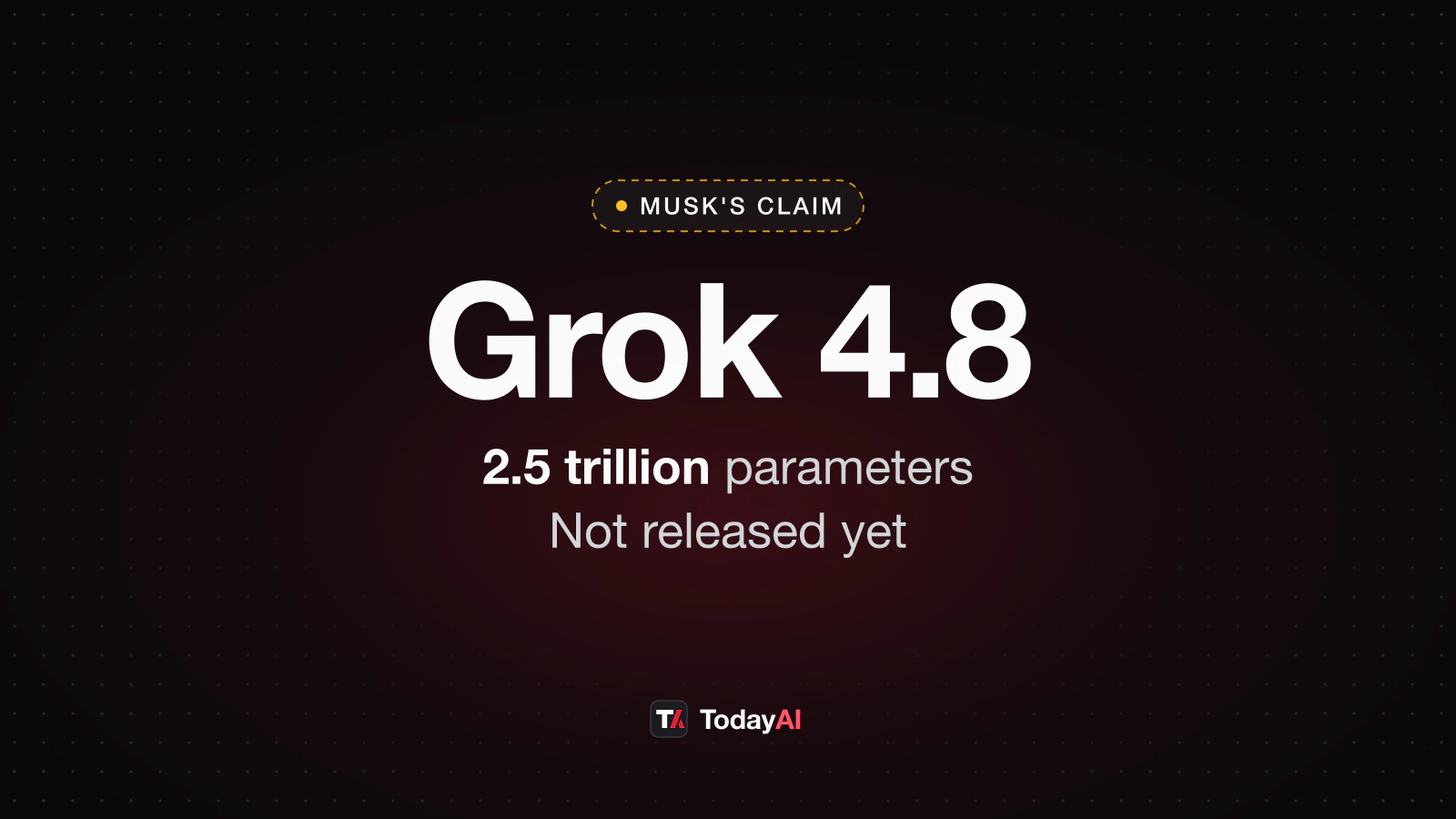
Grok 4.8 has no official release date yet. On 17 November, Elon Musk said xAI had done "a soft rollout to some Bot users", with "another week or two of polish before general release". That points to late November or early December, if the estimate holds.
Musk says Grok 4.8 is a 2.5 trillion parameter model. He has also admitted it is "not as good" as Anthropic's Claude Opus 5.5. xAI itself has published nothing: no model card, no price and no test scores.
Grok 4.8 at a glance
| Question | Answer, as of 25 November |
|---|---|
| Is it out? | Not for everyone. Musk says some Grok Bot users have it in a soft rollout |
| Release date | Not announced. On 17 November Musk said "another week or two" |
| How big is it? | 2.5 trillion parameters, according to Musk. xAI hasn't published a figure |
| Is it better than Claude Opus 5.5? | No, by Musk's own account: "Not as good" |
| Price | Not announced |
| Test scores | None published |
When is Grok 4.8 coming out?
There's no official date. Musk has given a running commentary on X instead. Here is how it has moved.
| Date | What Musk said | Source |
|---|---|---|
| About 14 September | It is "a 2.5T model trained with our new C++ software stack". Main training would finish that week, then reinforcement learning | Press accounts of his posts |
| 10 November | Main training "is done", "4.8 is in RL and the evals are starting to climb", and "We will do a soft rollout to Bot users later this week" | X post |
| 17 November | "Grok 4.8 has not rolled out for general use yet, just some trials behind the scenes" | X post |
| 17 November, about 30 minutes later | "We did do a soft rollout to some Bot users, but still have another week or two of polish before general release" | X post |
The 17 November posts went out in the evening UK time. Penchan, which covered them, dates them 18 November, Taiwan time.
"A week or two" from 17 November means somewhere between 24 November and 1 December. As of 25 November, xAI's API release notes don't list Grok 4.8, and xAI hasn't published an announcement. Musk didn't say who is in the soft rollout, how many people have it, or whether the API is included. Grok Bot is an xAI product that launched in August.
Treat "a week or two" as an estimate, not a promise. The 10 November post said the rollout would come "later this week". Musk didn't confirm it had happened until 17 November, a week later.
How many parameters does Grok 4.8 have?
2.5 trillion, according to Musk. Press accounts quote him calling it "a 2.5T model trained with our new C++ software stack", in posts from around 14 September. We couldn't open that original post, and one outlet dates it to 13 September. xAI hasn't published the figure, so it rests on Musk's word alone.
Parameters are the adjustable numbers inside a model, the dials set during training. Think of them as the model's brain cells. 2.5 trillion of them is a very big model. Bigger models can hold more knowledge, but they cost more to train and run.
Size alone doesn't predict quality. A well-trained smaller model can beat a badly trained bigger one, and that has happened many times across the industry.
The other half of the claim is the software. A software stack is the layers of code that drive training: the programs that spread the work over thousands of chips and keep them busy. Analytics India Magazine reports that Musk called the training software "an internally developed stack in C and C++", written by Starlink's software team and "not written by AI". C and C++ are fast, low-level programming languages. Rewriting in them is a bet that you'll waste less of your expensive hardware.
On 10 November Musk went further. He said xAI had "dumped JAX/SGLang", two widely used open-source tools, and "rewritten the entire RL and inference stack from scratch in C/C++, which took some extra time". Inference is the part that runs the model when you use it.

Is Grok 4.8 better than Grok 4.7?
Musk thinks so, but there are no numbers yet. On 10 November he wrote that "Grok 4.8 will bear no resemblance to 4.7 (thankfully). It is not yet incredible, but, this time, the foundations are built right, so I expect it to evolve to be something special."
Here is what's on the record for each.
| Grok 4.7 | Grok 4.8 | |
|---|---|---|
| Released | 21 September 2026 | Not yet. Soft rollout to some Grok Bot users, per Musk |
| Parameters | Not published. xAI calls it "a new, larger base model" than Grok 4.6 | 2.5 trillion, per Musk. Not published by xAI |
| Context window (how much text it can take in at once) | 500,000 tokens | Not published |
| API price per million tokens (input / output) | $2 / $6 for prompts under 200,000 tokens, $4 / $12 above | Not published |
| Published test scores | Yes, including 71.0% on DeepSWE v1.1 and 37.6% on Terminal-Bench 4.0 | None |
| Official announcement | xAI news post | None |
Sources: xAI's Grok 4.7 announcement and API release notes; Musk's posts for Grok 4.8.
Grok 4.7's scores are xAI's own. Grok 4.8 has no scores of any kind, from xAI or anyone else.
How does Grok 4.8 compare with Claude Opus 5.5?
Worse, says Musk. On 10 November an X user asked him "how will grok 4.8 compare to opus 5.5?" He replied: "Not as good. Opus 5.5 is a masterpiece."
In the same reply he said "Grok 5 should exceed Opus 5.5 and maybe that happens in 2 or 3 months". ForkLog reported the exchange on 11 November. Musk gave no scores for either claim.
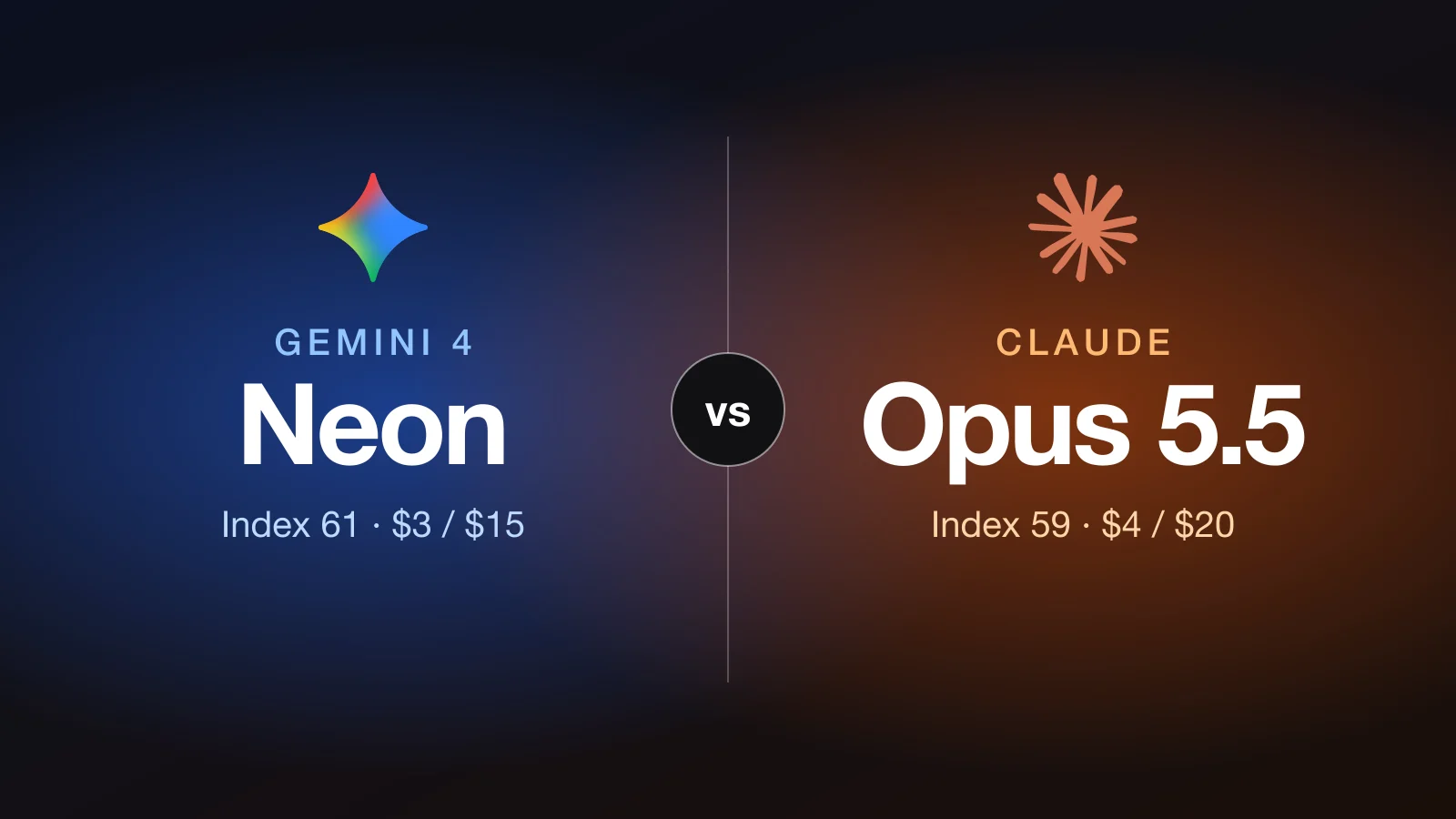
It's unusual for a company boss to say his next model trails a rival's. It also means nobody should expect Grok 4.8 to top the leaderboards. For where Opus 5.5 sits, see how it compares with Gemini 4 Neon.
How much will Grok 4.8 cost?
xAI hasn't announced a price. For reference, Grok 4.7 costs $2 per million input tokens and $6 per million output tokens on xAI's API, for prompts under 200,000 tokens. Tokens are the chunks of text AI is billed in. A bigger model usually costs more to run, but we won't guess at a figure until xAI publishes one.
What's confirmed and what isn't
| Claim | Status, as of 25 November |
|---|---|
| Grok 4.8 exists and is being tested | Musk says so. No xAI announcement |
| 2.5 trillion parameters | Musk's claim. No model card |
| New C and C++ training and inference software | Musk's claim |
| Main training finished, now in reinforcement learning | Musk's claim, 10 November |
| Soft rollout to some Grok Bot users | Musk's claim, 17 November. Not independently confirmed |
| General release date | Not known. Musk says "a week or two" from 17 November |
| Price | Not known |
| Test scores | Not known |
| Weaker than Claude Opus 5.5 | Musk's own view, with no numbers |
Our read
The C++ story is more interesting than the size. If it really lets xAI get more useful work out of its hardware, that's a genuine advantage. But it's a claim about efficiency, and efficiency only matters if the finished model is better.
Musk has now told us two useful things. Grok 4.8 is close to general release, and it won't beat Claude Opus 5.5. That's a more honest pitch than "2.5 trillion" suggests on its own.
If you use Grok for work, nothing changes today. Stay on Grok 4.7 and don't build plans around 4.8 until there's a price and a score from someone other than xAI.
If you're following the race, treat "2.5 trillion" as a headline, not a result. The thing to watch for is an independent score, from Epoch AI or a public leaderboard. For scale, the top of Epoch AI's capability index is Claude Fable 5.2 on 173 (see our write-up). When Grok 4.8 gets a score, you'll be able to compare it on our /compare page, or see how five other recent launches landed.