DeepSWE was, for a few months, the coding benchmark a lot of developers trusted most. It came from Datacurve, a startup that sells coding data to AI labs, and its rankings seemed to match how the models actually felt to use.
Now its official leaderboard looks abandoned. The last model it added was GPT-6 Astra, on 3 September 2026. That's 84 days ago. Since then, Anthropic, OpenAI and Google have all released new top models, and none of them is on the board. DeepSWE changelog
Datacurve hasn't said the project is over. It also hasn't said anything on the site about a pause. Here's what we know.
DeepSWE at a glance
| Question | Answer, as of 26 November |
|---|---|
| Who makes it | Datacurve, a coding-data startup founded by Serena Ge and Charley Lee |
| Launched | May 2026 (v1.1 on 15 June) |
| What it tests | 113 original coding tasks across 91 repositories and five languages |
| Last model added | GPT-6 Astra, 3 September 2026 |
| Top score on the board | 74% when rounded: GPT-6 Astra 74.1%, Gemini 3.8 Flash 73.8%, Claude Opus 5 73.6% |
| Independent review | Epoch AI: "Flawed", grading errors in at least 23 of 113 tasks |
| Official status | No shutdown or pause notice on the site |
| Code repository | Last commit 26 August 2026 |
TechCrunch · DeepSWE leaderboard · Epoch AI · GitHub
Why developers liked DeepSWE so much
Most coding benchmarks, like SWE-bench, are built from old bug fixes copied from public GitHub projects. That causes two problems. The models may have already seen those fixes during training. And the tests that check the answer were written for the original fix, not for any correct fix.
DeepSWE tried to fix both. Its tasks were written from scratch, so no model could have memorised them. The reference solutions are much bigger: Datacurve says they average 668 lines across 7 files, against about 120 lines for SWE-Bench Pro. And each task had its own hand-written checker. VentureBeat · Datacurve
It also launched with a story. Datacurve said that on SWE-Bench Pro, Claude Opus 4.7 and Opus 4.6 had been running commands like git log to find the real fix hidden in the project's history. In the runs it reviewed, that explained about 18% of Opus 4.7's passes and 25% of Opus 4.6's. DeepSWE ships only the starting code, so there's nothing to look up. VentureBeat
The first version's results spread the models out instead of bunching them together. GPT-5.5 scored 70%, 14 points ahead of GPT-5.4 at 56%. Claude Opus 4.7 got 54%, Sonnet 4.6 got 32%, and Claude Haiku 4.5 scored 0%, despite 39% on SWE-Bench Pro. VentureBeat
AI X loved it. "DEEPSWE is the gold benchmark standard now," one user posted. When Opus 4.8 arrived, Lisan al Gaib wrote that it "gets score-, time- and token-mogged by GPT-5.5 on DeepSWE." Vaibhav Srivastav pointed out GPT-5.5 got there "~2x faster" and at "~1/2 the cost."
What kept people coming back was that the order felt right. On Hacker News, one developer said it had "generally matched my impressions of models for general SWE." Another said: "I have yet to find a better gauge of useful work for my case." Hacker News
The website helped too. It let you compare each model at every effort level, with cost per task, which few other leaderboards do. "They nailed the UI," one GitHub user wrote. "All the others are confusing as heck." GitHub
The 74% wall
Over the summer, the top of the board stopped spreading out. By September, the top three models were all at 74% once rounded: GPT-6 Astra (74.1%), Gemini 3.8 Flash (73.8%) and Claude Opus 5 (73.6%). DeepSWE leaderboard
Many lab-reported scores then landed in the same place. Anthropic's Opus 5.5 system card gave 74.2%. DeepSeek reported 74.2% for V4.1 Flash. "Once again, 74% same number every single time. I strongly suspect it's the ceiling," one GitHub user wrote in September. GitHub · DeepSWE 1.1 tracker
The same Hacker News developer who praised it noticed the timing: it matched their experience "at least until we had Opus 5. Which coincidentally is when they hit 74%." Hacker News
A ceiling like that usually means one of two things. Either some tasks can't be passed even with a correct answer, or the models have learned the test. As it turned out, there was evidence for both.
The Epoch AI review
On 17 September, Epoch AI, a well-known AI research group, launched a project to audit popular benchmarks. Its review of DeepSWE v1.1, dated 7 September, found problems in at least 23 of the 113 tasks, just over 20%. That crossed Epoch's line for calling a benchmark "Flawed". Epoch AI
Every problem Epoch logged was a false negative: the checker failing a model that had done the work correctly. In 18 of the 23 cases, the model had edited the project's existing tests, which then clashed with DeepSWE's hidden tests and broke the grading. Epoch said this error "could affect any task." It also said its review was partial: it stopped looking once it passed the 20% mark. Epoch AI
That matters for the 74% wall. A model only trips this bug on some runs, but if around a fifth of the tasks can mark right answers as wrong, it would help explain why scores stall in the mid-70s.
Datacurve didn't respond on Epoch's page. Its founders responded on X instead:
- Co-founder Charley Lee, 18 September: "We think it's great that lots of people are reviewing and scrutinizing DeepSWE. It being our first benchmark, we wanted to invite public collaboration and discourse, which is why we shared all our tasks and grading results in the open."
- CEO Serena Ge, 20 September: "As an iterative process, we've been cooking behind the scenes on existing issues and new innovations to keep pushing the frontier of measurement."
Screenshot of both posts, shared on GitHub
That's the closest thing to an official statement. It came about two weeks after the last leaderboard update, and we couldn't find any later update from the team.
Other audits piled on. MaxxBench, launched in October, took 89 DeepSWE tasks and changed the requirements. Claude Opus 5.5 held up, scoring 76.4% against its 74.2% DeepSWE score. Others dropped hard: Gemini 3.8 Flash fell from 73.8% to 53.4%, and DeepSeek V4.1 Flash from 74.2% to 55.6%. MaxxBench's makers point out that once a benchmark's tasks are public, developers can tune models against them. Big drops like these suggest some models are better at DeepSWE's tasks than at the skill behind them. MaxxBench · Hacker News
The silence
The leaderboard says "updated September 22, 2026", but the changelog lists nothing after GPT-6 Astra on 3 September, and no newer model appears anywhere in the page's data. The page still promises that "new frontier models are added to the DeepSWE leaderboard as they're released." DeepSWE leaderboard · DeepSWE 1.1 tracker
This is what the board looks like today, frozen in its early-September state:
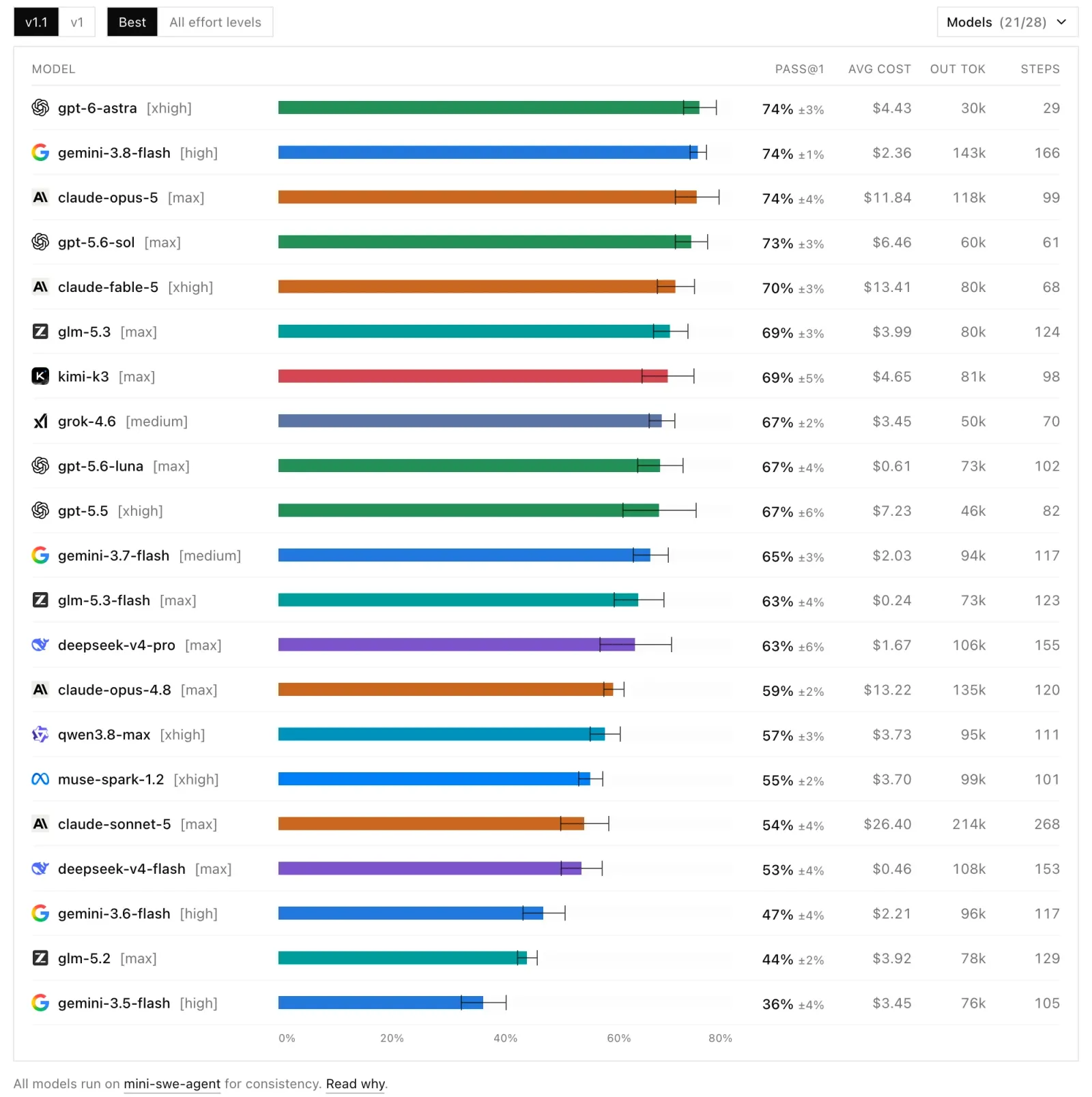
The DeepSWE v1.1 rankings as they stand today. Screenshot: DeepSWE leaderboard, Datacurve, taken 26 November 2026.
The page's cost chart tells the same story. The header still reads "updated September 22, 2026", and the newest dot on it is GPT-6 Astra:
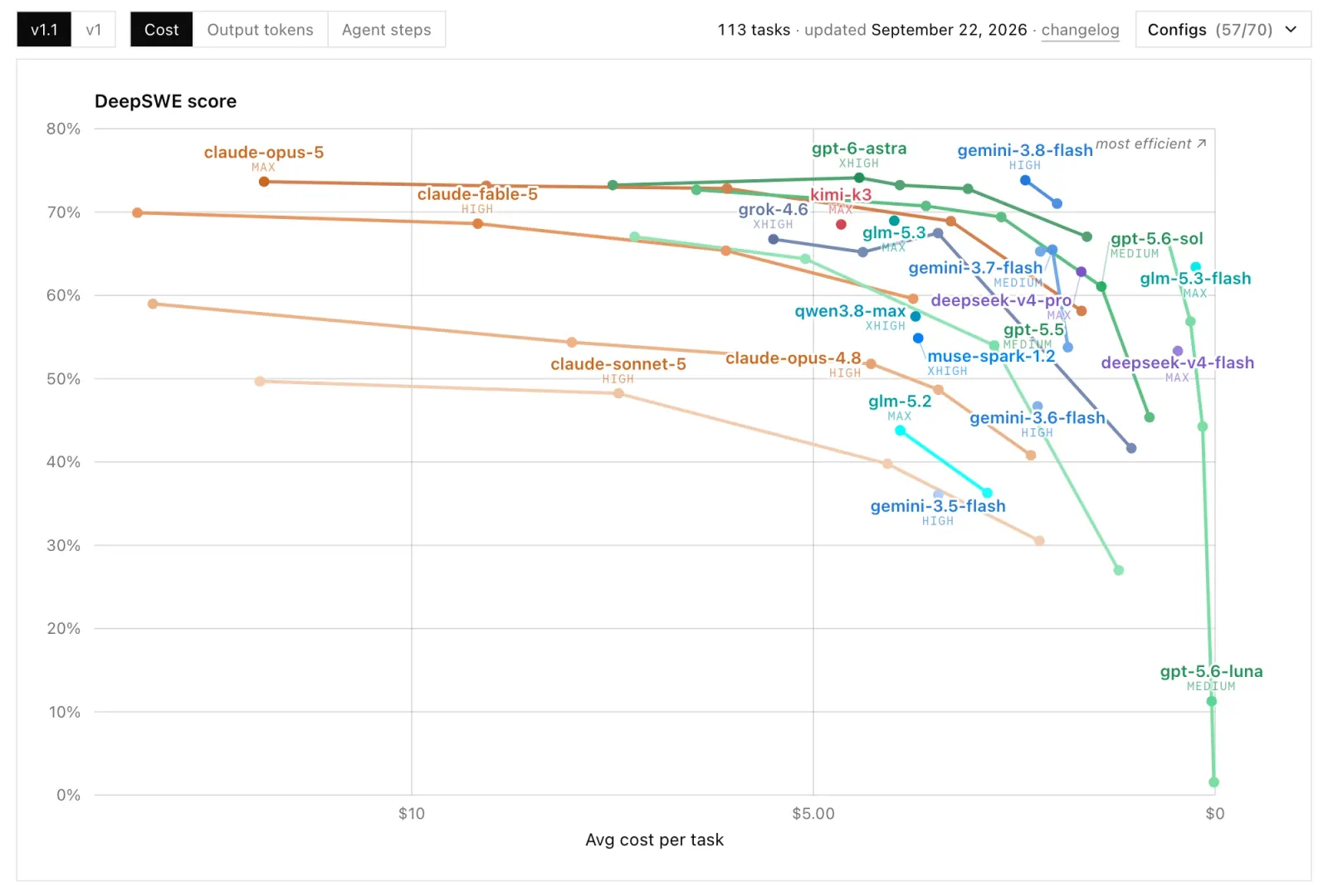
Score against average cost per task, by model and effort level. Screenshot: DeepSWE leaderboard, Datacurve, taken 26 November 2026.
The code repository has been quiet even longer. Its last commit was on 26 August. GitHub
Models missing from the official board include:
- Claude Opus 5.5 and Sonnet 5.5
- Claude Fable 5.1 and 5.2
- GPT-6 Sol, GPT-6.1 Sol and GPT-6.2 Astra
- Gemini 4 Argon, Carbon and Neon
- Grok 4.7, Kimi K3.1 Pro and Qwen 4 Max
Users noticed. A GitHub issue titled "Is this repo dead?" opened on 16 October. "Very sad. This was my goto benchmark," one person replied. Another wrote: "I depended on them to determine which models/effort to use." GitHub
The same question reached Reddit. In October, a post on r/ArtificialInteligence asked simply, "Is DeepSWE dead?", pointing out there were "no results for any of the recent models: Claude 5.5; sol 6.1; Mistral Large 4." Replies were puzzled rather than angry. "That is odd. Maybe they know something we don't?" one user wrote. Another thought it "feels more like the site stopped getting updates than the project just died," but added it "would be weird if they dropped it with no real note." Reddit
The bigger complaint was the lack of any notice. "DeepSWE said it published every task and grading result for open collaboration, but the review and the team's response exist on X," one user wrote. "A one-liner like 'working on the next version, updates paused for now' would've been enough." GitHub
The open questions on those threads haven't had an answer from the Datacurve team.
Labs are still using it anyway
The official board has stopped, but DeepSWE scores haven't. AI labs keep printing DeepSWE 1.1 numbers in their own launch posts. An independent tracker lists self-reported scores for Claude Opus 5.5, GPT-6.1 Sol, Gemini 4 Argon, Grok 4.7 and others. The highest on that list is Gemini 4 Argon's 77.9%. DeepSWE 1.1 tracker
xAI's Grok 4.7 card says its score came from an evaluation Datacurve ran but never posted. So Datacurve has run at least one test for a lab that never made it onto the public board. DeepSWE 1.1 tracker
Be careful with these numbers. Labs pick their own effort settings and setups, so the scores don't line up with the official runs. We used one in our Qwen 4 Max coverage, where Alibaba's own chart put it narrowly ahead on DeepSWE.
Who has moved on
Artificial Analysis, one of the most-watched model rankings, added DeepSWE to its Coding Agent Index in the summer. In late October it replaced DeepSWE with FrontierCode, a benchmark from Cognition, the company behind Devin. Average scores fell from 54.8 to 47.4 after the switch, mainly because the same setups averaged 65.6% on DeepSWE but 45.1% on FrontierCode. Artificial Analysis on X · Artificial Analysis methodology
FrontierCode 2.0 came out on 27 October with 132 tasks written by open-source maintainers. Instead of asking "do the tests pass?", it asks whether a maintainer would actually merge the change. Its leaderboard is still adding models, most recently on 24 November. Claude Fable 5.2 leads at 50.2%, ahead of Opus 5.5 at 47.3%. Cognition
Not everyone is sold. One DeepSWE fan replied on GitHub that they're "not so convinced one can trust that benchmark," because what they valued was DeepSWE's tasks being unseen by the models. GitHub
So, is DeepSWE dead?
As a live leaderboard, yes, for now. It hasn't added a model in 84 days, it misses every top model released since September, and Artificial Analysis has dropped it from its index. If you open it today, you're looking at a snapshot from early September.
As a project, we don't know. Datacurve hasn't shut it down. Its CEO said in September the team was working on "existing issues and new innovations", which reads like a version 2. But there has been no date, no notice on the site, and no reply to users asking.
There's also a fair case that DeepSWE did its job. It flagged a real cheating problem in an older benchmark, it spread the models out when others couldn't, and it showed that a public test eventually gets learned. That last lesson is also why a frozen v1.1 can't come back as it was.
What to use instead
- FrontierCode if you want a hard, current coding leaderboard that's still updating.
- Artificial Analysis's Coding Agent Index if you want one number that blends coding, terminal work and codebase questions.
- Your own tasks. Give two or three models the same real job from your codebase and compare. It's the only test nobody can train on. Our guide to picking the right AI model walks through it.
And if you see a new model's launch post quoting a DeepSWE score, remember it's the lab's own run, on a test where official scores top out around 74% and the grading has known bugs.