Levent Alpöge and Claude produced a proof of the Riemann hypothesis that independent mathematical software has accepted. On 21 November, Lean FRO and the Mathlib Initiative certified that Alpöge had stated and proved the classical conjecture correctly. Andrew Sutherland's verification at MIT, updated on 24 November, also covers the generalized statement for Dirichlet L-functions.
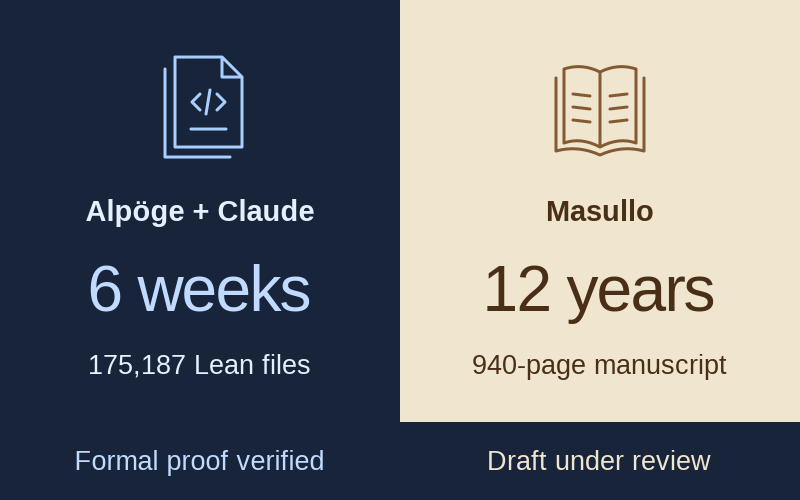
The proof went public on 20 November, the same day a separate manuscript by Stanford's Alessandro Masullo appeared. The two are now at different stages of review.
What did Lean verify in the Claude-assisted proof?
Alpöge is a number theorist at Anthropic. He published a short note describing the collaboration with Claude and released a library of 175,187 Lean files. Lean is a language for writing mathematics in a form a computer can check.
The checks covered two separate questions. First, independent tools compared the statement Alpöge proved with Mathlib's vetted statement of the actual Riemann hypothesis. Second, Lean's own checker and independently written checkers accepted the exported proof. Sutherland's audit found that the five headline theorems rely only on three standard Lean axioms. Lean and Mathlib statement · MIT verification files
For the generalized version, the result covers Dirichlet L-functions, a particular family of functions that includes relatives of the Riemann zeta function. MIT's verification describes exactly which statements were checked. What MIT verified
What happened to Alessandro Masullo's proof?
On 20 November, hours after Alpöge's announcement, Ravi Vakil, the president of the American Mathematical Society, posted something on his blog that had been meant to stay quiet for another year.
It was a 940-page manuscript by Alessandro Masullo, a Stanford postdoc, titled The Music of the Primes. It claims a proof of the generalized Riemann hypothesis, which would also prove the original. Masullo says it is the result of about 12 years of work, with no AI involved at any stage.
The plan had been to polish the work at Stanford before going public. Brian Conrad, a Stanford number theorist, had been checking the argument for months. Vakil's announcement and updates
After posting, Vakil reported that readers had identified problems in the argument. His 22 November update says the manuscript remains under review. Vakil's updates
What is the Riemann hypothesis, in plain English?
Prime numbers, like 2, 3, 5, 7 and 11, are the building blocks of all whole numbers. They look scattered at random: sometimes close together, sometimes with big gaps.
In 1859, Bernhard Riemann found a formula that links where the primes fall to a special function, now called the zeta function. That function has an infinite list of special points, called zeros. Riemann guessed that all the important ones sit on one straight line.
That guess is the Riemann hypothesis. It puts a bound on how far the distribution of primes can stray from its predicted pattern. In the past, computers had confirmed that the first ten trillion zeros lie on the line. The formal proof covers all the nontrivial zeros, including ones no computer could reach by counting. Clay Mathematics Institute
Thousands of published results begin with "assuming the Riemann hypothesis is true…". A proof would turn all of them into settled facts at once. It's also one of the Clay Mathematics Institute's seven Millennium Prize Problems, worth $1 million.
Why this matters for AI
The verification gives mathematicians a way to build on a proof that would take a long time to read line by line. The work now is to explain its key ideas and see where else they apply. Michael Rubinstein at the University of Waterloo has posted a 265-page companion to the classical proof to help readers follow the argument.
Has the $1 million Clay prize been awarded?
The Clay Mathematics Institute still lists the Riemann hypothesis as active. Its rules require a solution to appear in a qualifying outlet, at least two years to pass after that publication, and the international mathematics community to accept it before the institute will consider the prize. Millennium Prize rules
Correction, 25 November: an earlier version of this article said Alpöge's human-readable write-up ran past 250,000 pages, citing a secondary report. Alpöge has since said that figure was a joke.
For more on the company behind Claude, read our explainer on Anthropic's IPO.