Nvidia has had a rough week. Its chief executive, Jensen Huang, resigned on 11 November after reports about his personal conduct. We've covered where his exit stands and what Sam Altman said about it. Now three separate stories about US policy and Nvidia's chips have landed together. Here is each one, and how they connect.
First, the basics: export controls
Export controls are rules that limit what a country's companies can sell abroad. Since 2022 the US has restricted sales of the most advanced AI chips to China, because those chips train and run the most capable AI systems, which have military as well as commercial uses. Nvidia makes most of them.
The rules are only as strong as their enforcement. Chips are small, valuable and easy to resell, so a shipment sent to one country can be rerouted to another.
The probe: Megaspeed
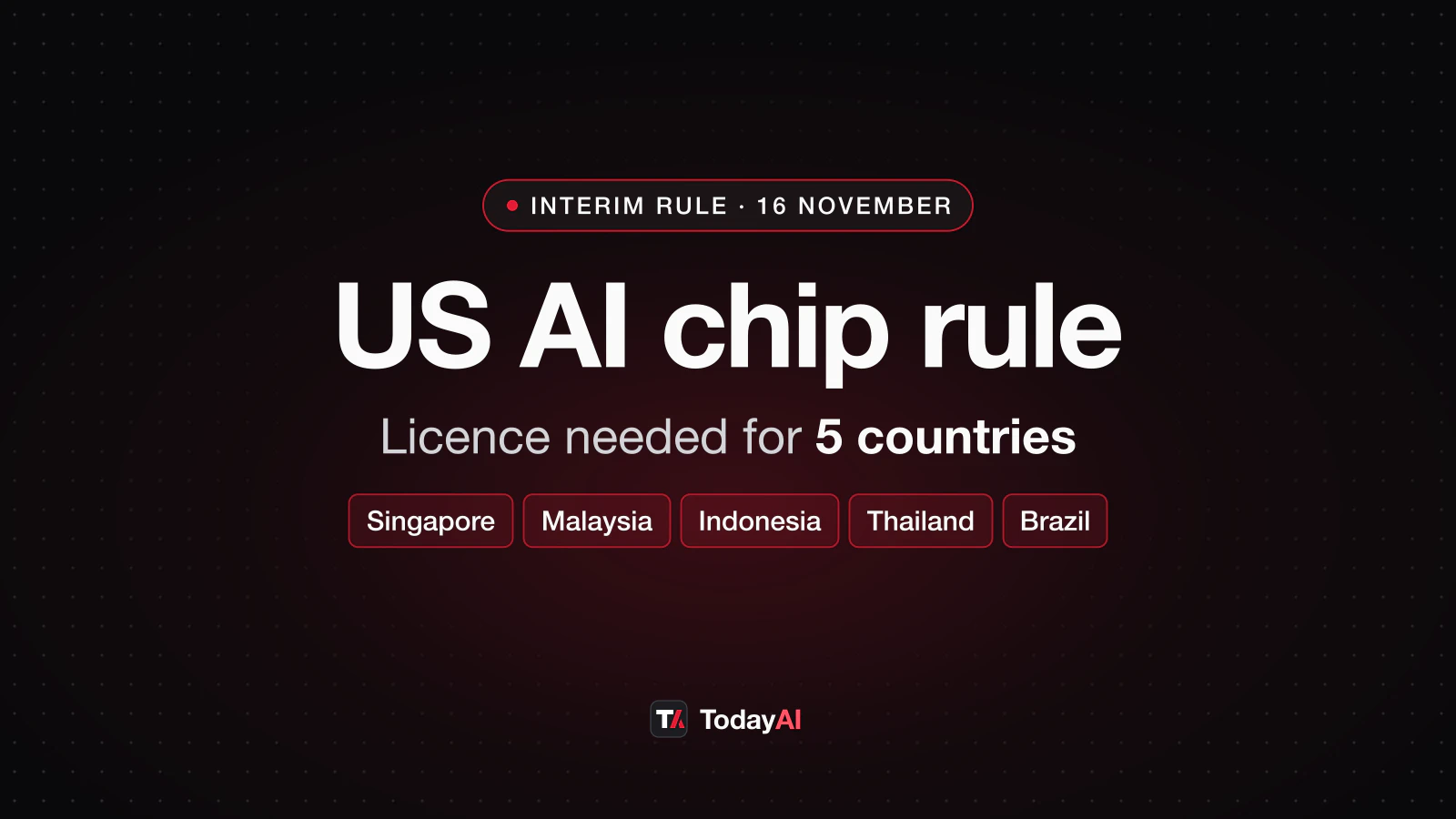
The US Department of Justice and Department of Commerce confirmed in a joint statement on 16 November that they are investigating Megaspeed, a Singapore-based computing company. According to the BBC report carried by Yahoo, Megaspeed is described as the biggest buyer of Nvidia chips in Southeast Asia, and is suspected of helping ship Nvidia AI chips to China in breach of US export controls.
The same report gives this timeline:
- The US began looking at Megaspeed in 2024.
- In May 2025, Commerce investigators asked Nvidia for records of its sales to the firm.
- In June 2025, Nvidia put Megaspeed on a "no sell" list, and Commerce's Bureau of Industry and Security (BIS) carried out an on-site check with Singaporean officials.
- Afterwards, the Justice Department took the lead on the criminal side.
Megaspeed said on 15 November that it had launched an internal investigation. The two departments said they would use the law against any criminal conduct. We could not confirm which exact chip models were involved, and the reporting we found describes suspicions, not charges or a court finding.
This is not the first Singapore case. Bloomberg reported in August on a separate BIS-led probe of freight forwarder Apex Logistics over servers containing Nvidia chips.
The warning: remote access
The second story is about what happens when the chips never leave a data centre. CNBC reported on 17 November, citing sources, that Nvidia has told customers the proposed Remote Access Security Act (RASA) could expose both Nvidia and its customers to US "legal action".
The loophole it targets is simple. A Chinese company cannot easily buy restricted chips, but it can rent time on them in a data centre elsewhere, over the internet. CNBC says RASA would give the US government broader power to control access to cloud services, treating remote access like physical hardware. The bill passed the House in January and has not passed the Senate. CNBC's article did not name the sponsors, and we could not find them in the sources we checked.
CNBC also reports that Nvidia told customers it would not sell chips to buyers who rent more than half their GPUs to Chinese companies. It adds that the Financial Times separately reported verbal guidance that clients send at least 51 per cent of their services to non-Chinese customers. Nvidia did not respond to CNBC's request for comment, so none of this is an on-the-record Nvidia statement. CNBC also says Commerce's BIS announced a separate interim rule on 16 November aimed at remote access.
The label: "national champions"
The third story points the other way. CoinDesk, citing the Wall Street Journal, reports that the Trump administration plans to name more than two dozen AI companies as "national champions". Named examples are Nvidia, Amazon, Microsoft, OpenAI and Anthropic. The stated aim is to help them expand overseas and compete with global rivals.
CoinDesk says it could not verify the report, no announcement has been made, and it is unclear what benefits the label would bring. Other outlets describe faster regulatory reviews and government advocacy, but we could not confirm those details from the reporting we could read.
What to take from it
- Enforcement is catching up. The Megaspeed probe began in 2024 and is only now public. Rules on paper matter less than who checks the shipments.
- The cloud is the next battleground. If the physical route is closed, renting compute is the obvious workaround, which is why Nvidia is reportedly telling clients to be careful.
- Washington wants both things. It is tightening control of where Nvidia's chips go while, reportedly, promoting Nvidia as a national asset abroad. Those goals can pull against each other.
- Much of this rests on unnamed sources. Treat the bill warning and the champion list as reports until officials or Nvidia confirm them.
For the demand side of the chip story, see our piece on chip "double counting". This isn't investment advice.