Ask a student whether they use AI and the answer is almost always yes. The harder question is whether they are learning more, or just producing finished-looking work.
The honest answer so far is: it depends on how the AI is used. Here is what the evidence says, and where it runs out.
How many students use AI?
A lot. These are surveys, so they show what people say they do.
- UK universities. In the HEPI student survey 2026 (as reported by The Decoder), 95% of 1,054 full-time undergraduates used AI in at least one way. That was 66% in 2024. The fieldwork was in December 2025. In 2026, 12% said they put AI-generated text directly into assessed work, up from 3% in 2024.
- US teens. Pew Research Center surveyed 1,458 teens aged 13 to 17 in September and October 2025. 54% had used chatbots for schoolwork, and 1 in 10 said they did all or most of their schoolwork with chatbot help. Among teens who had used them, 76% said students at their school use them to cheat at least sometimes.
- Worldwide. The Digital Education Council's 2024 survey, reported by Campus Technology, found 86% of 3,839 students in 16 countries used AI in their studies.
These surveys use different questions and groups, so don't compare the percentages directly.
When AI help backfires
In a randomised controlled trial (an experiment where people are assigned to groups by chance, so the groups are comparable), researchers gave nearly 1,000 high-school maths students in Turkey different kinds of help. The paper, by Hamsa Bastani and colleagues, appeared in the journal PNAS in 2025.
Students with a plain ChatGPT-style assistant did 48% better on practice problems than a no-AI group. When the AI was taken away for a test, they did 17% worse.
A "tutor" version that gave hints and didn't hand over answers did 127% better in practice. Its later test results were about the same as the no-AI group's. So the guardrails stopped the harm. They did not produce a clear gain on the test.
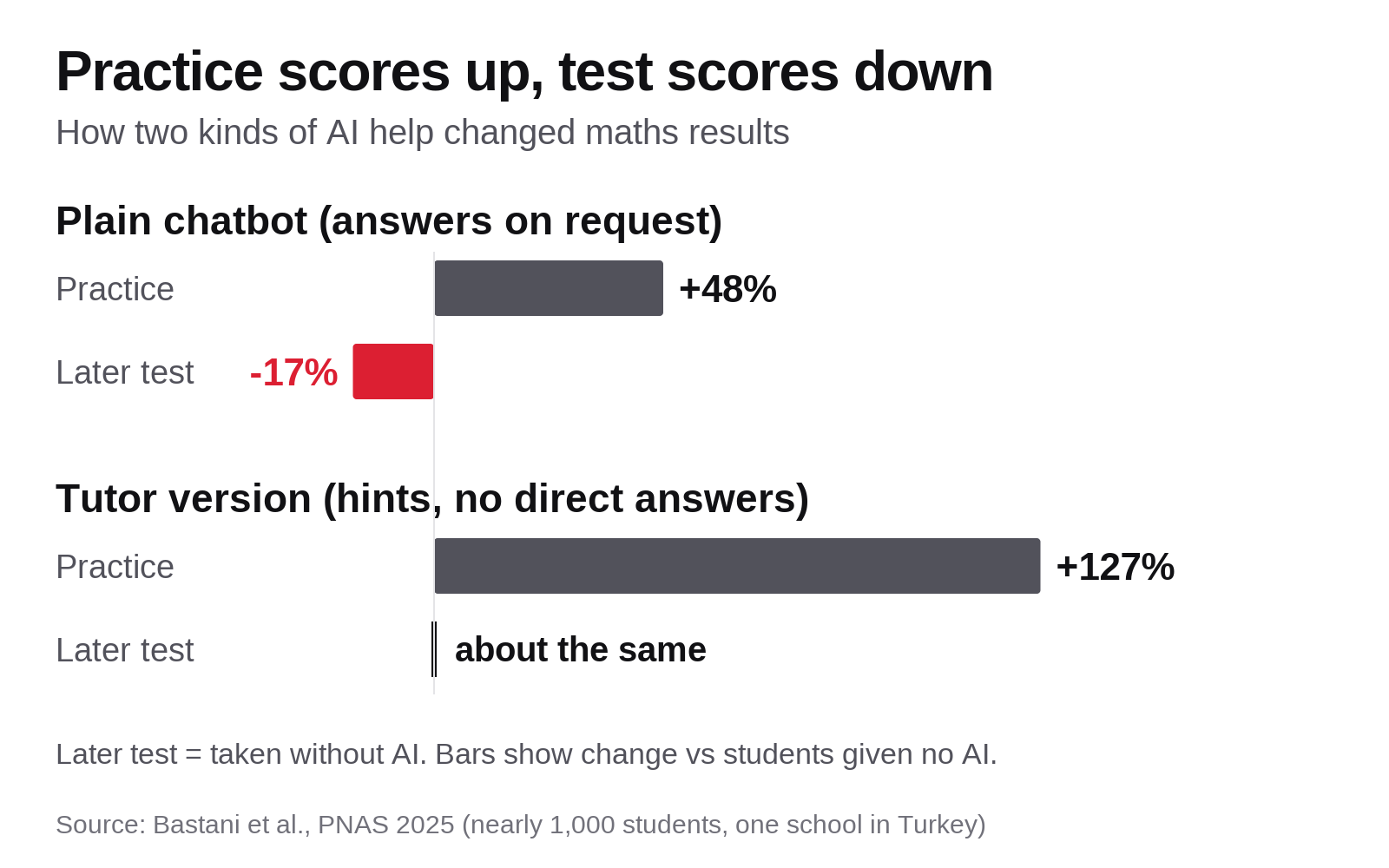
The limits: one school, one country, one subject, and early-days AI. The researchers also found students who used AI were overconfident about how much they had learned.
When AI tutoring helps
Some studies are more positive, but they too are narrow.
- Harvard physics. In a trial with fewer than 200 undergraduates, reported by The Hechinger Report, students learned more than twice as much from a custom AI tutor at home as from a normal in-class session, in less time. The tutor was given the correct solutions and told to go one step at a time. The limits are big: two short lessons, one elite university, and tutoring sessions supervised over Zoom. The study has since been published in the journal Scientific Reports (June 2025), but it had no delayed test, so it can't show whether the gains lasted.
- Nigeria. A World Bank pilot ran a six-week after-school English programme in 2024 in which teachers guided students using AI. The authors report a gain of about 0.3 standard deviations (a standard measure of effect size), which they describe as nearly two years of typical learning. But the post called the results preliminary. Teachers were central, and long-term effects are unknown.
The pattern across both: the AI was structured and a teacher or researcher was in the loop.
Does AI weaken thinking?
You may have seen headlines about ChatGPT and "brain damage". The evidence is thinner than that.
MIT Media Lab's "Your Brain on ChatGPT" had 54 adults write essays with ChatGPT, a search engine or no tool, while their brain activity was recorded with EEG (sensors on the scalp). The ChatGPT group showed the weakest connectivity between brain regions and struggled to quote their own essays. It is a small preprint, not peer-reviewed, and the authors call the conclusions preliminary. It does not show lasting harm.
A Microsoft and Carnegie Mellon survey of 319 knowledge workers found that people who trusted AI more reported using less critical thinking, and people confident in their own skills checked AI output more. That is self-reported, shows association rather than cause, and six of the seven authors work at Microsoft, which sells AI tools.
Both fit the idea of cognitive offloading: handing a mental task to a tool. That is fine for a calculator on a hard sum. It is a problem if the task was the thing you were meant to learn.
Tutor products: what they do
Several AI companies now offer a learning-focused mode. They work in broadly similar ways. We have not seen head-to-head trials comparing them.
- Khanmigo, from the non-profit Khan Academy, guides learners with questions rather than direct answers. It needs a paid subscription for families.
- ChatGPT study mode, announced in July 2025, asks guiding questions and gives quizzes. Students can switch it off.
- Claude's learning mode, introduced in April 2025 as part of Claude for Education, responds with Socratic questions (questions that lead you to the answer).
- Gemini Guided Learning, launched in August 2025, asks open-ended questions and breaks problems into steps.
Whether a student uses these, or just switches back to a normal chat, is the catch.
Academic integrity and assessment
Detectors are not the answer. See Can teachers detect ChatGPT? for why a score is an estimate, not proof.
Some institutions are redesigning assessment instead. The University of Sydney's two-lane approach separates supervised "secured" assessments that check what students can do, such as exams or oral questioning (a viva), from unsupervised ones where AI use is allowed and taught. The idea is that banning AI in an unsupervised task can't be enforced.
Formative assessment, meaning low-stakes work that helps students learn rather than giving a grade, can then use AI openly, while a smaller number of supervised tasks carry the grades.
What do governments say?
- England. The Department for Education's guidance, updated on 12 August 2025, says pupils should use generative AI only with appropriate safeguards. It says there is limited evidence on the impact on learners' development. It points to JCQ guidance on AI misuse in formal assessments.
- UNESCO. Its September 2023 guidance said governments should regulate generative AI in education and consider an age limit of 13 for classroom use.
- Ohio, US. A state budget law (House Bill 96) required every public school district to adopt an AI policy by 1 July 2026, according to a law-firm summary. It sets no content.
What it means for you
Students. Try the task first. Then use AI to explain, quiz you and critique your attempt. If you can't do it without the AI, you haven't learned it yet. Our study guide and prompt examples show how.
Teachers. Include some assessment where students show their thinking without AI, such as talking through their work. Check which AI tools your school has approved.
Parents. Ask your child to explain a piece of work in their own words. Find out your school's AI rules.
The evidence is early, with small studies and fast-changing tools. Expect the picture to change.