
Ask an AI "should I take this job offer?" and you'll usually get a tidy, balanced answer. Some pros, some cons, "ultimately it depends on your priorities". It reads well. It's also easy to ignore.
The trouble is that a chatbot tends to be agreeable. It leans towards the framing you gave it and smooths over the awkward parts. One easy fix is to stop asking for one answer and ask for a trial instead.
The idea: put your question on trial
You set up three roles inside a single chat:
- The prosecutor makes the strongest honest case against your idea or plan.
- The defense answers each charge and makes the strongest case for it.
- The judge weighs both sides, gives a verdict, and says what would change their mind.
Because each role has a job, none of them has to be polite. The prosecutor's whole purpose is to find the holes. The defense can't wave them away, because the judge is watching.
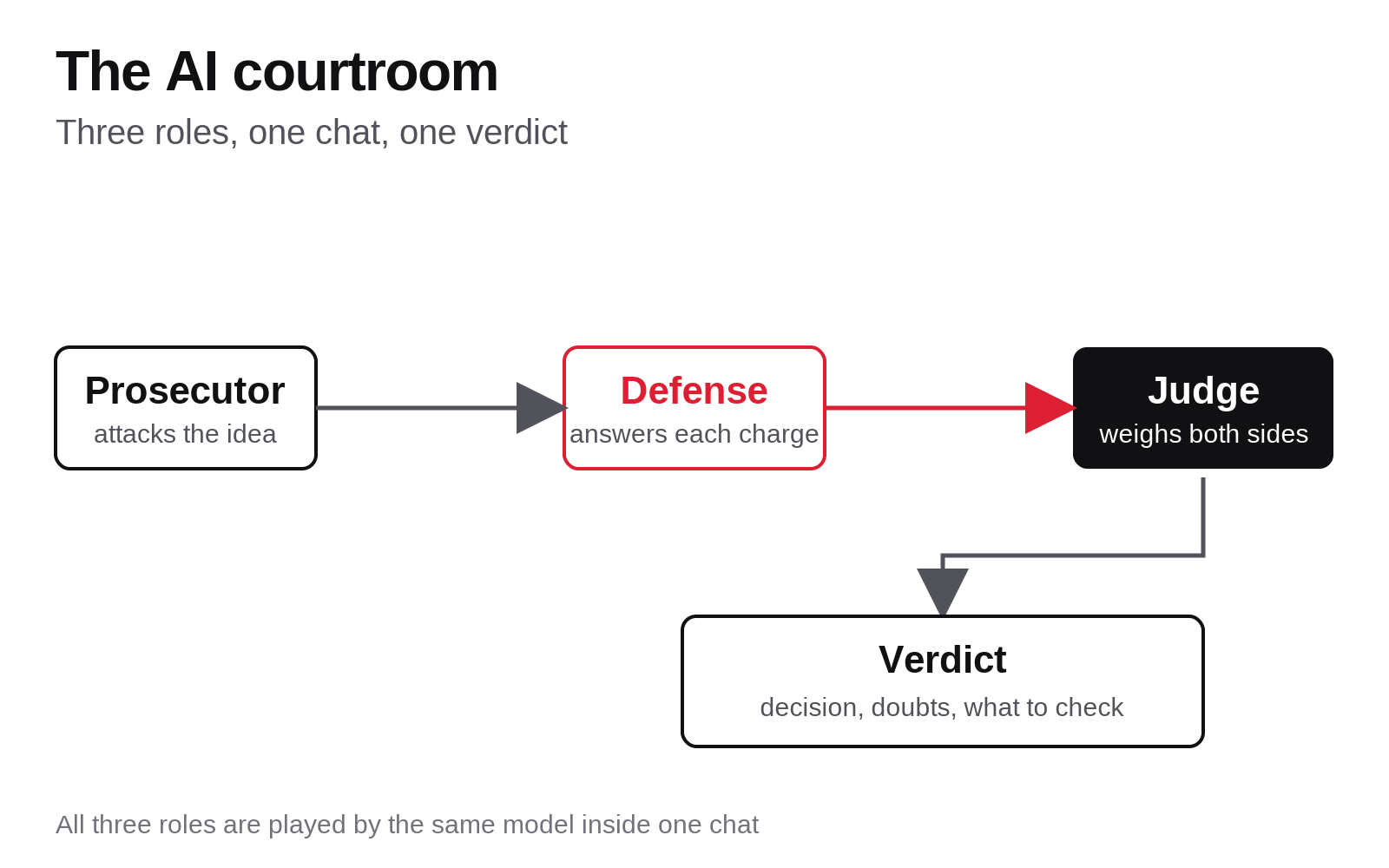
You don't need a special tool or paid plan. It works in ChatGPT (GPT-6.2), Claude (Fable 5.2 or Sonnet 5.5), Gemini 4 Neon, or whichever assistant you already use. It's just a prompt. If you're new to writing prompts, our 10 before-and-after prompt examples cover the basics.
Worked example 1: a job offer
These two examples are illustrations of the kind of difference you can see, not test results. Your own output will vary.
The single prompt: "I've been offered a job paying 15% more at a smaller company. Should I take it?"
A typical reply: a bullet list of higher pay, more responsibility, less job security, a note about company culture, and a closing line that it depends on your goals. Nothing is wrong with it. Nothing in it changes what you do on Monday.
The courtroom version gives the prosecutor a free hand. The charges might look like this:
- You're comparing salaries but haven't compared total pay: bonus, pension match, health cover.
- "Smaller company" is carrying a lot of weight. You haven't asked how long the funding lasts.
- You haven't said why you want to leave, so the raise may be covering for an unsolved problem.
The defense replies that the raise is real, that smaller firms often give faster promotion, and that charge 3 only matters if the problem would follow you. The judge then rules something like: "Not proven either way. The decision turns on two facts you can find out this week: the full compensation package and the company's runway. Ask for both before deciding."
The useful part is the last sentence. The debate didn't decide for you. It turned a vague "it depends" into a short list of specific things to go and check.
Worked example 2: a business plan
The single prompt: "Is my plan to sell handmade candles online a good business idea?"
A typical reply: encouraging, with a list of tips on branding and social media. It answers "is it good?" with "here's how to do it".
The courtroom version: the prosecutor goes straight for the weak spots. Candles are a crowded market. You haven't said what makes yours different. Shipping wax products can be costly or awkward. You haven't priced your time.
The defense concedes the first point and argues that a clear niche (say, one scent family or one local story) is the answer. The judge's verdict might be: "The idea isn't the problem, the missing price and positioning are. Before spending money, work out your cost per candle including your time, and test one small batch with ten real buyers."
Same model, same topic. The second answer is more useful because it was forced to disagree with itself first.
The copy-ready courtroom template
Paste this into a new chat, replace the bracketed parts, and send it.
I want to stress-test a decision using a mock courtroom. You will play three roles in one reply.

THE QUESTION:
[Describe your decision, plan or claim in 3-6 sentences. Include the facts you know and what you're worried about.]

THE ROLES:
1. PROSECUTOR: Make the strongest honest case AGAINST this. List 3-5 specific charges: risks, missing information, weak assumptions. Don't invent facts. If you are unsure of something, say so.
2. DEFENSE: Respond to each charge in turn. Concede the ones that are fair. Then make the strongest honest case FOR it.
3. JUDGE: Weigh both sides. Give a verdict in one of these forms: "go ahead", "go ahead if...", "don't", or "not enough information". Then list:
   - The 2-3 facts the decision really depends on
   - Which of those I should verify myself, and how
   - What would change your verdict

RULES:
- Keep each role under 200 words.
- Don't be polite to the idea. Be fair to the evidence.
- If a claim depends on numbers, dates or laws, flag it as "check this" rather than stating it as fact.
Making it better
- Give it real detail. A debate about "a job offer" is shallow. A debate that includes your savings, your notice period and why you're leaving is useful.
- Run a second round. Reply with "Prosecutor, respond to the defense. Then the judge updates the verdict." Often the most interesting point turns up in round two.
- Swap the models. Run the prosecutor in one assistant and paste the charges into another for the defense. Two different models are less likely to share the same blind spot. Our guide to picking the right AI model can help you choose.
- Ask for the other side. Once you have a verdict, ask: "Now argue the opposite verdict as convincingly as you can."
Where it goes wrong
A courtroom feels rigorous. That is exactly why you should be careful with it.
- It's one mind, not three. The prosecutor, the defense and the judge all come from the same model. If it holds a mistaken assumption, all three are likely to hold it. A debate can look balanced while every side is working from the same wrong premise.
- It can be confidently wrong on facts. A prosecutor will happily "cite" a market figure, a law or a company detail that sounds right and isn't. Debates don't fix this. They can make a made-up fact sound more convincing because someone argued it well.
- It knows only what you told it. The judge can't see your finances, your boss or your gut feeling. If you leave out the thing that matters, the trial won't find it.
- The judge can be swayed by style. Whichever side writes more persuasively may win, even if the other side had the better point. Read the arguments, not just the verdict.
- It isn't advice. For anything about health, money, law or safety, use it to prepare better questions for a professional, not to replace one.
The fix is the same each time. Treat the verdict as a list of things to check, not an answer to trust. The template above asks the judge to name the facts that matter so you know where to look. For more on why chatbots can sound sure and still be wrong, see our piece on AI agents versus chatbots.
When to use it, and when to skip it
It earns its place on decisions where you might be fooling yourself: a job change, a purchase, a plan you're excited about, an argument you're about to make. It's less useful for simple lookups, where a debate just adds noise, and for questions with a checkable answer, where you should check it.
A good habit is to ask for the courtroom only when you notice you want a particular answer. That's when a single prompt is most likely to simply agree with you.


