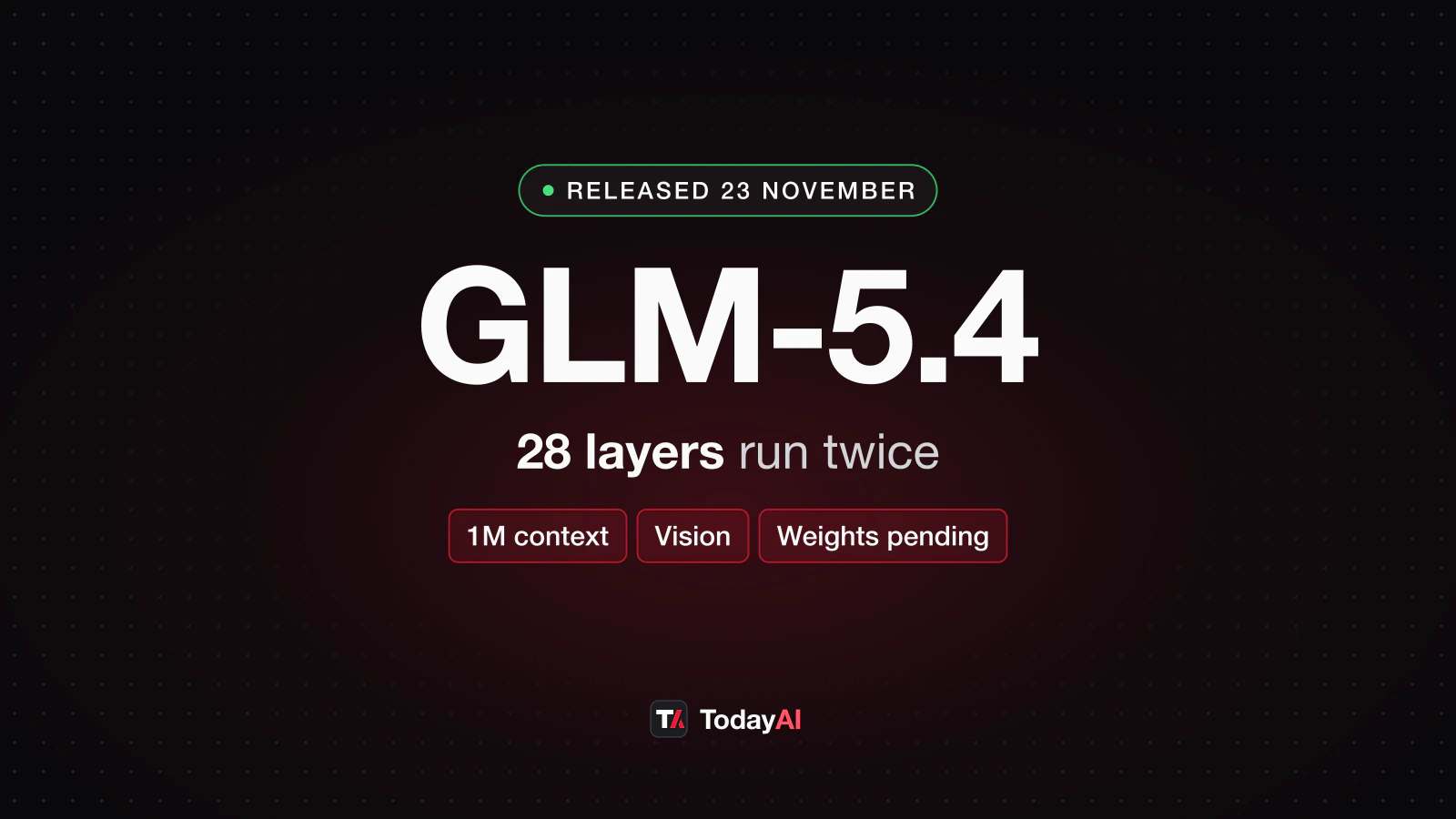
GLM-5.4 is Z.ai's new flagship coding model, released on 23 November. It can read screenshots and video alongside code, holds up to a million tokens of context, and makes two passes through part of its network instead of one.
As of 25 November you can only use it through Z.ai's GLM Coding Plan and its own apps. There's no GLM-5.4 download on Hugging Face, no pay-as-you-go API price and no OpenRouter listing yet. Z.ai launch announcement · GLM-5.4 docs
GLM-5.4 specs at a glance
| Spec | GLM-5.4, as of 25 November |
|---|---|
| Released | 23 November 2026 |
| Made by | Z.ai (Zhipu AI) |
| Input | Text, images, video and files |
| Output | Text |
| Context window | 1 million tokens |
| Maximum output | 128K tokens |
| Architecture | GLM-5 base at roughly 750 billion parameters, with 28 layers run twice |
| Thinking mode, tool calling, structured output | Yes |
| Speed, per Z.ai | Up to 200 tokens a second off-peak, 70 to 80 at peak |
| Where to use it | GLM Coding Plan, ZCode, Z.ai Chat |
| API price | Not published |
| Open weights | Not yet. Z.ai says after safety work, no date |
Sources: Z.ai's GLM-5.4 docs and launch post. Tokens are the chunks of text AI works in, roughly three-quarters of a word each.
Is GLM-5.4 on Hugging Face?
No. As of 25 November there's no official GLM-5.4 repository. The address where it would live, huggingface.co/zai-org/GLM-5.4, isn't public, and the newest models on Z.ai's Hugging Face page are the GLM-5.3 family, uploaded on 25 August.
Z.ai says it plans to release GLM-5.4's weights "after completing necessary safety hardening", as VentureBeat reported. It gave no date or licence. Any "GLM-5.4" files you find from other uploaders aren't from Z.ai.
If you need open weights today, GLM-5.3 is the newest Z.ai flagship you can download.
GLM-5.4 benchmarks so far
There are no independent scores for the full model yet. Here's what exists, and who measured it.
Z.ai's own research test. Z.ai's controlled comparison used a 30-billion-parameter research model, not GLM-5.4 itself. The looped version used about 10% more training compute at the same parameter count, with the biggest gains on maths, scientific reasoning and long-context tasks. On GPQA-Diamond and MMLU-Pro, two hard question sets, its answers were 10 to 14% shorter on average, according to Z.ai's docs. Z.ai research results
Z.ai's size claim. Z.ai says GLM-5.4 reaches intelligence "comparable to 2T-3T parameter models", two to three trillion parameters. It has published a win-rate chart against three other models, but VentureBeat notes it doesn't explain how the chart was made.
One reviewer's coding test. The reviewer AICodeKing ran GLM-5.4 at maximum reasoning effort through his KingBench 4 coding test, as reported by VentureBeat and DataCamp:
| KingBench 4 | GLM-5.4 | Gemini 4 Neon |
|---|---|---|
| Time to finish | 431 minutes | 109 minutes |
| Steps taken | 1,128 | 244 |
GLM-5.4 placed 7th overall and, according to DataCamp, first among open models. That's a strong placing for a model Z.ai plans to open up, but it took about four times as long as Neon. Testers like its bug-finding and call it slow.
Leaderboards. As of 23 November, we found no GLM-5.4 result on Artificial Analysis's leaderboard or Vals AI's Terminal-Bench 4.0 board. It also isn't on Contra's design benchmark, where the stealth model Gestalt sits on top.
For real coding work, measure elapsed time to a patch that passes your tests. Generation speed captures only part of that wait.
GLM-5.4 vs GLM-5.3
| GLM-5.4 | GLM-5.3 | |
|---|---|---|
| Released | 23 November | 14 August |
| Image and video input | Yes | No (text only; GLM-5.3-Flash takes images) |
| Coding Plan credit multiplier, input / cached / output | 4.6 / 1.1 / 16 | 6.9 / 1.7 / 24 |
| Pay-as-you-go API, per million tokens | Not published | $1.40 in, $0.26 cached, $4.40 out |
| On OpenRouter | No | Yes |
| Open weights on Hugging Face | Not yet | Yes |
Sources: Coding Plan credit rates, Z.ai API pricing, GLM-5.3 model card and GLM-5.3-Flash introduction, all checked 25 November.
Why credits go further. Z.ai cut the input credit multiplier from 6.9 to 4.6 and the output multiplier from 24 to 16. At those rates, a fixed credit balance buys 1.5 times as many uncached input or output tokens. Cached input drops from 1.7 to 1.1. On weekly quota plans, Z.ai says GLM-5.4's quota is 1.5 times GLM-5.3's. The plan still applies both five-hour and weekly limits, and actual usage depends on your cache hit rate and how much the model writes.
How to use GLM-5.4
Coding Plan. All tiers support GLM-5.4. Z.ai lists plans starting at $18 per month. In tools that let you enter the model ID, use glm-5.4. Z.ai's Claude Code setup uses glm-5.4[1m] for the million-token configuration. Z.ai's Coding Plan docs also cover Codex, OpenCode, Cline and its own ZCode. Coding Plan · Claude Code setup
Z.ai's own apps. The launch announcement also lists ZCode and Z.ai Chat. ZCode · Z.ai Chat
What vision adds for coding. The GLM-5.3 flagship was text-only. A practical use case for GLM-5.4 is a mobile layout bug. Send a screenshot with the affected route and viewport width, then ask the assistant to find the component behind the layout and verify the fix at that width. The screenshot supplies the visual symptom, while the code and browser checks establish what caused it.
Z.ai calls its broader idea generalized coding: code that produces things outside a typical software project. Its launch demos include a six-axis robot arm modelled in FreeCAD and an interactive 3D birdwatching scene rendered with custom shaders. Z.ai demos
GLM-5.4 API price: when?
Not yet. As of 25 November, Z.ai's pay-as-you-go price list stops at the GLM-5.3 family, and GLM-5.4 isn't in OpenRouter's model list. Z.ai's docs say the API "will be made available upon completion of the security assessment". It hasn't given a date.
For a rough guide, GLM-5.3 costs $1.40 per million input tokens and $4.40 per million output. GLM-5.4's price may differ. We'll add it here when Z.ai publishes it.
How the Loop Transformer works
In an ordinary Transformer, each layer processes a token once per forward pass. GLM-5.4 sends the model's internal representation through the same 28 layers twice, reusing their weights. Z.ai adapted a pretrained GLM-5 base at roughly the 750-billion-parameter scale. A second pass adds computation without needing a second copy of those weights. Per-token gates control how much each pass changes the result. Z.ai architecture notes
Repeating layers also creates a memory problem. The second pass reuses selected entries from the first pass's attention cache and keeps its own updates within a sliding window. That matters when the session holds a long history of code, test output and tool calls. Z.ai documents a 1-million-token configuration for Claude Code. Architecture notes · Claude Code setup
The trade-off is time. Two passes mean more computation per token, which fits testers' reports that GLM-5.4 is thorough but slow.
What's next: GLM-5.5
Z.ai hasn't announced GLM-5.5. Tech in Asia has reported that Zhipu's management expects to launch it in December, with about 3 trillion parameters. Treat that as a report, not a release date: there's no model card, API listing or weights yet.
GLM 5.5 was also the popular guess for Gestalt, the stealth model topping Contra's design benchmark, though Contra now says that model is American. Here's what we know about Gestalt and GLM 5.5.