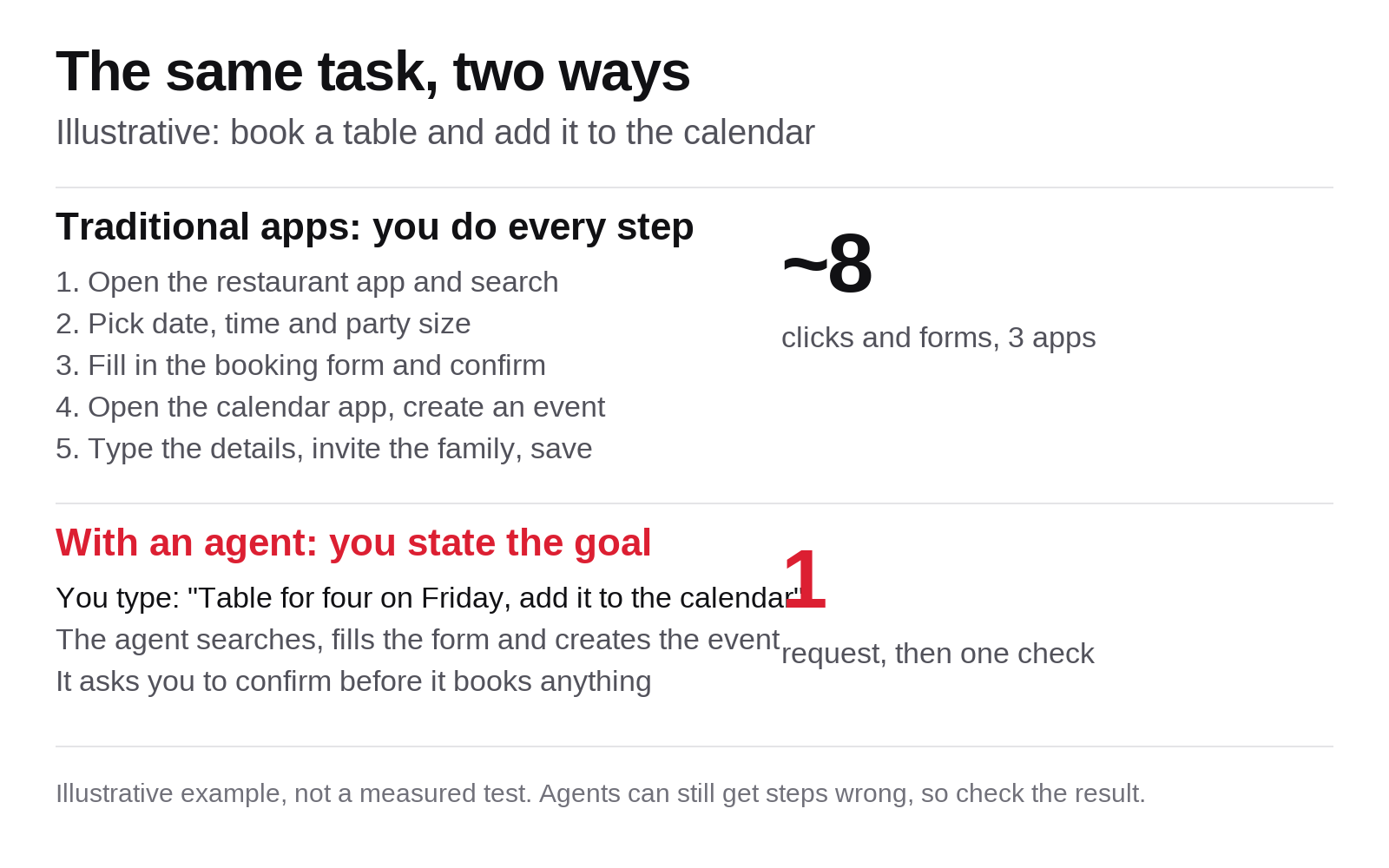
Most software works the same way it did twenty years ago. You open an app, find the right menu, fill in a form, click save, then open a different app and do it again.
AI agents aim to skip that. You say what you want, and the software does the clicking. Is that the end of the app as we know it? Not quite, but something real is shifting.
The old way and the new way
In a traditional app, the interface (the screens, buttons and menus you see) is how you tell the software what to do. You carry out every step of a workflow (a series of steps that makes up a job), and you're the one who knows how the pieces fit together.
With an agent, you describe the goal instead: "Find me a table for four on Friday and add it to the family calendar." The agent breaks that into steps and tries them. If you're new to the idea, our guide to what makes agents different from chatbots covers the basics.
How can an agent use an app?
There are three main routes.
1. Through an API. An API is a doorway built for other software rather than for people. It's the quickest, most reliable route, but only if the app offers one.
2. Through a browser. The agent opens websites and fills in forms much as you would. OpenAI's ChatGPT agent, announced in July 2025, uses a visual browser, a text browser, a terminal and direct API access, and picks between them. OpenAI says it asks permission before actions with consequences and that you can take over at any time.
3. By looking at the screen. This is computer use: the AI reads screenshots, moves a cursor, clicks and types. Anthropic introduced it in October 2024 and was candid that it was "still experimental—at times cumbersome and error-prone". On OSWorld, a test of computer tasks, its model scored 14.9% with screenshots alone, or 22.0% given more steps. Anthropic said the next-best AI system scored 7.8%, so it was a lead, but still a long way from reliable.
MCP: a plug socket for agents
Connecting an agent to every app individually would be a mess. The Model Context Protocol (MCP) is an open standard that gives AI tools one common way to connect to apps and data, a bit like a universal plug.
It began at Anthropic. On 9 December 2025 the Linux Foundation, a non-profit that hosts open-source projects, announced a new Agentic AI Foundation to look after it. Platinum members include Amazon Web Services, Anthropic, Google, Microsoft and OpenAI, and the foundation said there were more than 10,000 published MCP servers (connectors to individual tools) at launch. That is a fair sign MCP is becoming the common standard. We couldn't find a verified current server count, so treat 10,000 as a late-2025 figure.
Where it's already happening
- Coding. Anthropic describes Claude Code as a tool that reads your codebase, edits files, runs commands and can open pull requests (proposed code changes). It can also use MCP to update tickets in tools like Jira.
- Customer support. Intercom's Fin agent answers customers' questions. Intercom lists a resolution at $0.99, and says it bills at most one outcome per conversation.
- Sales and CRM. Salesforce sells Agentforce agents for its customer-records software, priced per action (more on that below).
- Everyday web jobs. OpenAI lists research, shopping, meal planning and calendar entries among ChatGPT agent's uses. OpenAI also says humans still do better on spreadsheet-type tasks.
All of these are company claims about their own products. Results will vary with the job.
What could change
Fewer screens for routine work. If an agent does the clicking, a human no longer needs a polished form for every step. Software could be built more as a back end that agents call, sometimes called "headless". That's a prediction, not a done deal.
Pricing by result, not by seat. Most business software is charged per seat: a monthly fee for each person with a login. That makes less sense if an agent does the work. Intercom's per-resolution price is one example. Salesforce's launch of per-action pricing in May 2025 is another: $0.10 per action, with its own example of 3 to 6 actions ($0.30 to $0.60) against $2 under its older per-conversation pricing. Salesforce also offered a flat per-user licence with unlimited agent use, so even here the shift is a mix, not a clean break. Prices have likely moved since, so check the live pages.
Pressure on software firms. SaaS (software rented by subscription) earns much of its money from seats and from people spending hours inside its screens. If agents do that work, those firms may need new ways to charge, and some smaller tools could be bypassed. That's our analysis rather than a reported outcome, and we haven't found verified figures showing revenue falling because of agents.
What probably won't change soon
Reliability on long tasks. The research group METR measures the length of tasks, in human working time, that an AI agent finishes with 50% success. It found that figure doubling about every seven months, with Claude 3.7 Sonnet managing tasks of roughly an hour in its March 2025 study. Models have moved on since. That's fast progress, and METR's own page warns parts of the analysis are out of date. But "50% success" still means failing half the time, and each extra step adds a chance of error.
Real-world payoff. In a METR trial, 16 experienced open-source developers did 246 tasks, half with AI tools allowed. They took 19% longer with AI, despite expecting a 24% speed-up. The authors say it may apply only to that setting, and tools have improved since.
Cost and hype. Gartner predicts that over 40% of agentic AI projects will be cancelled by the end of 2027, citing rising costs and unclear value. It also warns of "agent washing", where old chatbots are relabelled as agents.
Security and accountability. An agent with access can also be tricked or can overreach. We cover that in can AI agents get into systems they shouldn't, and the question of blame in who is responsible when an agent causes damage.
People like control. Seeing what's happening, and pressing the button yourself, matters most when money, health or jobs are involved. Even the agents above are built to ask first.
What it means for you
- Office workers: expect agents to handle repetitive jobs like drafting, sorting and data entry. Always check the output before it goes to a client.
- Students: you'll still need to know what the apps do. An agent is hard to supervise if you can't tell a good result from a bad one.
- Developers: coding agents are the most mature case, but the METR trial suggests measuring your own results. To see how the pieces fit, try building a small agent in Python.
- Small businesses: support and booking are the natural starting points. Check whether pricing is per seat, per action or per result, and what happens when the agent gets it wrong.
Apps aren't disappearing. But more of the clicking may be done by something else, and the screen you open may become the place where you check the work rather than do it.