Every few weeks a new model name starts trending, and for a day or two it sounds like a done deal. This week's is Krypton.
It isn't one. Here's what's actually known, and it's not much.
Where the name came from
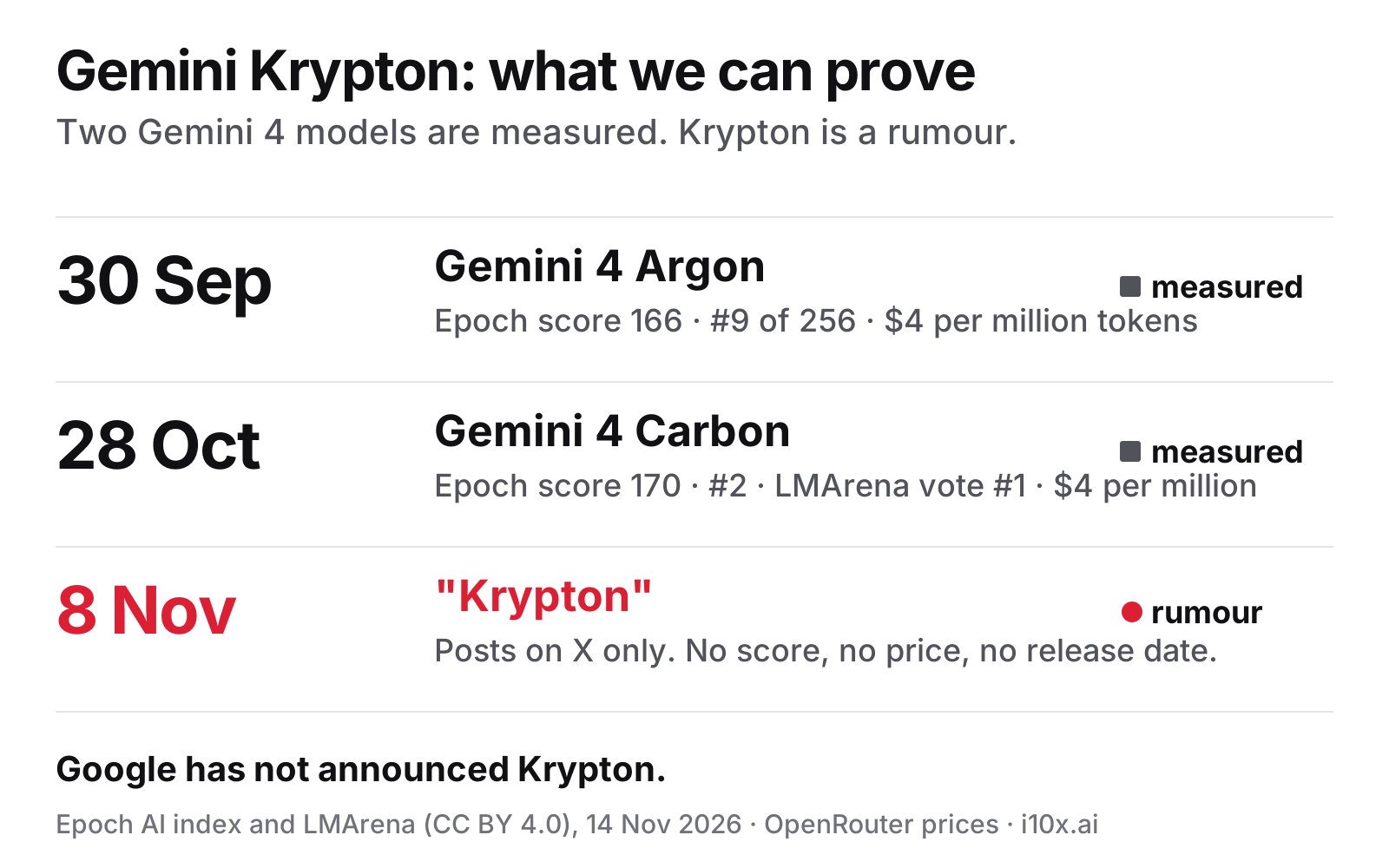
On 8 November, a user on X called @lyraxana posted that Google had released "an internal checkpoint called Krypton". A checkpoint is a saved snapshot of a model partway through development. The post had no charts or numbers.
Benchmark accounts amplified it. A tester shared side-by-side clips of a version labelled "krypton-a" against Gemini 4 Carbon and Argon, without saying how they got access. A second write-up lists more posts from 9 November, including a clip of an animation Krypton supposedly made from a single prompt, and a comparison with Claude Opus 5.5.
That is the whole evidence base.
What isn't known
Almost everything. Both write-ups say Google hasn't announced or confirmed Krypton. There is no model card (the plain-English fact sheet a lab publishes with a model), no benchmark results, no price and no release date.
We can't even say what the name means. It might be a shipping product, a nickname used in testing, or something else. The name fits the pattern of Gemini 4 Argon and Carbon, which are both chemical elements, so "it's the next Gemini" is a reasonable guess. It is only a guess.
Sites selling API access already have "Gemini 4 Krypton" pages. Those are marketplace listings, not Google products, and I couldn't find anything on Google's own channels. Don't pay for one.
The bar Krypton would have to clear
This is the useful part. The claim is that Krypton beats Carbon, so look at Carbon.
Google made Carbon generally available on 10 November through Google AI Studio and Gemini for business, with Google AI Ultra subscribers getting it in the Gemini app. In the data we pulled on 14 November, it scores 170 on Epoch AI's capability index (a single score built from many hard tests), second of 256 models. It tops LMArena, where people vote on answers. We covered that split here.
Its price is $2 per million tokens in and $10 out, a blended $4. Tokens are the chunks of text AI is billed in, roughly three-quarters of a word each. Google says that introductory price ends on 30 November and then doubles.
So Carbon is already near the top, and only Claude Fable 5.2 scores higher. Beating it means a small gain over a very good model. Remember too that the top of the table is a photo finish, with margins of error that overlap.
How to read demo clips
A clip shows one try at one prompt. People post the best of several. "Looks better" in a video says little about whether a model solves problems more reliably, which is what the tests measure.
The posters' own details are mixed. One says Krypton took twice as long and wrote twice as much code as its siblings. That's slower, and probably pricier if billed by the token. Another says Claude Opus 5.5 finished faster but Krypton's visuals were better. The "recursive self-improvement" talk comes from posters, not from Google.
None of this is nothing. It's also not a result.
So what should you do?
If you build with AI, use what has a price and a model card. Carbon is the top Gemini today. Argon scores 166, ranks ninth, and is priced the same for now. Compare them, and everything else, on our /compare page.
If you're just curious, enjoy the leak, then wait. I'll be glad to be proven wrong, but a model with no scores and no price isn't yet a model you can choose.
When Google publishes a model card with test results and a price, that's when Krypton counts. Until then it's a name.